RUA / Awesome Robot Use Agent

Awesome Robot Use Agent

Research blogs, papers, benchmarks, open-source tools, and social demos for robot-use agents.

322 curated entries / Maintained by @KairunWen / Open to contributions

322 entries · all categories

Getting started Read, build, watch, evaluate

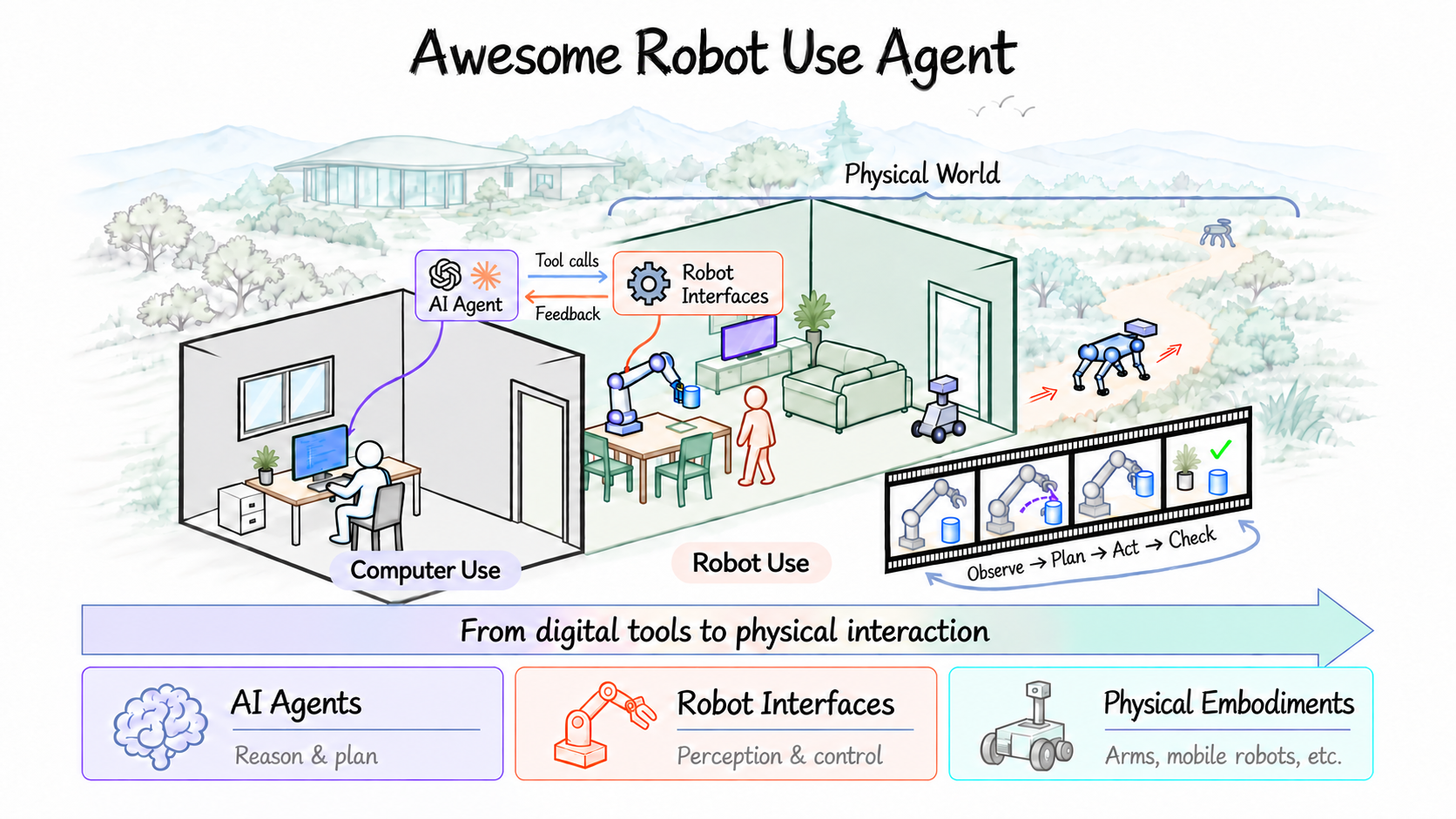
Robot-use agent overview: AI agents reason and plan, call robot interfaces, and use feedback to observe, act, and check outcomes in the physical world.

Articles

08

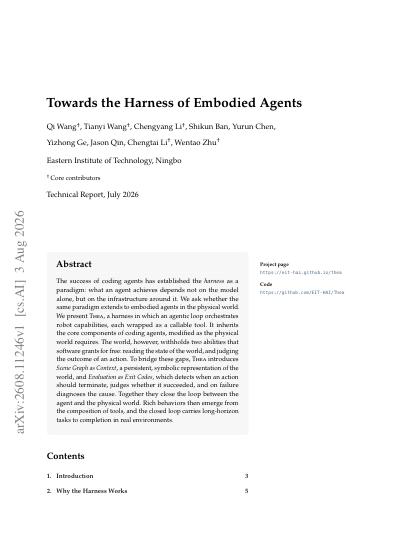
Claude plays robotics

· Shmuel Berman, Michael Ilie, Jia Deng, +1 author · Anthropic · Research article

Compares direct motor commands, generated controllers, pretrained-policy supervision, and RL training across control, locomotion, and manipulation tasks. Author-reported results show that robot embodiment and control interface strongly affect performance. Direct-control simulations pause between model calls; physical Go2 explorations should be distinguished from simulated benchmark results.

Details & sources
Institutions
Anthropic
Authors
Shmuel Berman, Michael Ilie, Jia Deng, Daniel Freeman

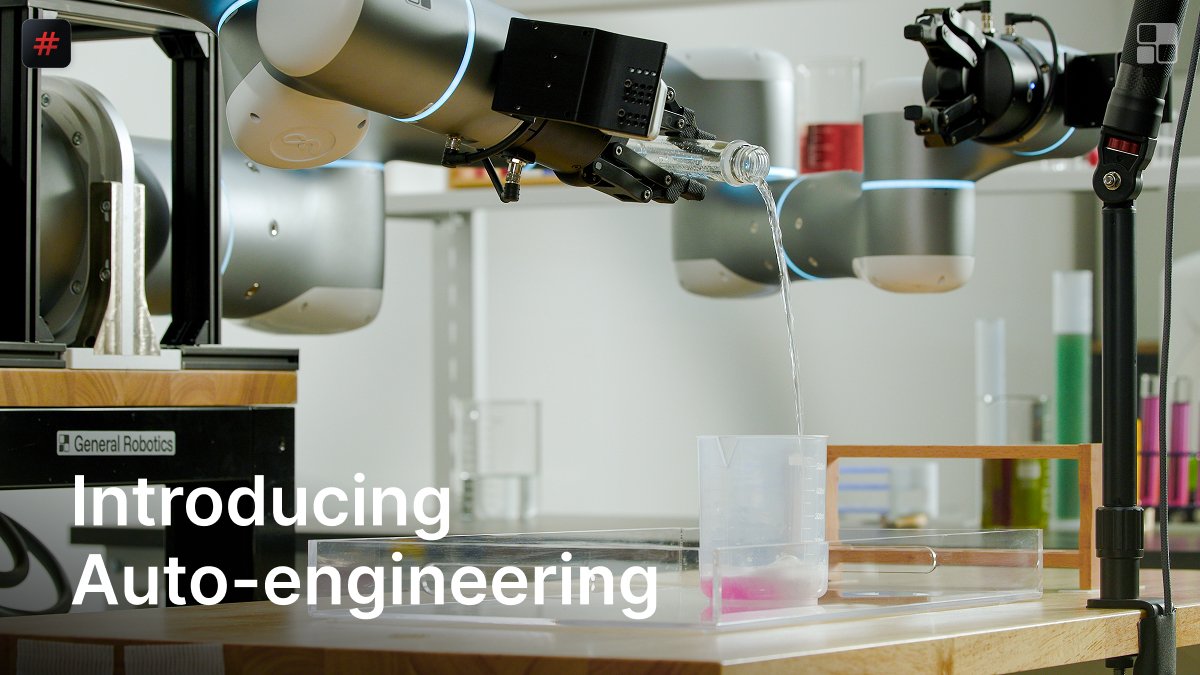
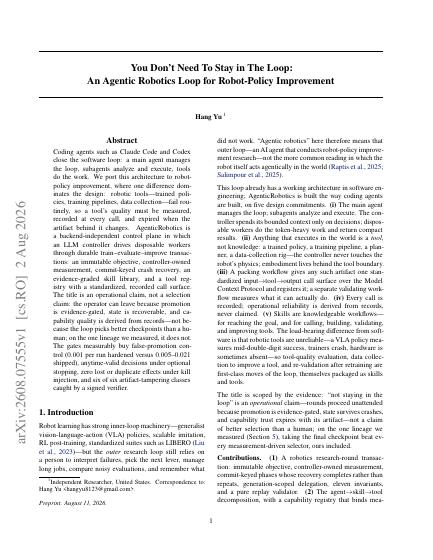
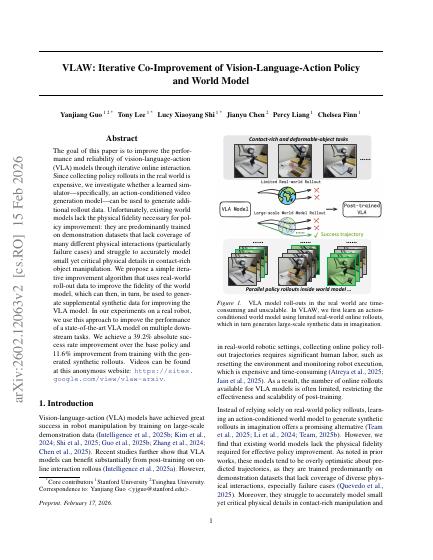
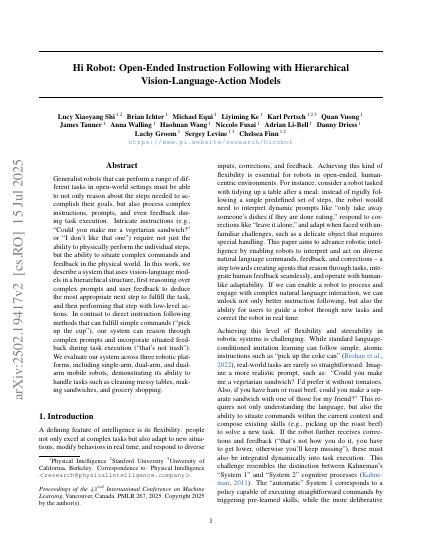
Introducing Auto Engineering for Robotics

· General Robotics · Research Blog

Introduces GRID’s agent-driven workflow for robot integration, simulation, skill creation, and deployment evaluation. Demonstrates laboratory manipulation tasks and describes how execution feedback helps agents diagnose failures, repair components, and retain reusable skills and engineering knowledge.

Details & sources
Institutions
General Robotics

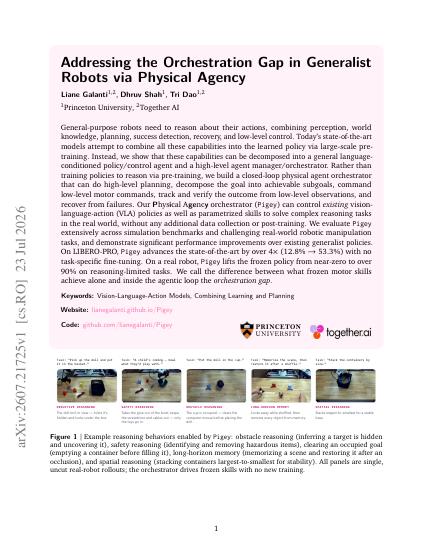
Introducing Waddle: agents that control robots

· Waddle Team · Waddle Labs · Research Blog

Describes agents that observe camera feeds, generate robot-control programs, and call action models as tools. Presents real-robot demonstrations of task decomposition, outcome verification, replanning, and multi-agent coordination, with reusable skills shared across agents.

Details & sources
Institutions
Waddle Labs
Authors
Waddle Team

NVIDIA brings agents to life with DGX Spark and Reachy Mini

· Jeff Boudier, Nader Khalil, Alec Fong · Hugging Face, NVIDIA · Technical tutorial

Connects Nemotron reasoning and vision models, NeMo Agent Toolkit, and Pipecat to Reachy Mini for voice, camera input, and robot behaviors. Describes ReAct tool calling and Python interfaces for hardware or simulation; focuses on a desktop interactive robot rather than general manipulation.

Details & sources
Institutions
Hugging Face, NVIDIA
Authors
Jeff Boudier, Nader Khalil, Alec Fong

Gemini Robotics ER 2

Google DeepMind · Model overview

Describes embodied reasoning for multi-step planning, tool use, success tracking, and multi-robot coordination. ER 2 provides high-level decisions while a connected VLA handles motor execution; the page presents developer-reported capabilities and evaluations.

Details & sources
Institutions
Google DeepMind

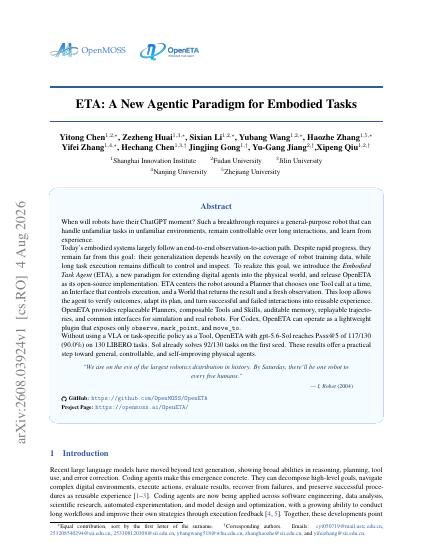
Goosebumps: a Paradigm Shift is Occurring in Robotics

· Ken Goldberg · UC Berkeley · Perspective

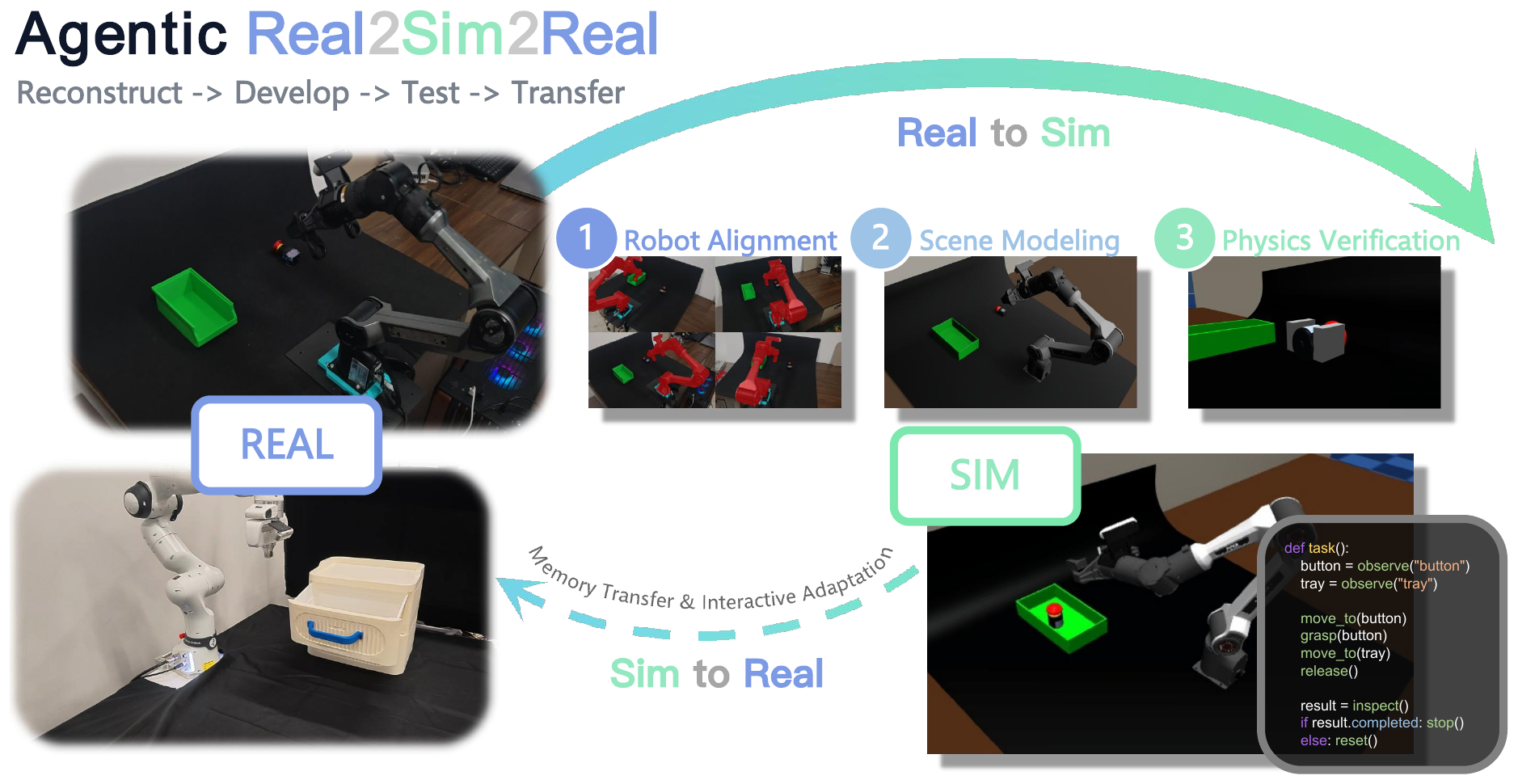
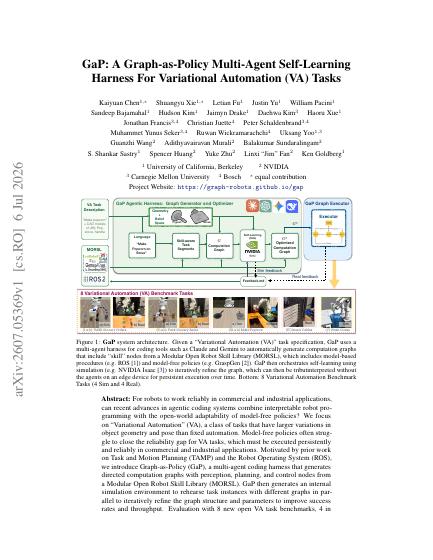
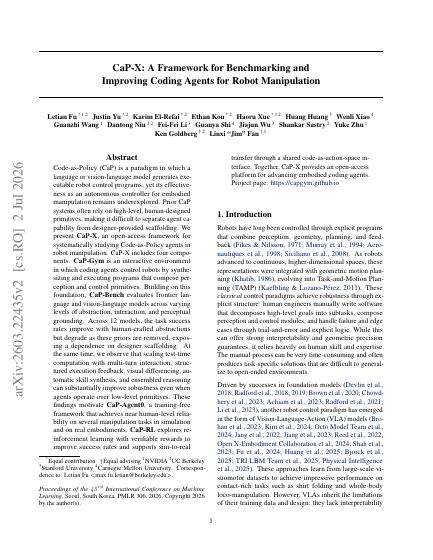
Argues that coding agents can bridge model-based engineering and robot learning by writing, testing, and refining modular robot programs offline. Discusses GaP, inverse physics, and real-to-simulation-to-real development, alongside remaining challenges in simulation accuracy, verification, and generalization.

Details & sources
Institutions
UC Berkeley
Authors
Ken Goldberg

Papers

144

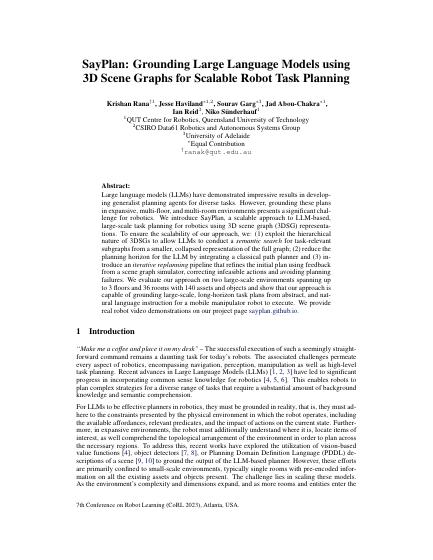
WorldMirror: Agentic Real-to-Sim Generation of Interactive Worlds from In-the-Wild Robot Demonstrations

· Tianling Xu, Weijie Wan, Honghao Su, +9 authors · Xspark AI, Tsinghua University +3

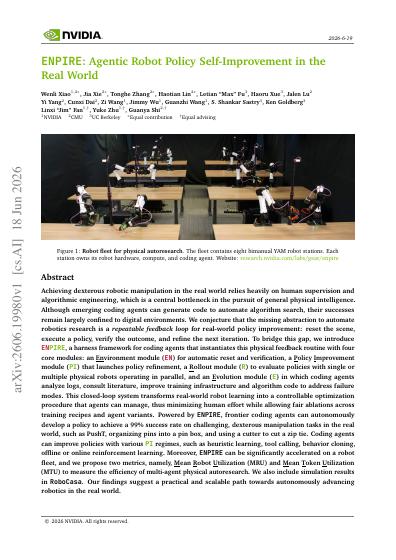
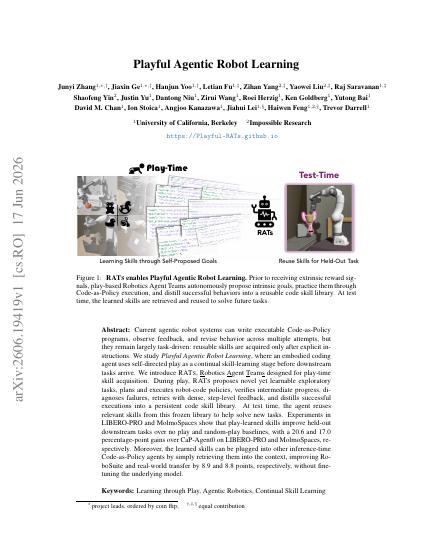
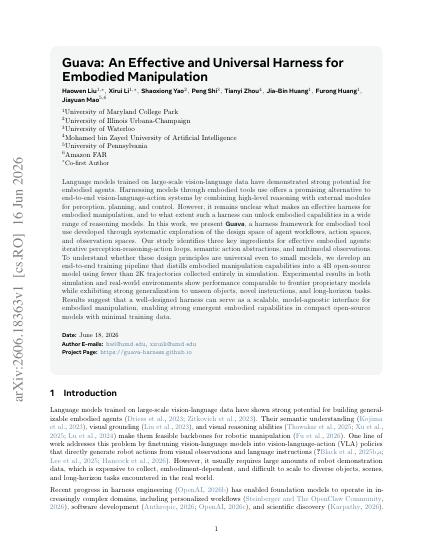
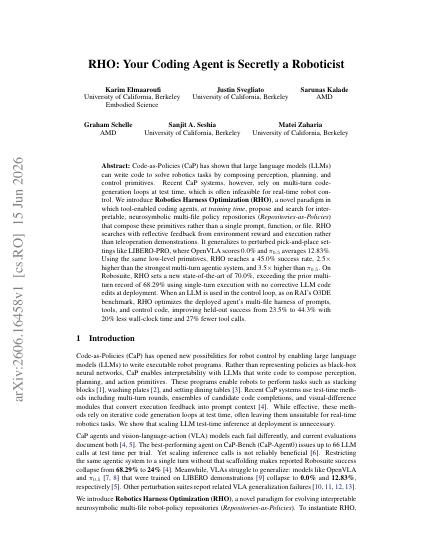
Reconstructs interactive digital twins from robot videos and recorded trajectories by refining executable world programs with tool orchestration and verification feedback.

Details & sources
Publication
ArXiv 2026
Institutions
Xspark AI, Tsinghua University, The University of Hong Kong, University College London, Peking University
Authors
Tianling Xu, Weijie Wan, Honghao Su, Kailun Su, Junyuan Tang, Huichi Zhou, Haozheng Zhang, Qi Xiong, Ping Luo, Wenbo Ding, Tianxing Chen, Yue Chen
Mechanism / release notes
A router delegates reconstruction, calibration, layout, and replay while maintaining shared world state and a camera-anchored coordinate system. Verification selects legal revisions within a fixed construction graph. Evaluated on DROID demonstrations through visual, spatial, and recorded-trajectory replay fidelity in Isaac Sim, without motion replanning or retargeting. The official page provides paper and demo results; no implementation repository is linked.

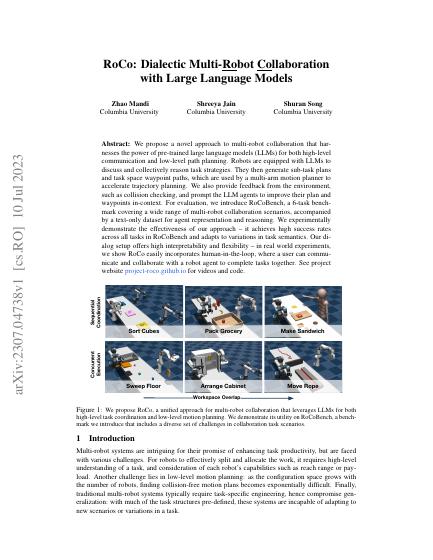
BrickWright: Agentic Creation of Physically Feasible Brick Builds

· Ava Pun, Kevin Dai, Sally Chen, +7 authors · Carnegie Mellon University, Stanford University

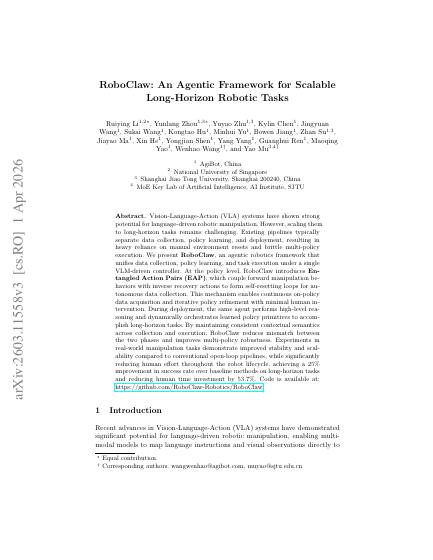
Equips coding agents with a brick-assembly API and validation feedback to generate physically feasible LEGO builds from text or image prompts.

Details & sources
Publication
ArXiv 2026
Institutions
Carnegie Mellon University, Stanford University
Authors
Ava Pun, Kevin Dai, Sally Chen, Maxwell Jones, Ruixuan Liu, Kangle Deng, Changliu Liu, Maneesh Agrawala, Deva Ramanan, Jun-Yan Zhu
Mechanism / release notes
Uses BrickLayer for catalog-part discovery, connector-based assembly, and validation in a plan-execute-validate loop with rendered feedback. Evaluated on generated LEGO models from 512 text prompts; feasibility checks cover collisions, floating parts, and connectivity, while stability and executable assembly sequences remain future work. The public repository contains the BrickLayer SDK and BrickWright agent framework.

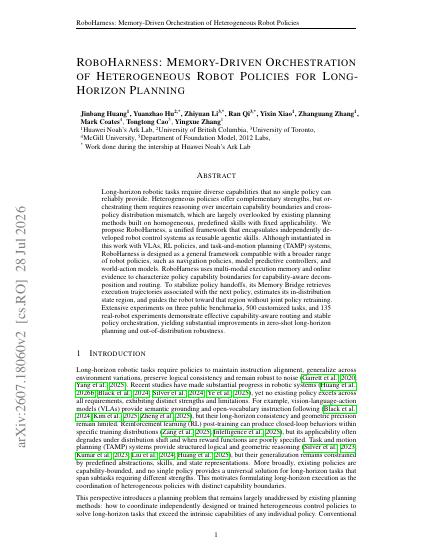
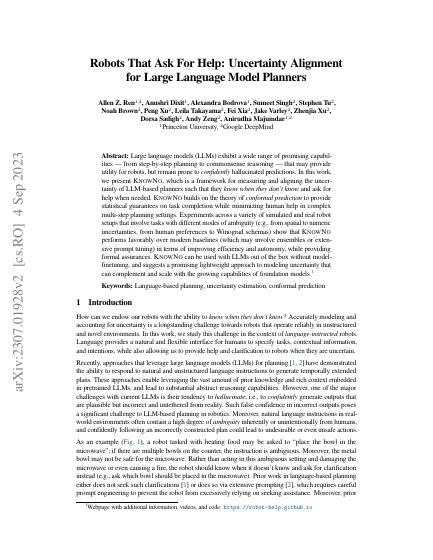
FastHarness: Experience-Driven Review Scheduling for Vision-Language-Action Policies

· Tao Lin, Yuxin Du, Haoxiao Wang, +2 authors · Shanghai Jiao Tong University, Zhejiang University

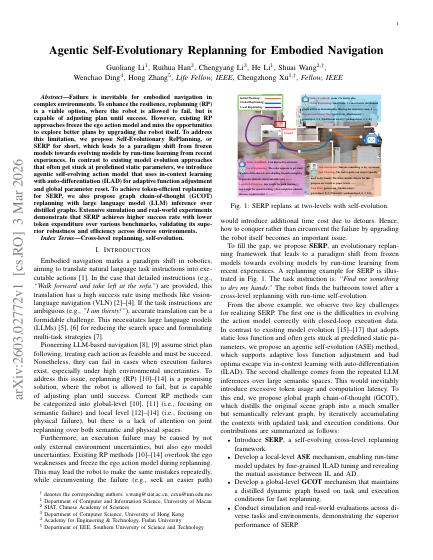
Schedules language-model reviews of a frozen VLA policy using accumulated execution experience, retaining a recovery path for unfamiliar or failed actions.

Details & sources
Publication
ArXiv 2026
Institutions
Shanghai Jiao Tong University, Zhejiang University
Authors
Tao Lin, Yuxin Du, Haoxiao Wang, Zile Zhong, Bo Zhao
Mechanism / release notes
Evaluated on four simulated manipulation tasks. The paper reports 57.2% fewer reviewer tokens from the first episode to the mean of the final five episodes. The MIT release provides the scheduler, experience store, and recovery logic; a VLA policy server, simulator, and runtime adapter must be supplied separately. No model training is required.

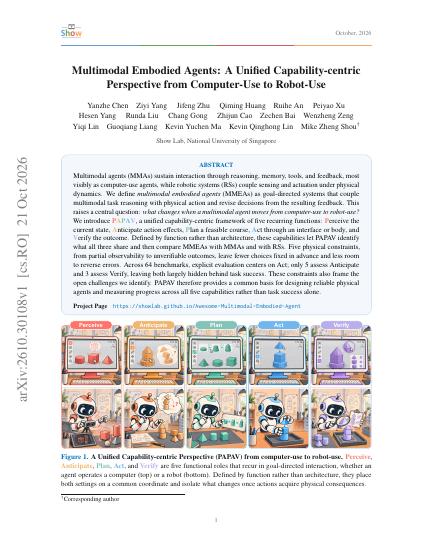
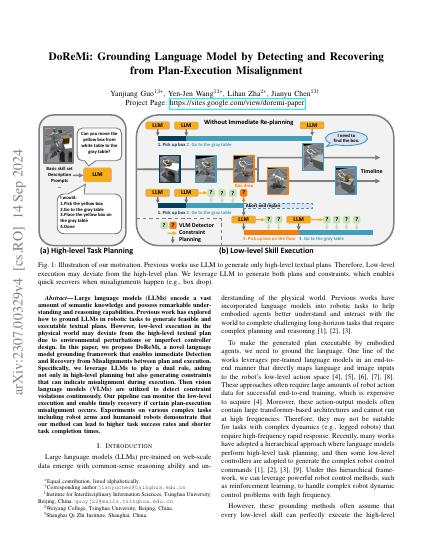
Multimodal Embodied Agents: A Unified Capability-centric Perspective from Computer-Use to Robot-Use

· Yanzhe Chen, Ziyi Yang, Jifeng Zhu, +14 authors · National University of Singapore

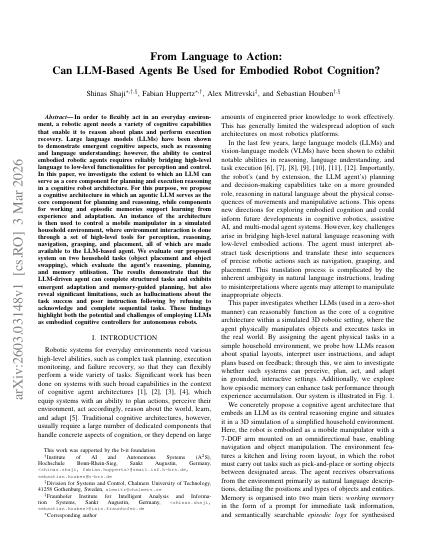
Unifies computer-use and robot-use through PAPAV: Perceive, Anticipate, Plan, Act, and Verify; examines physical constraints and benchmark coverage.

Details & sources
Publication
ArXiv 2026
Institutions
National University of Singapore
Authors
Yanzhe Chen, Ziyi Yang, Jifeng Zhu, Qiming Huang, Ruihe An, Peiyao Xu, Hesen Yang, Runda Liu, Chang Gong, Zhijun Cao, Zechen Bai, Wenzheng Zeng, Yiqi Lin, Guoqiang Liang, Kevin Yuchen Ma, Kevin Qinghong Lin, Mike Zheng Shou
Mechanism / release notes
First published on Figshare on 2026-09-10; the date shown here is the first arXiv posting on 2026-10-21. The earlier preprint remains linked for release history.

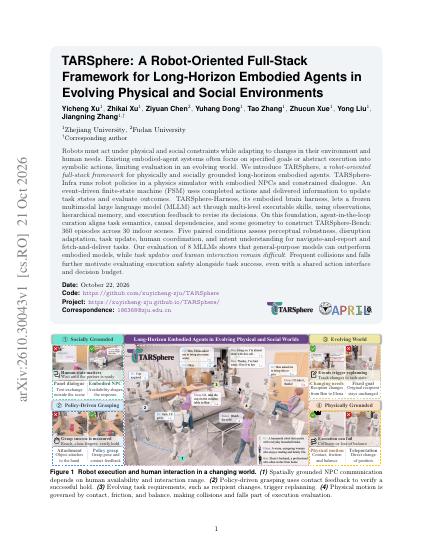
TARSphere: A Robot-Oriented Full-Stack Framework for Long-Horizon Embodied Agents in Evolving Physical and Social Environments

· Yicheng Xu, Zhikai Xu, Ziyuan Chen, +5 authors · Zhejiang University, Fudan University

Lets a frozen multimodal model compose executable robot skills, hierarchical memory, and execution feedback in changing physical and social environments.

Details & sources
Publication
ArXiv 2026
Institutions
Zhejiang University, Fudan University
Authors
Yicheng Xu, Zhikai Xu, Ziyuan Chen, Yuhang Dong, Tao Zhang, Zhucun Xue, Yong Liu, Jiangning Zhang
Mechanism / release notes
Combines a simulator runtime, agent harness, and TARSphere-Bench. The paper evaluates eight models on 360 episodes across 30 indoor scenes. The Apache-2.0 release includes framework code and episode examples; assets and checkpoints require separate installation. Real-robot support remains a TODO.

From VLM Planners to Robotic Agents: Self-Evolving Harnesses for History-Dependent Manipulation

· Tingwen Du, Haoyu Guo, Hanxue Zhang, +9 authors · University of Science and Technology of China, Shanghai Artificial Intelligence Laboratory +3

Wraps a fixed VLA executor with an editable planning harness that manages task history and selects improvements from rollout feedback.

Details & sources
Publication
ArXiv 2026
Institutions
University of Science and Technology of China, Shanghai Artificial Intelligence Laboratory, Shanghai Jiao Tong University, Mohamed bin Zayed University of Artificial Intelligence, Zhejiang University
Authors
Tingwen Du, Haoyu Guo, Hanxue Zhang, Xuanxu Wang, Junting Dong, Chao Gao, Mingfei Han, Tao Lu, Mulin Yu, Chunhua Shen, Xiaojun Chang, Zhihui Li
Mechanism / release notes
The selected harness is frozen before held-out testing, while episode context continues to update. The paper reports 51.38% RoboMME success with autonomous selection versus 44.38% without self-evolution. The Apache-2.0 implementation uses an external Codex planner and the released RoboMME grounded-subgoal π0.5 checkpoint; model weights and benchmark assets are downloaded separately. Evaluation is in simulation.

Plan First, Act Later: Streaming Reasoning for Executable Memory in Robot Control

· Qinghang Liu, Conglin Wang, Zongsheng Li, +6 authors · JD Logistics, Peking University +3

Converts streaming visual observations into semantic events and an executable subtask list that guides a low-level VLA policy.

Details & sources
Publication
ArXiv 2026
Institutions
JD Logistics, Peking University, University of California, Berkeley, PKU-FirstMoveAI Lab, Fudan University
Authors
Qinghang Liu, Conglin Wang, Zongsheng Li, Boyong He, Han Gao, Pengcheng Wang, Tao Sun, Lige Liu, Chang Liu
Mechanism / release notes
Uses short-term visual, semantic-event, and executable memory, with two-stage supervision for memory updates. The paper reports RoboMME evaluation and four real-world manipulation tasks. The official project page is available; its announced PAL_official repository returned HTTP 404 on 2026-10-24, so no implementation link is listed.

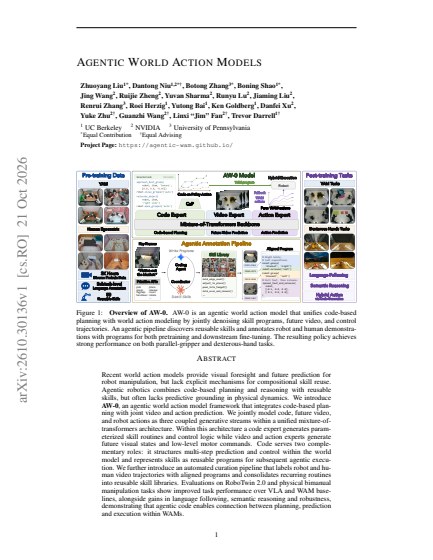
Agentic World Action Models

· Zhuoyang Liu, Dantong Niu, Botong Zhang, +15 authors · University of California, Berkeley, NVIDIA +1

Jointly generates skill programs, future video, and robot actions within a learned world action model, connecting reusable code with predictive control.

Details & sources
Publication
ArXiv 2026
Institutions
University of California, Berkeley, NVIDIA, University of Pennsylvania
Authors
Zhuoyang Liu, Dantong Niu, Botong Zhang, Boning Shao, Jing Wang, Ruijie Zheng, Yuvan Sharma, Runyu Lu, Jiaming Liu, Renrui Zhang, Roei Herzig, Yutong Bai, Ken Goldberg, Danfei Xu, Yuke Zhu, Guanzhi Wang, Linxi "Jim" Fan, Trevor Darrell
Mechanism / release notes
AW-0 couples code, video, and action experts and supports hybrid execution through generated programs or predicted actions. Evaluated on RoboTwin 2.0 and physical bimanual manipulation. BSD-2-Clause code and a pretrained checkpoint are public; the pretraining corpora and initial Cosmos-Predict2.5-2B checkpoint are not included. Frozen public components retain their own licenses.

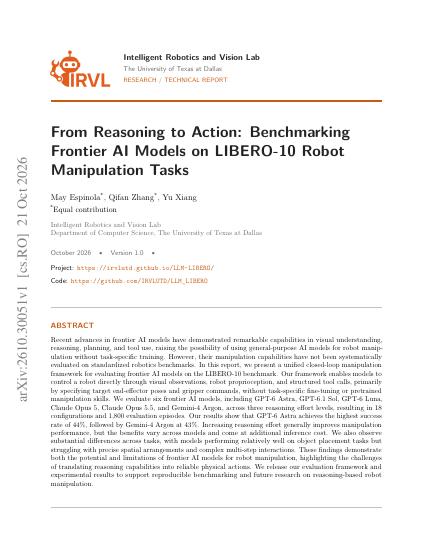
From Reasoning to Action: Benchmarking Frontier AI Models on LIBERO-10 Robot Manipulation Tasks

· May Espinola, Qifan Zhang, Yu Xiang · The University of Texas at Dallas

Evaluates frontier models as closed-loop LIBERO-10 controllers through visual observations, robot state, and end-effector pose and gripper tool calls.

Details & sources
Publication
ArXiv 2026
Institutions
The University of Texas at Dallas
Authors
May Espinola, Qifan Zhang, Yu Xiang
Mechanism / release notes
Reports six models at three reasoning-effort levels, totaling 18 configurations and 1,800 simulation episodes, without task-specific fine-tuning or pretrained manipulation skills. The public implementation is an Inspect Robots plugin with pinned dependencies and spending caps. Optional demonstration storyboards and task hints are separate configurations. No explicit repository license was found.

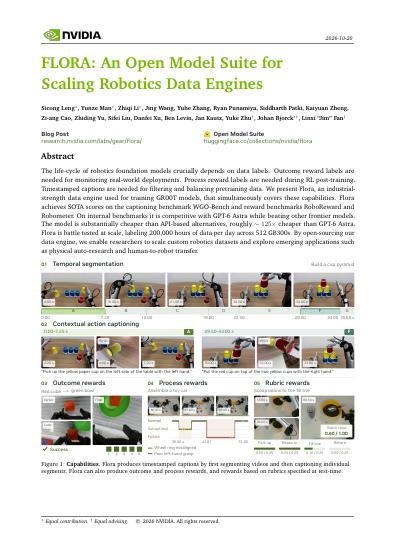
Flora: An Open Model Suite for Scaling Robotics Data Engines

· Sicong Leng, Yunze Man, Zhiqi Li, +14 authors · NVIDIA

Turns human and robot manipulation videos into timestamped action instructions, process rewards, and outcome scores for data curation, robot learning, and execution monitoring.

Details & sources
Institutions
NVIDIA
Authors
Sicong Leng, Yunze Man, Zhiqi Li, Jing Wang, Yuhe Zhang, Ryan Punamiya, Siddharth Patki, Kaiyuan Zheng, Zi-ang Cao, Zhiding Yu, Sifei Liu, Danfei Xu, Ben Levin, Jan Kautz, Yuke Zhu, Johan Bjorck, Linxi "Jim" Fan
Mechanism / release notes
Released resources include Flora-Captioner and Flora-Rewarder checkpoints plus a Flora-TempSeg adapter. Supports user-defined scoring rubrics; evaluated on WGO-Bench, RoboReward, and Robometer and used in GR00T data workflows.

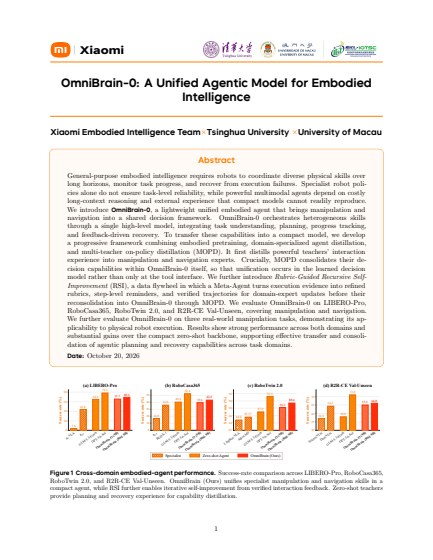
OmniBrain-0: A Unified Agentic Model for Embodied Intelligence

· Xiaomi Embodied Intelligence Team · Xiaomi, Tsinghua University +1

Uses one compact high-level model to orchestrate manipulation and navigation skills, track progress, and recover from execution failures.

Details & sources
Institutions
Xiaomi, Tsinghua University, University of Macau
Authors
Xiaomi Embodied Intelligence Team
Mechanism / release notes
The technical report describes 4B and 9B planners, embodied pretraining, domain-specialized distillation, multi-teacher on-policy consolidation, and a rubric-guided self-improvement data loop. It reports simulation benchmarks and three real-world manipulation tasks. The public repository contains the project website and report; implementation and model release remain pending.

AgenticRoboRL: Bringing Coding-Agent Post-Training to Agentic Robotics

· Xinxin Liu, Bingxin Xu, Wenrui Bao, +4 authors · University of Central Florida, University of Southern California +1

Post-trains a robot harness's planner with supervised fine-tuning and multi-turn reinforcement learning while keeping its execution components fixed.

Details & sources
Publication
ArXiv 2026
Institutions
University of Central Florida, University of Southern California, Michigan State University
Authors
Xinxin Liu, Bingxin Xu, Wenrui Bao, Ming Li, Wentao Bao, Chen Chen, Yuzhang Shang
Mechanism / release notes
Adapters cover frozen-VLA skill invocation through RPent and robot-code generation through CaP-X. Main reported results and released Qwen3.5-9B checkpoints use RPent on LIBERO-PRO, with transfer evaluation on LIBERO-Plus. The Apache-2.0 framework and SFT/RL weights are public; the reported robot evaluations run in simulation.

Physical AI: Concepts, Techniques, and Challenges

· Weinan Zhang, Chunhua Shen, Tianfan Xue, +49 authors · Shanghai AI Laboratory

Reviews physical AI through a perception–modeling–action loop, covering world models, embodied foundation models, robot control, and deployment challenges.

Details & sources
Publication
ArXiv 2026
Institutions
Shanghai AI Laboratory
Authors
Weinan Zhang, Chunhua Shen, Tianfan Xue, Bin Zhao, Bingqi Jiang, Zihan Guo, Zicai Cui, Yang Li, Ming Zhou, Xinyuan Chen, Lihe Ding, Xiao Chen, Yujin Wang, Shi Guo, Junting Dong, Tao Lu, Xing Shen, Haoyu Guo, Yao Mu, Haiyong Yu, Haoxiang Ma, Fuxian Huang, Qiaojun Yu, Yunsong Zhou, Kailin Li, Zirui Wang, Yufei Xue, Weishuai Zeng, Tao Huang, Zhigang Wang, Junli Liu, Pengyuan Wu, Pingrui Zhang, Haotian Wang, Dongzhan Zhou, Jiafei Cao, Feng Yuan, Xinyi Ye, Quanli Xuan, Mulin Yu, Shangding Gu, Kaiwen Song, Dong Wang, Jiarui Li, Kehui Liu, Zhongjie Jia, Dongjiang Li, Jiacheng Bao, Haoran Yang, Zhaoqing Chen, Yiming Sun, Bowen Zhou
Mechanism / release notes
Monograph with 12 chapters and 388 pages, spanning physical data and simulation, sim-to-real transfer, multi-agent coordination, hardware–software co-design, evaluation, reliability, and long-term deployment.

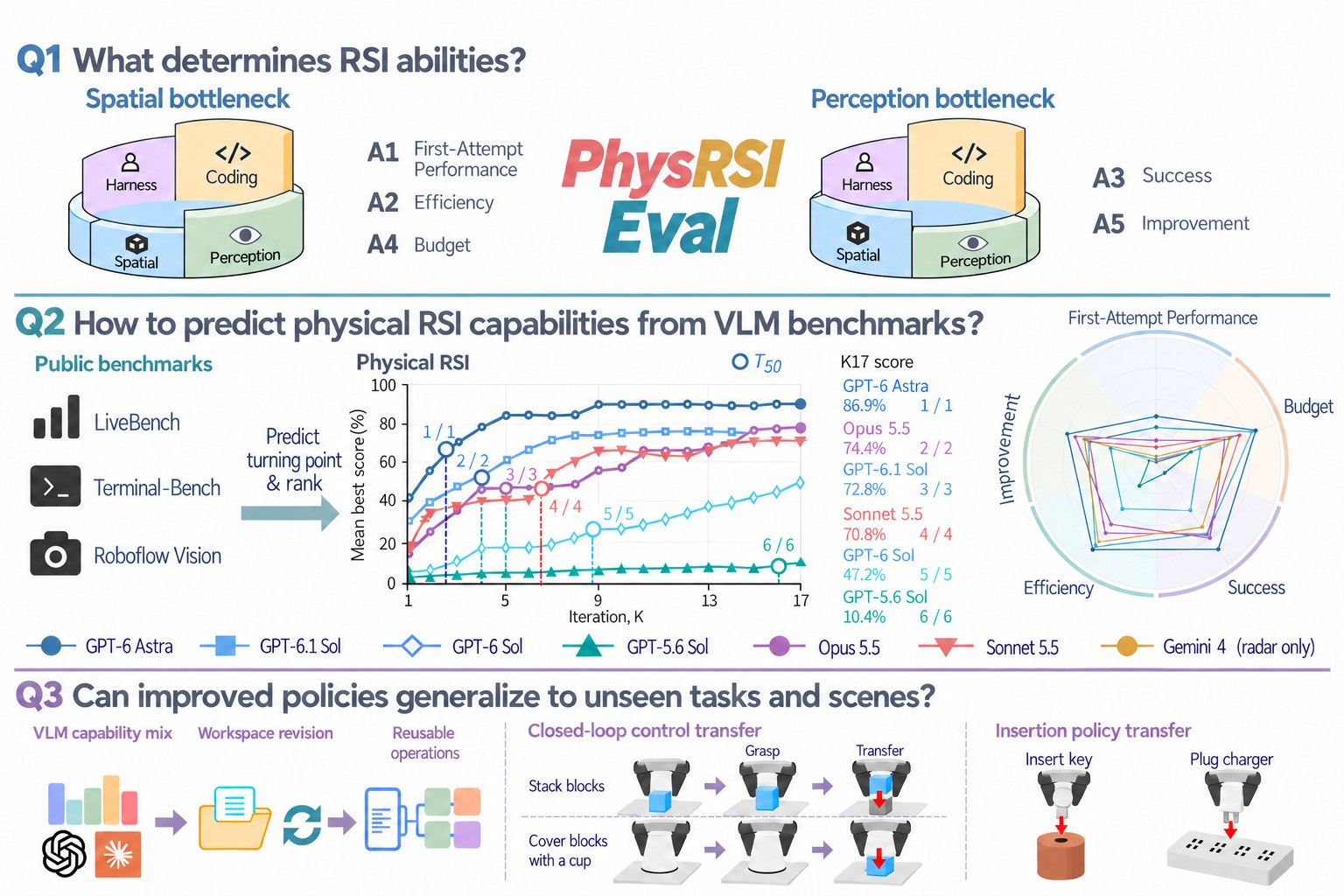
Where is Physical RSI capability from? An Observational Scaling Law of LLM-as-policy

· Zekai Li, Jiayi Yu, Jinlu Zhang, +8 authors · Galbot

Introduces PhysRSI-Eval to study how public model capabilities and early robot feedback relate to the speed, extent, and generalization of self-improvement.

Details & sources
Publication
ArXiv 2026
Institutions
Galbot
Authors
Zekai Li, Jiayi Yu, Jinlu Zhang, Luyang Niu, Zekun Qi, Jun Zheng, Xuchuan Chen, Dairu Liu, Yintianrun Zhang, He Wang, Li Yi
Mechanism / release notes
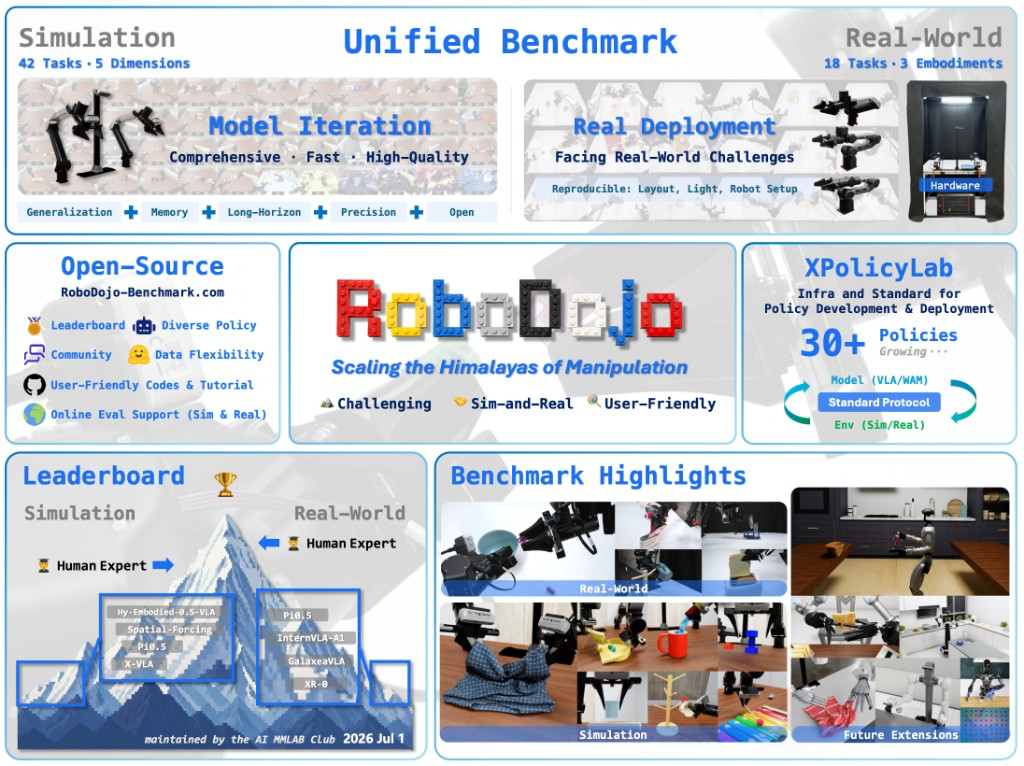
Uses 18 RoboDojo manipulation tasks with fixed model weights and interaction budgets. Tests workspace history, unseen layouts, and cross-task transfer; the capability associations are observational.

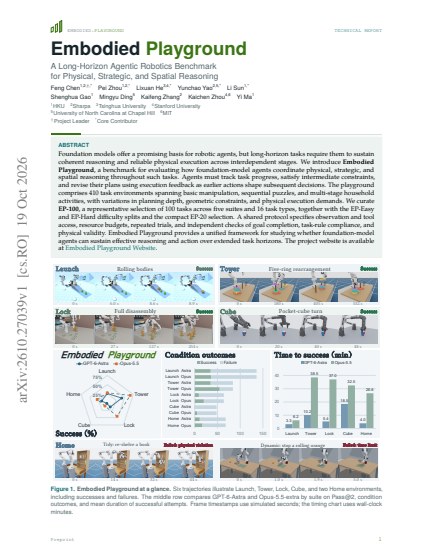
Embodied Playground: A Long-Horizon Agentic Robotics Benchmark for Physical, Strategic, and Spatial Reasoning

· Feng Chen, Pei Zhou, Lixuan He, +7 authors · The University of Hong Kong, Sharpa +4

Evaluates long-horizon physical, strategic, and spatial reasoning through robot interaction across manipulation, puzzles, and household activities.

Details & sources
Publication
ArXiv 2026
Institutions
The University of Hong Kong, Sharpa, Tsinghua University, Stanford University, University of North Carolina at Chapel Hill, MIT
Authors
Feng Chen, Pei Zhou, Lixuan He, Yunchao Yao, Li Sun, Shenghua Gao, Mingyu Ding, Kaifeng Zhang, Kaichen Zhou, Yi Ma
Mechanism / release notes
The full playground contains 410 task environments; EP-100 selects 100 tasks across five suites and 16 task types, with EP-Easy, EP-Hard, and compact EP-20 subsets. Protocols declare observation and tool access, budgets, repeated trials, and independent checks of goal completion, rules, and physical validity. The environments and SDK are public; an evaluation host runs the agent sessions. Code and non-code assets retain separate licenses.

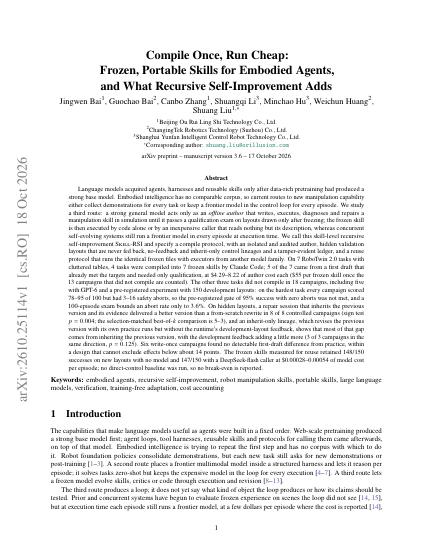
Compile Once, Run Cheap: Frozen, Portable Skills for Embodied Agents, and What Recursive Self-Improvement Adds

· Jingwen Bai, Guochao Bai, Canbo Zhang, +4 authors · Beijing Ou Rui Ling Shi Technology Co., Ltd., ChangingTek Robotics Technology (Suzhou) Co., Ltd. +1

Uses a strong model to write, diagnose, repair, and qualify robot skills offline, then reuses the frozen files as code alone or through a cheaper caller.

Details & sources
Publication
ArXiv 2026
Institutions
Beijing Ou Rui Ling Shi Technology Co., Ltd., ChangingTek Robotics Technology (Suzhou) Co., Ltd., Shanghai Yunfan Intelligent Control Robot Technology Co., Ltd.
Authors
Jingwen Bai, Guochao Bai, Canbo Zhang, Shuangqi Li, Minchao Hu, Weichun Huang, Shuang Liu
Mechanism / release notes
Skill-RSI separates compilation from deployment and validates after freezing on hidden layouts. Seven released skills cover four of seven RoboTwin 2.0 tasks; all experiments are in simulation. Code is Apache-2.0; data, ledgers, and frozen skills are CC BY 4.0. Raw model I/O and evidence images are not included, and no direct-control baseline was run.

The Bitter Lesson Comes to Robotics

· Christopher Leet, Achyutha Menon, Sravanthi Machcha, +3 authors · Robocurve, University of Southern California +1

Compares nine frontier multimodal models controlling physical robot arms on six manipulation tasks under multiple reasoning and service settings.

Details & sources
Publication
ArXiv 2026
Institutions
Robocurve, University of Southern California, University of California, Irvine
Authors
Christopher Leet, Achyutha Menon, Sravanthi Machcha, Sven Koenig, Tzu Kit Chan, Jay Chooi
Mechanism / release notes
Empirical real-robot study using tasks adapted from RoboDojo. The paper tracks performance, execution rate, and cost between July and October 2026, while noting that precision and efficiency remain limited under practical action budgets. Trend estimates describe this evaluated model and protocol sample; they are not guarantees of future capability growth. No public experiment implementation was identified.

HexaShell: A Thin Harness for Exploring the Limits of VLM Agents as Robot Coding Agents

· Hongcheng Gao, Alex Zhou, Jay Zhu, +13 authors · HexaFuture

Gives a coding agent a thin robot CLI and calibrated RGB observations, while a second agent turns failed episodes into reusable code tools.

Details & sources
Publication
ArXiv 2026
Institutions
HexaFuture
Authors
Hongcheng Gao, Alex Zhou, Jay Zhu, Zelin Zheng, Shijia Ge, Xiping Li, Di Wu, Yazhe Wang, Jianshu Zeng, Xuan Shangguan, Yongli Wang, Yexing Wan, Lingyu He, Zhiqi Jia, Sihang Wu, Xiao He
Mechanism / release notes
The paper reports official RoboDojo evaluation over 42 tasks, with 46.9% success and a separate progress score of 53.2. The Apache-2.0 release contains frozen tools, recipes, results, and interface contracts; the server, executors, agent container, and evolution loop are not included. Running the tools requires a compatible harness and RoboDojo's Isaac Sim environment.

InstAgent: A Recursively Self-Improving Agent Operating System for Heterogeneous Robot Collaboration

· Haoyang Luo, Junhao Qin, Jingyan Cao, +7 authors · ShanghaiTech University, InstAdapt

Composes robot capabilities into collaboration behavior trees and retains feedback-driven revisions, handoff checks, and shared multimodal memory for later tasks.

Details & sources
Publication
ArXiv 2026
Institutions
ShanghaiTech University, InstAdapt
Authors
Haoyang Luo, Junhao Qin, Jingyan Cao, Yi Huang, Guangjie Yang, Xiaoyu Chen, Haotao Lu, Tianxiang Gui, Ye Shi, Jingya Wang
Mechanism / release notes
The paper reports 20 real-world heterogeneous multi-robot tasks with three high-level models. Capability binding, execution monitoring, and handoff validation are part of the ROS 2 architecture. A public implementation was not verified; paper results and project demonstrations do not establish a released deployment package.

CoEvolve: Self-Evolving Code Policies from Skills to Strategies for Humanoid Robots

· Zicheng Liu, Haochen Wu, Jiawei He, +4 authors · Peking University, Renmin University of China +2

Revises executable multi-robot coordination over fixed motor skills using transition verification, checkpoint recovery, and reusable cooperative experience.

Details & sources
Publication
ArXiv 2026
Institutions
Peking University, Renmin University of China, Beijing XYZ Embodied AI Co., Ltd., Beijing Academy of Artificial Intelligence
Authors
Zicheng Liu, Haochen Wu, Jiawei He, Suyun Zhao, Huan Yang, Cheng Chi, Hao Tang
Mechanism / release notes
Evaluated with two simulated Unitree G1 humanoids carrying a shared payload through corridors. The setting uses simulator state and restores accepted simulator checkpoints; it is not a real-robot deployment. The announced code repository was unavailable when checked on 2026-10-23.

Self-Building Labs

· Jiaru Bai, Yuchi Zhao, Han Hao, +4 authors · University of Toronto, Vector Institute for Artificial Intelligence +3

Builds task-specific laboratory digital twins, robot skills, and experimental workflows from scientific goals, refining them through simulation and physical feedback.

Details & sources
Publication
ArXiv 2026
Institutions
University of Toronto, Vector Institute for Artificial Intelligence, Acceleration Consortium, Canadian Institute for Advanced Research, NVIDIA
Authors
Jiaru Bai, Yuchi Zhao, Han Hao, Miroslav Bogdanovic, Yang Cao, Varinia Bernales, Alán Aspuru-Guzik
Mechanism / release notes
The paper reports a real-world quantum-dot synthesis experiment; broader layouts and multi-robot configurations also use simulation. Scientific, twin, and safety agents develop and invoke device and robot interfaces. A public source-code release was not verified; deployment requires laboratory-specific equipment, calibration, and integration.

Spatial Memory by Agents, for Agents

· Qianwei Wang, Ce Zhang, Zhanpeng Luo, +3 authors · Nanjing University, Princeton University +3

Uses a coding agent to design and refine spatial memory construction and retrieval for robot localization, navigation, and question answering.

Details & sources
Publication
ArXiv 2026
Institutions
Nanjing University, Princeton University, Carnegie Mellon University, Johns Hopkins University, Mondo Robotics
Authors
Qianwei Wang, Ce Zhang, Zhanpeng Luo, Pengpeng Su, Shuo Yang, Hao Xu
Mechanism / release notes
A Designer Agent iterates using feedback from a fixed Query Agent. Selected memory code is frozen before processing held-out observation histories without downstream questions. Five tracks cover category localization, referring expressions, and spatial, temporal, and navigation-history QA.

CarryOn: A Dual-Loop Harness for Personalized and Reliable Robot Assistance

· Zixuan Wang, Yuqi Liu, Yuxin Chen, +7 authors · Hong Kong University of Science and Technology, The Chinese University of Hong Kong +1

Augments a frozen VLA policy with persistent user and scene memory, geometric action shielding, and recovery skills refined through reflection for personalized robot assistance.

Details & sources
Publication
ArXiv 2026
Institutions
Hong Kong University of Science and Technology, The Chinese University of Hong Kong, SmartMore
Authors
Zixuan Wang, Yuqi Liu, Yuxin Chen, Sengqiao Yang, Jinhui Ye, Pengguang Chen, Changsheng Lu, Shu Liu, Bei Yu, Jiaya Jia
Mechanism / release notes
Evaluated on a real robot and in simulation; safety and recovery results come from separate LIBERO-Safety and LIBERO-Object experiments. The official repository currently contains a README and announces a future code release.

Towards Agentic Robots: Model, Data, Environment, and Harness

· Chonghan Qin, Dongming Wu, Kaituo Feng, +13 authors · MMLab, The Chinese University of Hong Kong, Fudan University +4

Organizes research on agentic robots into four domains—Model, Data, Environment, and Harness—with a 17-category taxonomy and research agenda.

Details & sources
Publication
ArXiv 2026
Institutions
MMLab, The Chinese University of Hong Kong, Fudan University, NovaXBot, Tsinghua University, Zhejiang University, Sun Yat-sen University
Authors
Chonghan Qin, Dongming Wu, Kaituo Feng, Jiaxu Wang, Xinlei Yu, Peiwen Sun, Yijia Fan, Xilin He, Bingao Chen, Weitong Lian, Ryan Ji, Wenqi Ren, Xiaobin Hu, Dahua Lin, Yu-Gang Jiang, Xiangyu Yue

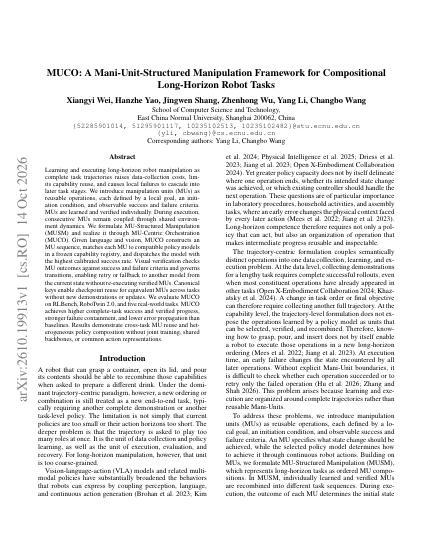
MUCO: A Mani-Unit-Structured Manipulation Framework for Compositional Long-Horizon Robot Tasks

· Xiangyi Wei, Hanzhe Yao, Jingwen Shang, +3 authors · East China Normal University

Composes reusable manipulation units, selects compatible policies from a capability registry, and uses visual verification to advance, retry, or switch executors after local failures.

Details & sources
Publication
ArXiv 2026
Institutions
East China Normal University
Authors
Xiangyi Wei, Hanzhe Yao, Jingwen Shang, Zhenhong Wu, Yang Li, Changbo Wang
Mechanism / release notes
Evaluated on RLBench, RoboTwin 2.0, and five real-world tasks. Verified units can be reused across tasks without new demonstrations, joint policy training, or replaying completed units.

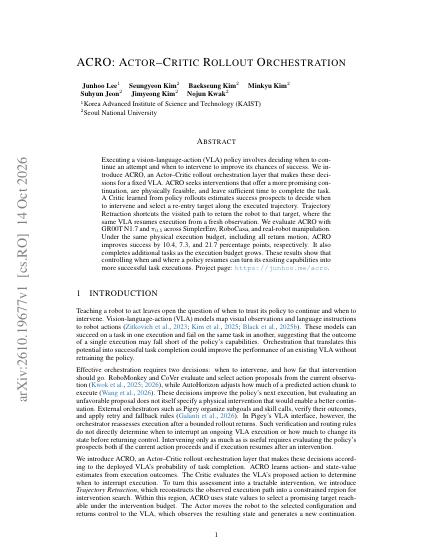
ACRO: Actor-Critic Rollout Orchestration

· Junhoo Lee, Seungyeon Kim, Baekseung Kim, +4 authors · KAIST, Seoul National University

Uses a learned critic to decide when a fixed VLA should continue or recover, retracting along its visited trajectory to a promising state before resuming execution.

Details & sources
Publication
ArXiv 2026
Institutions
KAIST, Seoul National University
Authors
Junhoo Lee, Seungyeon Kim, Baekseung Kim, Minkyu Kim, Suhyun Jeon, Jimyeong Kim, Nojun Kwak
Mechanism / release notes
Evaluated with GR00T N1.7 and π0.5 on SimplerEnv, RoboCasa, and real robots. The public implementation includes a mock rollout example; benchmark integrations and learned critic checkpoints are supplied separately.

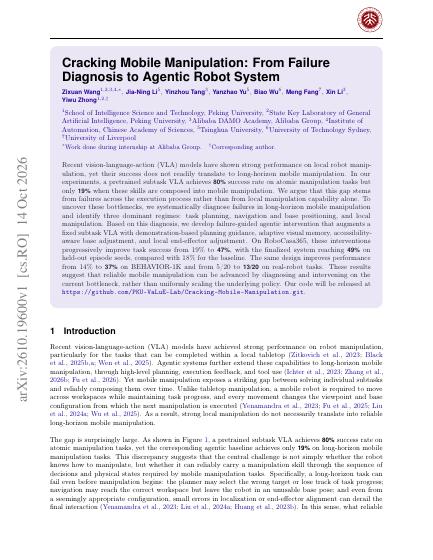
Cracking Mobile Manipulation: From Failure Diagnosis to Agentic Robot System

· Zixuan Wang, Jia-Ning Li, Yinzhou Tang, +5 authors · Peking University, Alibaba DAMO Academy, Alibaba Group +4

Augments a fixed subtask VLA with demonstration-based planning guidance, adaptive visual memory, and geometric corrections for mobile-base positioning and precise manipulation.

Details & sources
Publication
ArXiv 2026
Institutions
Peking University, Alibaba DAMO Academy, Alibaba Group, Institute of Automation, Chinese Academy of Sciences, Tsinghua University, University of Technology Sydney, University of Liverpool
Authors
Zixuan Wang, Jia-Ning Li, Yinzhou Tang, Yanzhao Yu, Biao Wu, Meng Fang, Xin Li, Yiwu Zhong
Mechanism / release notes
Diagnoses failures across planning, navigation and base positioning, and local manipulation. Evaluated on RoboCasa365, BEHAVIOR-1K, and real mobile-manipulation tasks. The repository currently provides the paper and project materials; implementation and checkpoints are listed as forthcoming.

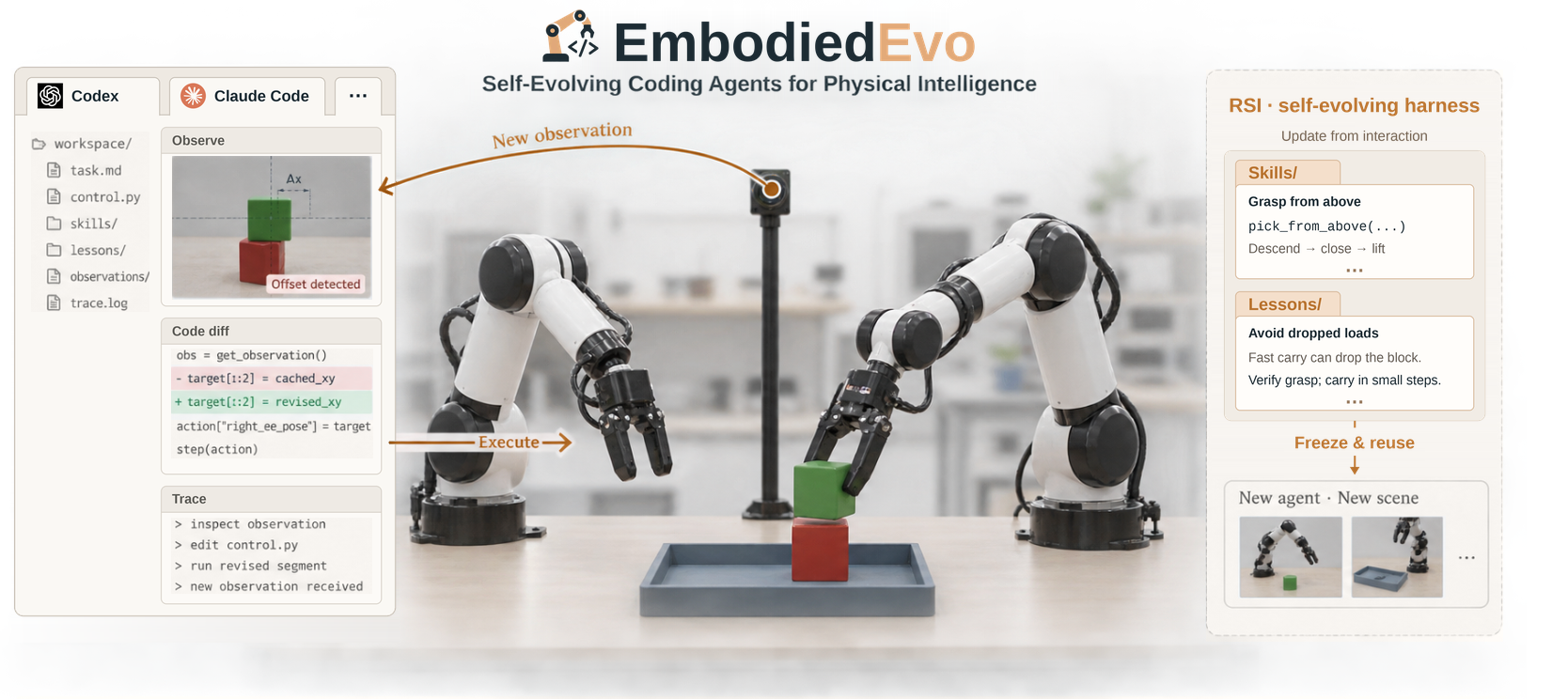
EmbodiedEvo: Self-Evolving Coding Agent For Physical Intelligence

· Wenyi Li, Yizhe Chi, Youjie Zheng, +8 authors · Navers Lab, Einsia.AI, Tsinghua University

Turns interaction feedback in a Playground scene into reusable code Skills and diagnostic Lessons, then freezes them for fresh agents to solve unseen scenes without model-weight updates.

Details & sources
Publication
ArXiv 2026
Institutions
Navers Lab, Einsia.AI, Tsinghua University
Authors
Wenyi Li, Yizhe Chi, Youjie Zheng, Chunyu Liu, Xiaoqiu Wang, Mingju Gao, Zheng Jiang, Deyao Hong, Calvin Xiao, Kaisen Yang, Qinhuai Na
Mechanism / release notes
Evaluated on RoboDojo-Sim with a Playground/Test protocol. The paper reports an average score of 44.48 and 37.82% success; these results are author-reported and have not been independently reproduced here.

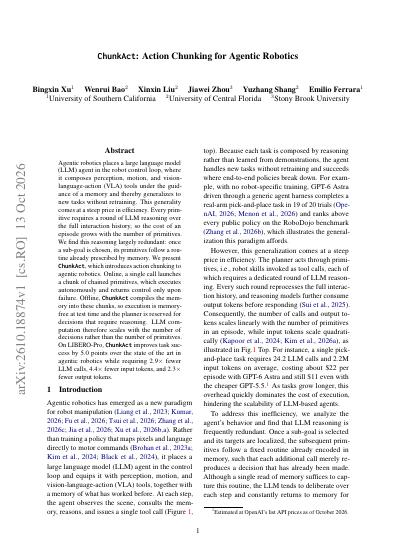
ChunkAct: Action Chunking for Agentic Robotics

· Bingxin Xu, Wenrui Bao, Xinxin Liu, +3 authors · University of Southern California, University of Central Florida +1

Groups robot-tool primitives into reusable action chunks, reducing repeated LLM deliberation while returning control to the agent when execution encounters a failure.

Details & sources
Publication
ArXiv 2026
Institutions
University of Southern California, University of Central Florida, Stony Brook University
Authors
Bingxin Xu, Wenrui Bao, Xinxin Liu, Jiawei Zhou, Yuzhang Shang, Emilio Ferrara
Mechanism / release notes
Supports online chunk triggering and offline compilation from agent memory. Evaluated on LIBERO-Pro, including unseen perturbations, with success and LLM-call and token costs reported separately.

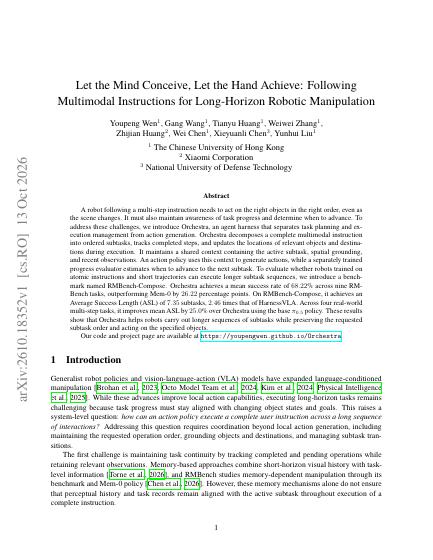
Let the Mind Conceive, Let the Hand Achieve: Following Multimodal Instructions for Long-Horizon Robotic Manipulation (Orchestra)

· Youpeng Wen, Gang Wang, Tianyu Huang, +5 authors · The Chinese University of Hong Kong, Xiaomi Corporation +1

Coordinates ordered subtasks, visual grounding, and working memory around an adapted action policy, using a separately trained progress evaluator to manage subtask transitions.

Details & sources
Publication
ArXiv 2026
Institutions
The Chinese University of Hong Kong, Xiaomi Corporation, National University of Defense Technology
Authors
Youpeng Wen, Gang Wang, Tianyu Huang, Weiwei Zhang, Zhijian Huang, Wei Chen, Xieyuanli Chen, Yunhui Liu
Mechanism / release notes
Evaluated on RMBench, RMBench-Compose, and four real-world tasks. RMBench-Compose tests longer compositions after training on atomic skills and short trajectories; average success length counts consecutive completed subtasks.

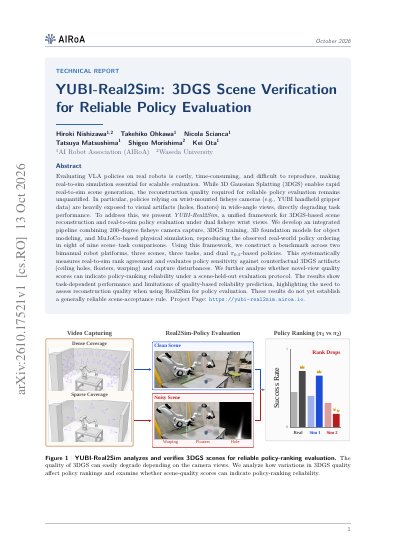
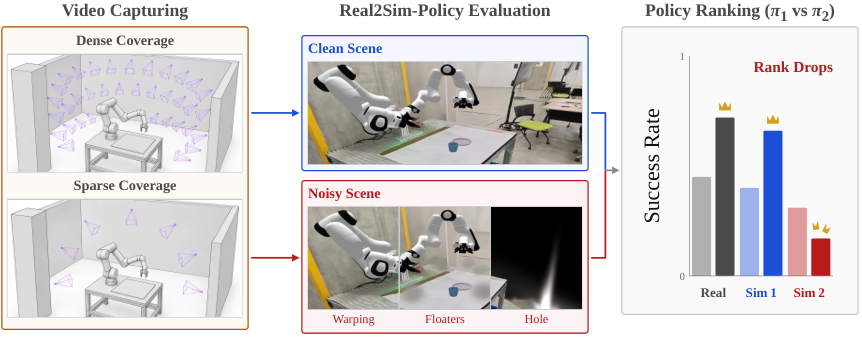
YUBI-Real2Sim: 3DGS Scene Verification for Reliable Policy Evaluation

· Hiroki Nishizawa, Takehiko Ohkawa, Nicola Scianca, +3 authors · AI Robot Association (AIRoA), Waseda University

Studies whether 3D Gaussian Splatting reconstructions preserve real-world VLA policy rankings under dual fisheye wrist views.

Details & sources
Publication
ArXiv 2026
Institutions
AI Robot Association (AIRoA), Waseda University
Authors
Hiroki Nishizawa, Takehiko Ohkawa, Nicola Scianca, Tatsuya Matsushima, Shigeo Morishima, Kei Ota
Mechanism / release notes
Combines scene capture and reconstruction with object models and MuJoCo simulation. Evaluates two bimanual platforms, three scenes, three tasks, and paired π0.5-based policies; reconstruction artifacts and limited capture coverage can change ranking agreement.

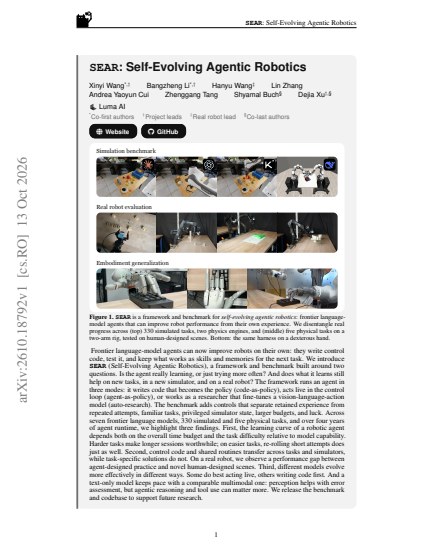
SEAR: Self-Evolving Agentic Robotics

· Xinyi Wang, Bangzheng Li, Hanyu Wang, +5 authors · Luma AI

Studies whether robot agents retain useful skills and memories beyond extra retries, and whether improvements transfer across tasks, simulators, and real robots.

Details & sources
Publication
ArXiv 2026
Institutions
Luma AI
Authors
Xinyi Wang, Bangzheng Li, Hanyu Wang, Lin Zhang, Andrea Yaoyun Cui, Zhenggang Tang, Shyamal Buch, Dejia Xu
Mechanism / release notes
SEAR compares code-as-policy, live agent-as-policy, and VLA auto-research modes across seven frontier models, 330 simulated tasks, and five physical tasks. Budget-matched controls distinguish retained experience from restarts, privileged information, and luck. The paper and project are public; the repository contains announcement assets and an unchecked code-release milestone, not an executable implementation.

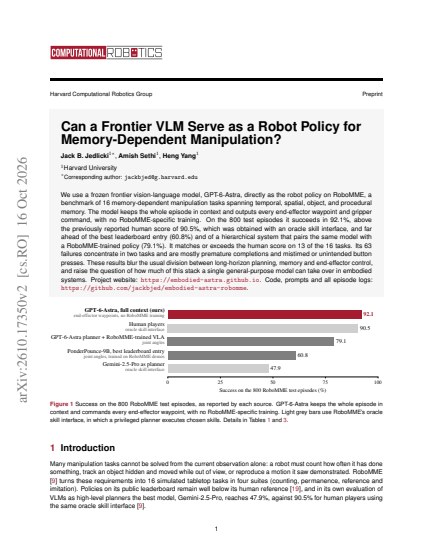
Can a Frontier VLM Serve as a Robot Policy for Memory-Dependent Manipulation?

· Jack B. Jedlicki, Amish Sethi, Heng Yang · Harvard University

Uses a frozen frontier VLM as a direct waypoint-and-gripper policy, keeping the full episode in context for memory-dependent manipulation.

Details & sources
Publication
ArXiv 2026
Institutions
Harvard University
Authors
Jack B. Jedlicki, Amish Sethi, Heng Yang
Mechanism / release notes
The authors report 737 successes in 800 scheduled RoboMME simulation episodes, with environment errors counted as failures. MIT evaluation code, prompts, configuration, and episode logs are public. This is one evaluation run of an undated API model; human and hierarchical-policy comparisons use different action interfaces and should not be interpreted as matched controller comparisons.

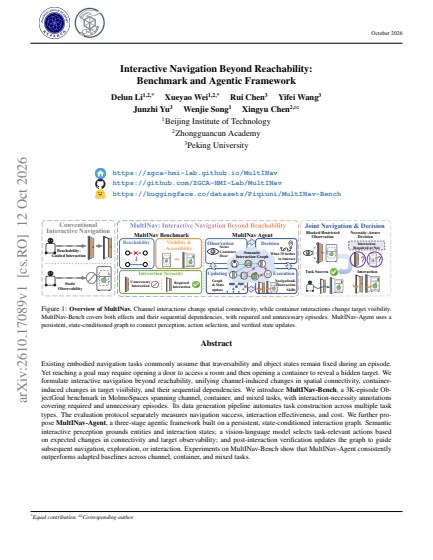
Interactive Navigation Beyond Reachability: Benchmark and Agentic Framework

· Delun Li, Xueyao Wei, Rui Chen, +4 authors · Beijing Institute of Technology, Zhongguancun Academy +1

Benchmarks navigation that requires deciding whether to open doors or containers, with an agent that verifies interactions and updates a persistent graph.

Details & sources
Publication
ArXiv 2026
Institutions
Beijing Institute of Technology, Zhongguancun Academy, Peking University
Authors
Delun Li, Xueyao Wei, Rui Chen, Yifei Wang, Junzhi Yu, Wenjie Song, Xingyu Chen
Mechanism / release notes
MultINav-Bench provides 3,000 ObjectGoal episodes in MolmoSpaces, spanning channel, container, and mixed tasks with interaction-necessity annotations. Navigation success, interaction effectiveness, and cost are measured separately. MultINav-Agent connects semantic perception, VLM action selection, and post-interaction state verification. Code is Apache-2.0; benchmark data are public, while MolmoSpaces assets have separate upstream requirements and terms.

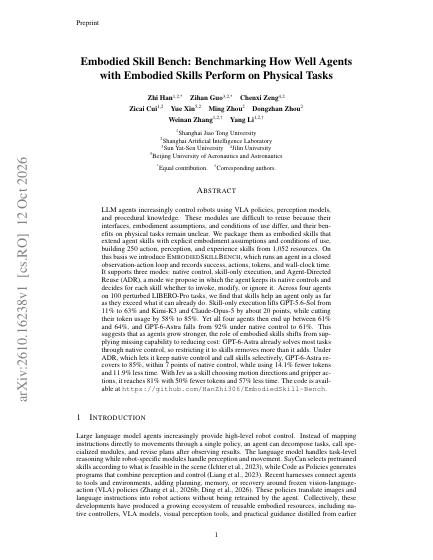
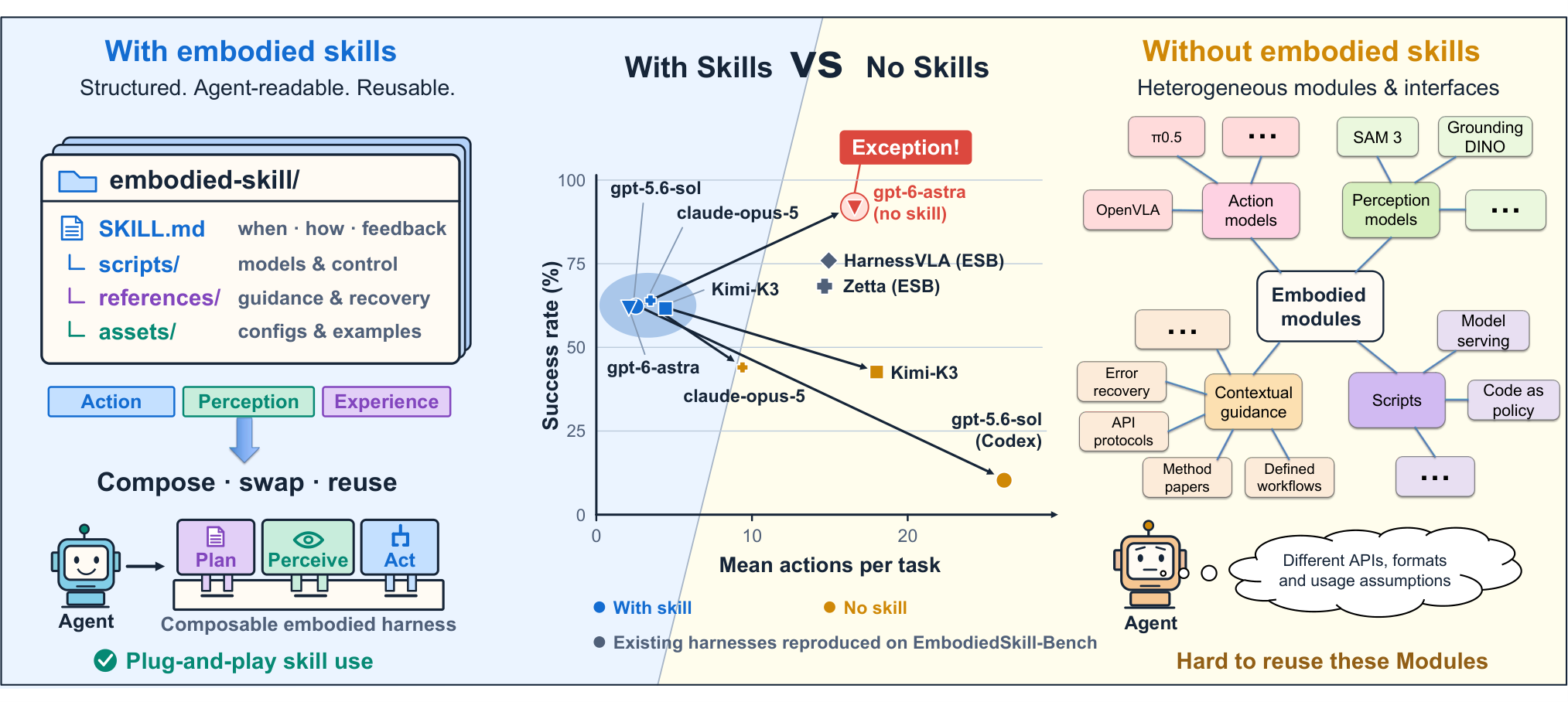
Embodied Skill Bench: Benchmarking How Well Agents with Embodied Skills Perform on Physical Tasks

· Zhi Han, Zihan Guo, Chenxi Zeng, +6 authors · Shanghai Jiao Tong University, Shanghai Artificial Intelligence Laboratory +3

Benchmarks how action, perception, and experience skills change agents' manipulation success and execution cost across 100 perturbed LIBERO-Pro tasks.

Details & sources
Publication
ArXiv 2026
Institutions
Shanghai Jiao Tong University, Shanghai Artificial Intelligence Laboratory, Sun Yat-sen University, Jilin University, Beihang University
Authors
Zhi Han, Zihan Guo, Chenxi Zeng, Zicai Cui, Yue Xin, Ming Zhou, Dongzhan Zhou, Weinan Zhang, Yang Li
Mechanism / release notes
Compares native control, skill-only execution, and Agent-Directed Reuse, which retains native controls while selecting or adapting skills. The paper constructs 250 skills from 1,052 resources. Public code includes the runtime, construction tools, task roster, and evaluator; the skill library and standalone ADR/Jev integrations are not included.

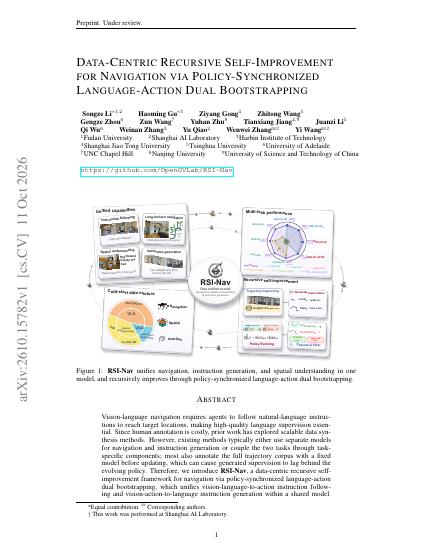
RSI-Nav: Data-Centric Recursive Self-Improvement for Navigation via Policy-Synchronized Language-Action Dual Bootstrapping

· Songze Li, Haoming Gu, Ziyang Gong, +11 authors · Fudan University, Shanghai AI Laboratory +7

Unifies navigation, instruction generation, and spatial understanding in one VLM; filters generated instructions by navigation success and path efficiency, then updates the policy after each trajectory shard with spatial-data replay.

Details & sources
Publication
ArXiv 2026
Institutions
Fudan University, Shanghai AI Laboratory, Harbin Institute of Technology, Shanghai Jiao Tong University, Tsinghua University, University of Adelaide, University of North Carolina at Chapel Hill, Nanjing University, University of Science and Technology of China
Authors
Songze Li, Haoming Gu, Ziyang Gong, Zhitong Wang, Gengze Zhou, Zun Wang, Yuhan Zhu, Tianxiang Jiang, Juanzi Li, Qi Wu, Weinan Zhang, Yu Qiao, Wenwei Zhang, Yi Wang
Mechanism / release notes
Built on Qwen3.5-9B and evaluated on R2R-CE, RxR-CE, and a DEEP Robotics M20 robot. Released code covers training, trajectory conversion, recursive self-improvement, and R2R-CE evaluation; weights and datasets are prepared separately.

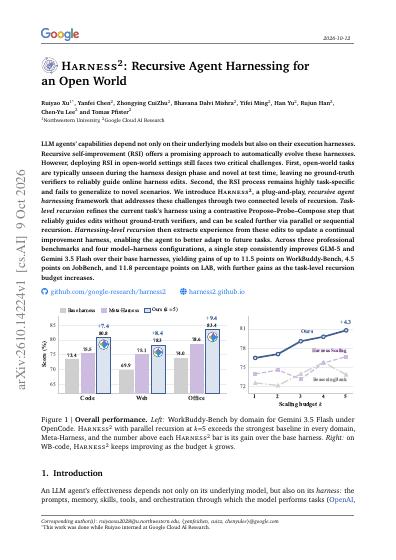
Harness²: Recursive Agent Harnessing for an Open World

· Ruiyao Xu, Yanfei Chen, Zhongying CuiZhu, +6 authors · Northwestern University, Google Cloud AI Research

Refines agent harnesses through contrastive Propose–Probe–Compose trials without ground-truth feedback, then retains adopted harnesses and reusable lessons for future tasks while keeping model weights fixed.

Details & sources
Publication
ArXiv 2026
Institutions
Northwestern University, Google Cloud AI Research
Authors
Ruiyao Xu, Yanfei Chen, Zhongying CuiZhu, Bhavana Dalvi Mishra, Yifei Ming, Han Yu, Rujun Han, Chen-Yu Lee, Tomas Pfister
Mechanism / release notes
Evaluated on WorkBuddy-Bench, JobBench, and LAB for office, web, code, and legal tasks. Released code supports parallel and sequential recursion with OpenCode and Codex executors; provides methodological context for robot-use harness evolution.

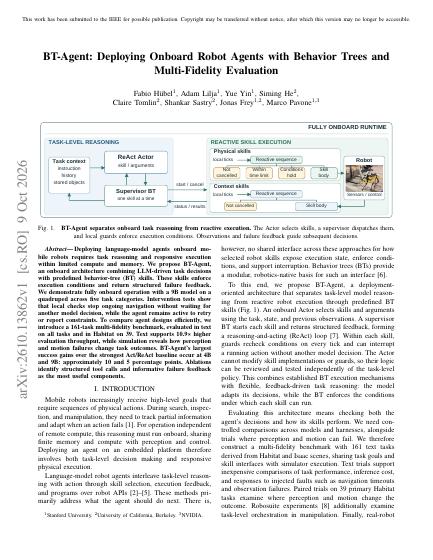
BT-Agent: Deploying Onboard Robot Agents with Behavior Trees and Multi-Fidelity Evaluation

· Fabio Hübel, Adam Lilja, Yue Yin, +5 authors · Stanford University, University of California, Berkeley +1

Combines onboard language-model task decisions with behavior-tree skills that enforce local execution conditions and return structured failure feedback.

Details & sources
Publication
ArXiv 2026
Institutions
Stanford University, University of California, Berkeley, NVIDIA
Authors
Fabio Hübel, Adam Lilja, Yue Yin, Siming He, Claire Tomlin, Shankar Sastry, Jonas Frey, Marco Pavone
Mechanism / release notes
The paper reports onboard quadruped operation and a 161-task text benchmark with 39 tasks evaluated in Habitat. The Apache-2.0 code release requires separately integrated robot drivers and services; release 0.1.0rc1 itself has not been robot-tested. The companion benchmark is not public pending redistribution permission.

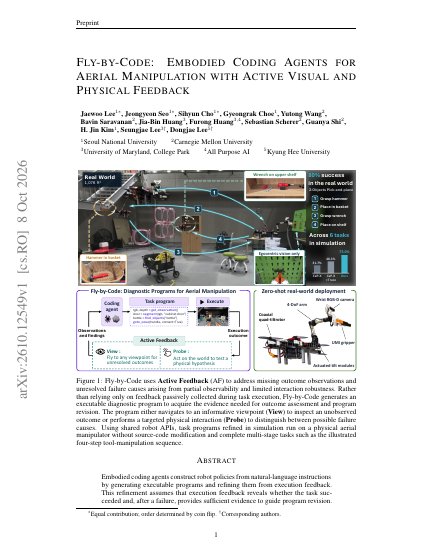
Fly-by-Code: Embodied Coding Agents for Aerial Manipulation with Active Visual and Physical Feedback

· Jaewoo Lee, Jeongyeon Seo, Sihyun Cho, +10 authors · Seoul National University, Carnegie Mellon University +3

Generates diagnostic programs that actively change viewpoints and probe physical interactions in simulation to improve aerial manipulation code.

Details & sources
Publication
ArXiv 2026
Institutions
Seoul National University, Carnegie Mellon University, University of Maryland, College Park, All Purpose AI, Kyung Hee University
Authors
Jaewoo Lee, Jeongyeon Seo, Sihyun Cho, Gyeongrak Choe, Yutong Wang, Bavin Saravanan, Jia-Bin Huang, Furong Huang, Sebastian Scherer, Guanya Shi, H. Jin Kim, Seungjae Lee, Dongjae Lee
Mechanism / release notes
Active Feedback separates diagnostic actions from task execution, supporting completion checks and failure analysis. Evaluated on six simulated aerial manipulation tasks and two real-world tasks using shared robot APIs; task programs transfer without source-code changes. Code is announced as coming soon.

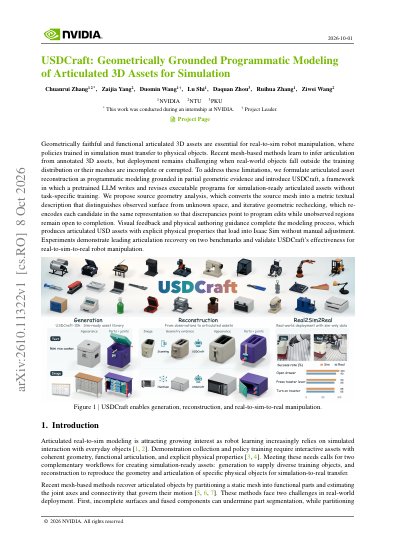
USDCraft: Geometrically Grounded Programmatic Modeling of Articulated 3D Assets for Simulation

· Chuanrui Zhang, Zaijia Yang, Duomin Wang, +4 authors · NVIDIA, Nanyang Technological University +1

Uses an LLM to write and revise articulated USD asset programs from partial mesh geometry, visual feedback, and physical authoring constraints.

Details & sources
Publication
ArXiv 2026
Institutions
NVIDIA, Nanyang Technological University, Peking University
Authors
Chuanrui Zhang, Zaijia Yang, Duomin Wang, Lu Shi, Daquan Zhou, Ruihua Zhang, Ziwei Wang
Mechanism / release notes
Encodes observed geometry as metric text and rechecks candidate assets to guide code edits. Reports articulation reconstruction and real-to-sim-to-real manipulation with assets loaded into Isaac Sim; the project page marks code and dataset releases as TODO.

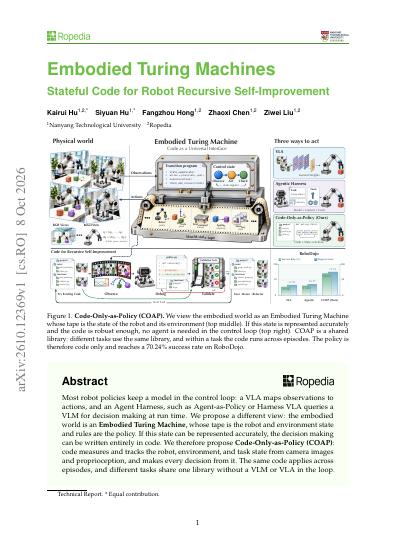
Embodied Turing Machines: Stateful Code for Robot Recursive Self-Improvement

· Kairui Hu, Siyuan Hu, Fangzhou Hong, +2 authors · Nanyang Technological University, Ropedia

Introduces Code-Only-as-Policy (COAP), a shared stateful code library that improves from execution feedback and controls robot tasks without model inference at test time.

Details & sources
Publication
ArXiv 2026
Institutions
Nanyang Technological University, Ropedia
Authors
Kairui Hu, Siyuan Hu, Fangzhou Hong, Zhaoxi Chen, Ziwei Liu
Mechanism / release notes
Reports 70.24% success across RoboDojo’s 42 bimanual tasks. The authors identify accurate state measurement and robust code logic as key limitations.

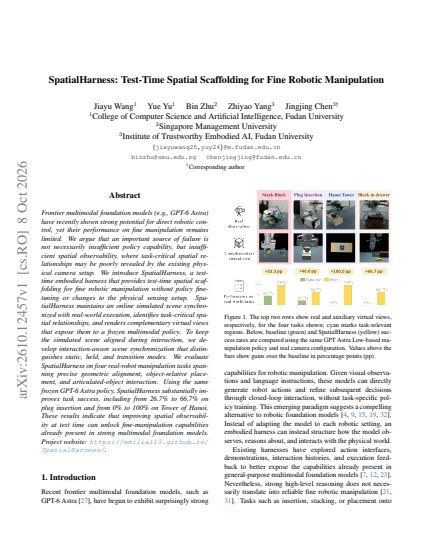
SpatialHarness: Test-Time Spatial Scaffolding for Fine Robotic Manipulation

· Jiayu Wang, Yue Yu, Bin Zhu, +2 authors · Fudan University, Singapore Management University

Supplies a frozen multimodal robot policy with complementary virtual camera views from an online scene synchronized with physical execution, improving visibility of task-critical geometry.

Details & sources
Publication
ArXiv 2026
Institutions
Fudan University, Singapore Management University
Authors
Jiayu Wang, Yue Yu, Bin Zhu, Zhiyao Yang, Jingjing Chen
Mechanism / release notes
Evaluated on four real-robot fine-manipulation tasks. Scene synchronization tracks static, held, and transition states without policy fine-tuning or additional physical cameras.

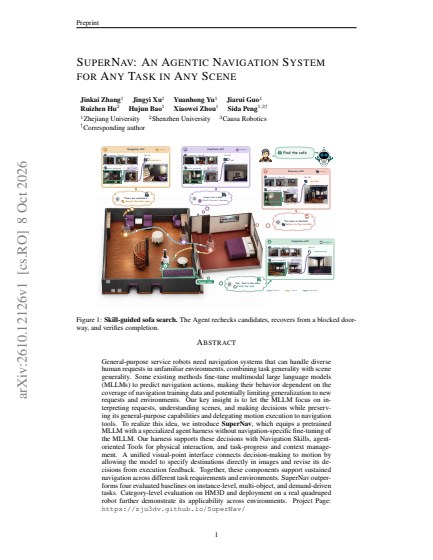
SuperNav: An Agentic Navigation System for Any Task in Any Scene

· Jinkai Zhang, Jingyi Xu, Yuanhong Yu, +5 authors · Zhejiang University, Shenzhen University +1

Equips a pretrained multimodal model with navigation skills, tools, and task-progress memory, using image-point destinations and execution feedback to handle diverse navigation requests.

Details & sources
Publication
ArXiv 2026
Institutions
Zhejiang University, Shenzhen University, Causa Robotics
Authors
Jinkai Zhang, Jingyi Xu, Yuanhong Yu, Jiarui Guo, Ruizhen Hu, Hujun Bao, Xiaowei Zhou, Sida Peng
Mechanism / release notes
Supports geometric and learned motion executors without navigation-specific fine-tuning of the MLLM. Evaluated on category-level, instance-level, multi-object, and demand-driven navigation, with real Unitree Go2 demonstrations. The released code supports Habitat-GS and AI2-THOR; real-robot drivers are not included.

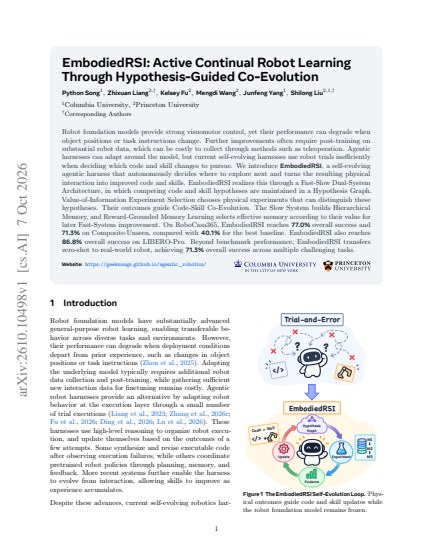
EmbodiedRSI: Active Continual Robot Learning Through Hypothesis-Guided Co-Evolution

· Python Song, Zhixuan Liang, Kelsey Fu, +3 authors · Columbia University, Princeton University

Selects informative robot trials to test competing hypotheses and jointly refine executable code, reusable skills, and memory around frozen robot foundation models.

Details & sources
Publication
ArXiv 2026
Institutions
Columbia University, Princeton University
Authors
Python Song, Zhixuan Liang, Kelsey Fu, Mengdi Wang, Junfeng Yang, Shilong Liu
Mechanism / release notes
Combines a hypothesis graph and value-of-information experiment selection with fast code-skill updates and slower memory consolidation. Evaluated on RoboCasa365, LIBERO-Pro, and real-robot transfer.

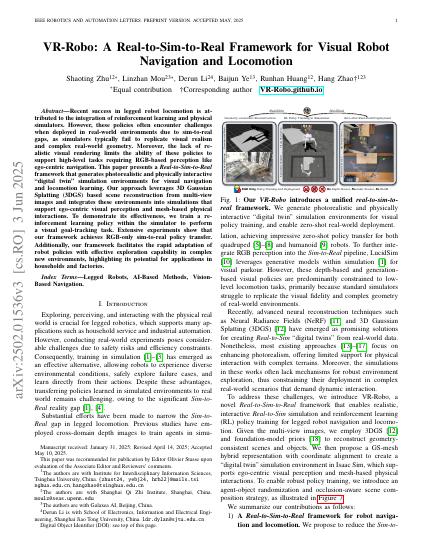
Agentic RSR: Real-to-Sim-to-Real through Scene Reconstruction and Execution-Grounded Robot Policies

· Yihan Li, Yating Feng, Shengjiu Sun, +7 authors · HKUST (Guangzhou), Sun Yat-sen University

Links task-relevant scene reconstruction with execution-grounded policy development, simulation testing, and transfer to a real robot.

Details & sources
Publication
ArXiv 2026
Institutions
HKUST (Guangzhou), Sun Yat-sen University
Authors
Yihan Li, Yating Feng, Shengjiu Sun, Jianing Chen, Hao Ren, Bowen Yang, Weisheng Xu, Qiwei Wu, Hui Cheng, Renjing Xu
Mechanism / release notes
The paper reports 18 scenes across two robots passing a joint visual check, with real-robot task success reaching 80% of simulation success. The public repository documents a staged implementation; its README says the latest DSH scene-reconstruction configuration is outside its reproduction scope.

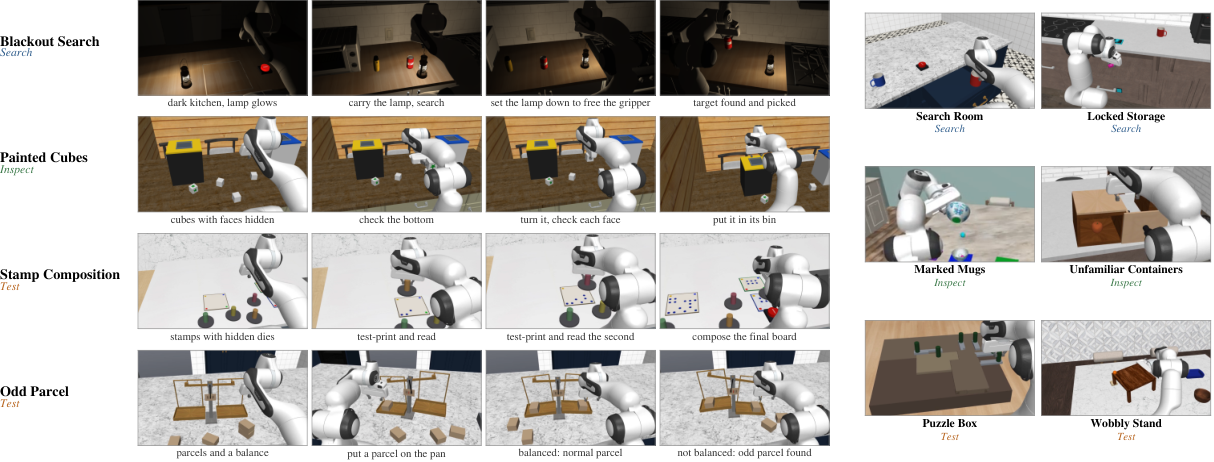
RoboQuest: Generalist Physical Agents that Search, Inspect and Test

· Liu Renhang, Navonil Majumder, Tej Deep Pala, +1 author · Nanyang Technological University

Studies whether multimodal agents that directly control a mobile manipulator can gather hidden task information by searching, inspecting, and testing, then decide when the task is complete.

Details & sources
Publication
ArXiv 2026
Institutions
Nanyang Technological University
Authors
Liu Renhang, Navonil Majumder, Tej Deep Pala, Soujanya Poria

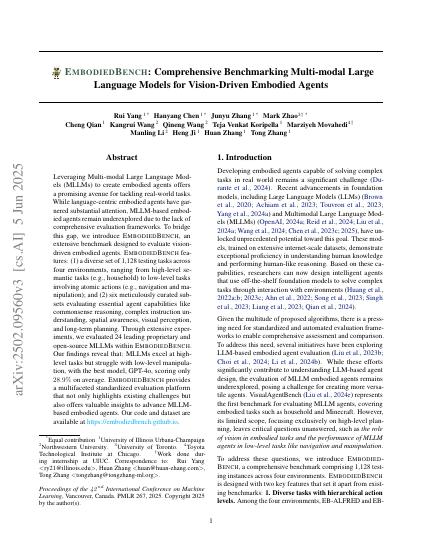
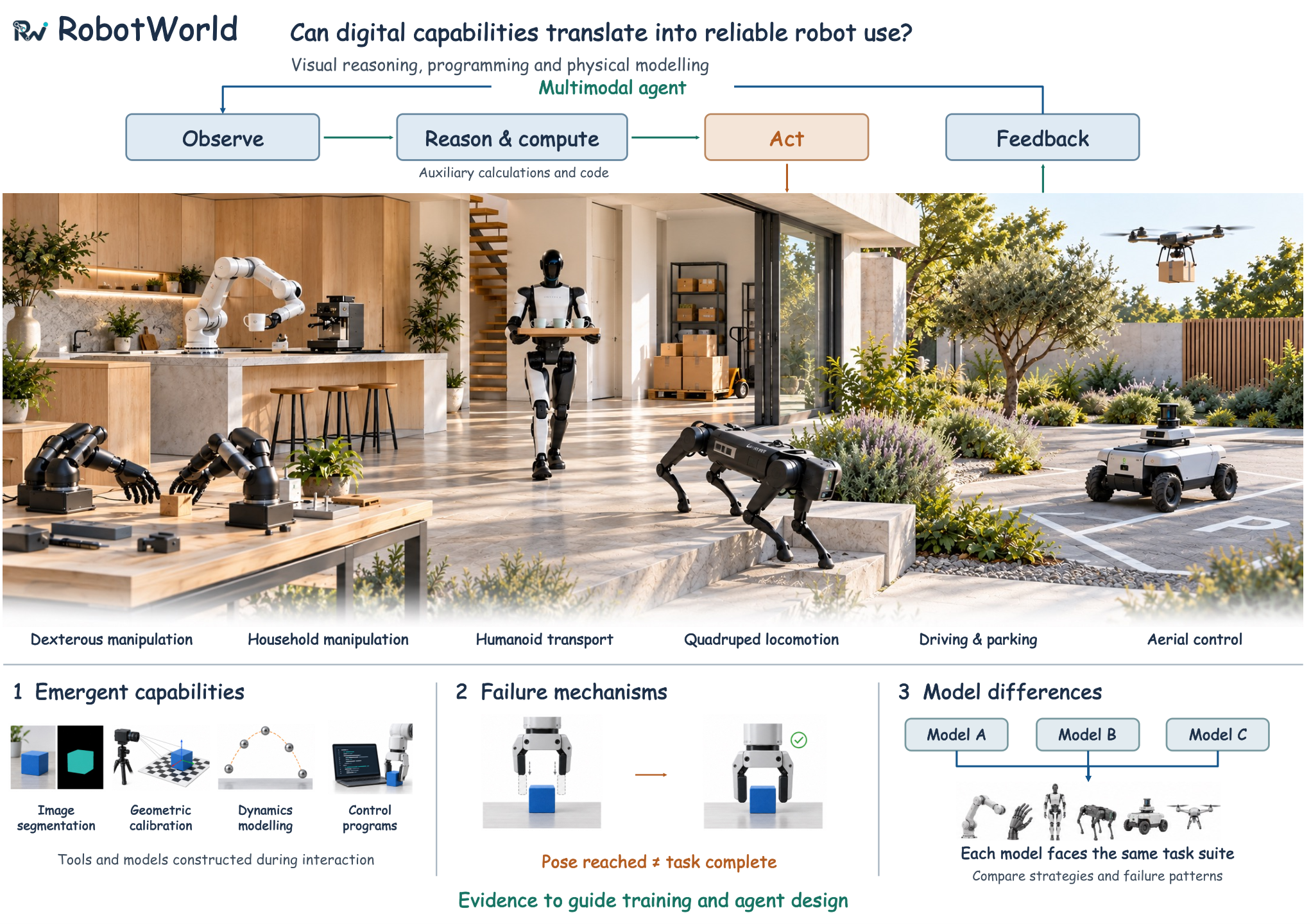
RobotWorld: Benchmarking Multimodal Agents for Robot Use Across Diverse Tasks and Embodiments

· Zhiqin Yang, Chenxin Li, Xiaomeng Hu, +30 authors · Hong Kong University of Science and Technology, Chinese University of Hong Kong +9

Studies how multimodal agents combine perception, reasoning, and tool use across robot embodiments, linking task outcomes to feedback use, recovery, and completion assessment.

Details & sources
Publication
ArXiv 2026
Institutions
Hong Kong University of Science and Technology, Chinese University of Hong Kong, Nanjing University, Stanford University, University of California, Berkeley, National University of Singapore, MIT, Tsinghua University, Carnegie Mellon University, Fudan University, University of Hong Kong
Authors
Zhiqin Yang, Chenxin Li, Xiaomeng Hu, Yibin Liu, Weidong Huang, Jiankai Sun, Haitao Li, Zijian Wu, Yuzhi Huang, Fanding Huang, Hanwen Sun, Jiashun Liu, Jingqi Tong, Mingxin Huang, Shaoli Hu, Shijue Huang, Tianyi Bai, Xinyuan Wang, Yunlong Lin, Zhengyang Tang, Zhexin Zhang, Zhuo Chen, Xierui Song, Juntao Dai, Boyuan Chen, Jiaming Ji, Fangneng Zhan, Mengkang Hu, Wei Xue, Yonggang Zhang, Han Hu, Tsung-Yi Ho, Yike Guo

EmbodiedSmith: Scaling Embodied Data through Recursive Self-Improvement Flywheel in Simulation

· Yikai Qin, Yifei Deng, Mingjian Liang, +13 authors · The Hong Kong University of Science and Technology (Guangzhou), Xiaomi Robotics +8

Couples asset, scene, and task generation through an agentic refinement loop, using simulation feedback to revise scenes and robot plans for scalable demonstration generation.

Details & sources
Publication
ArXiv 2026
Institutions
The Hong Kong University of Science and Technology (Guangzhou), Xiaomi Robotics, Southeastern University, Tsinghua University, Zhejiang University, Westlake University, Symbiosis Robotics, Peking University, Xi’an Jiaotong University, Beijing Academy of Artificial Intelligence
Authors
Yikai Qin, Yifei Deng, Mingjian Liang, Wenxuan Song, Zepeng Lin, Zhiyi Jiang, Jiajun Fu, Qiao Sun, Huashuo Lei, Xicheng Gong, Jiayi Chen, Han Zhao, Shuanghao Bai, Pengxiang Ding, Pengwei Wang, Haoang Li
Mechanism / release notes
Agents build and execute skill graphs, diagnose failures, and validate trajectories with programmatic checks and independent VLM review. Supports mobile manipulators, humanoids, dexterous hands, deformable objects, and fluids.

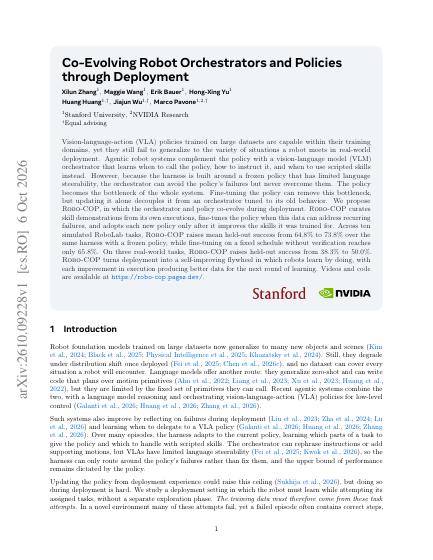
Co-Evolving Robot Orchestrators and Policies through Deployment (Robo-COP)

· Xilun Zhang, Maggie Wang, Erik Bauer, +4 authors · Stanford University, NVIDIA Research

Co-evolves a VLM orchestrator and robot policy during deployment by curating execution data, selectively fine-tuning skills, and verifying candidate policies before adoption.

Details & sources
Publication
ArXiv 2026
Institutions
Stanford University, NVIDIA Research
Authors
Xilun Zhang, Maggie Wang, Erik Bauer, Hong-Xing Yu, Huang Huang, Jiajun Wu, Marco Pavone
Mechanism / release notes
Updates orchestrator memory to reflect each adopted policy’s capabilities. Evaluated on ten simulated RoboLab tasks and three real-world tasks, with held-out success assessed after deployment.
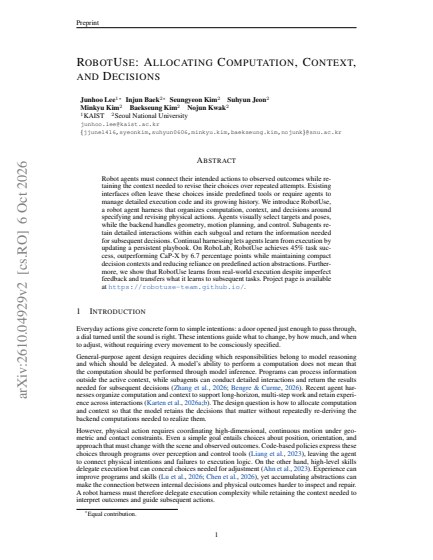
RobotUse: Allocating Computation, Context, and Decisions

· Junhoo Lee, Injun Baek, Seungyeon Kim, +4 authors · KAIST, Seoul National University

Lets agents choose visual targets and poses while a backend handles geometry and control; subgoal-local contexts and a persistent playbook retain execution experience.

Details & sources
Publication
ArXiv 2026
Institutions
KAIST, Seoul National University
Authors
Junhoo Lee, Injun Baek, Seungyeon Kim, Suhyun Jeon, Minkyu Kim, Baekseung Kim, Nojun Kwak
Mechanism / release notes
Evaluated on RoboLab with additional physical Franka demonstrations. The public release includes the agent harness, visual action tools, and simulator integration; the physical Panda adapter is excluded.

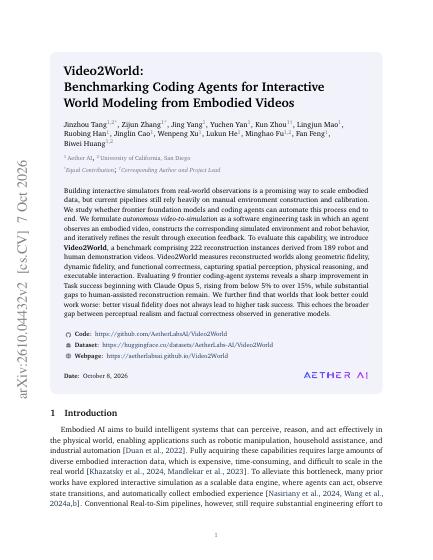
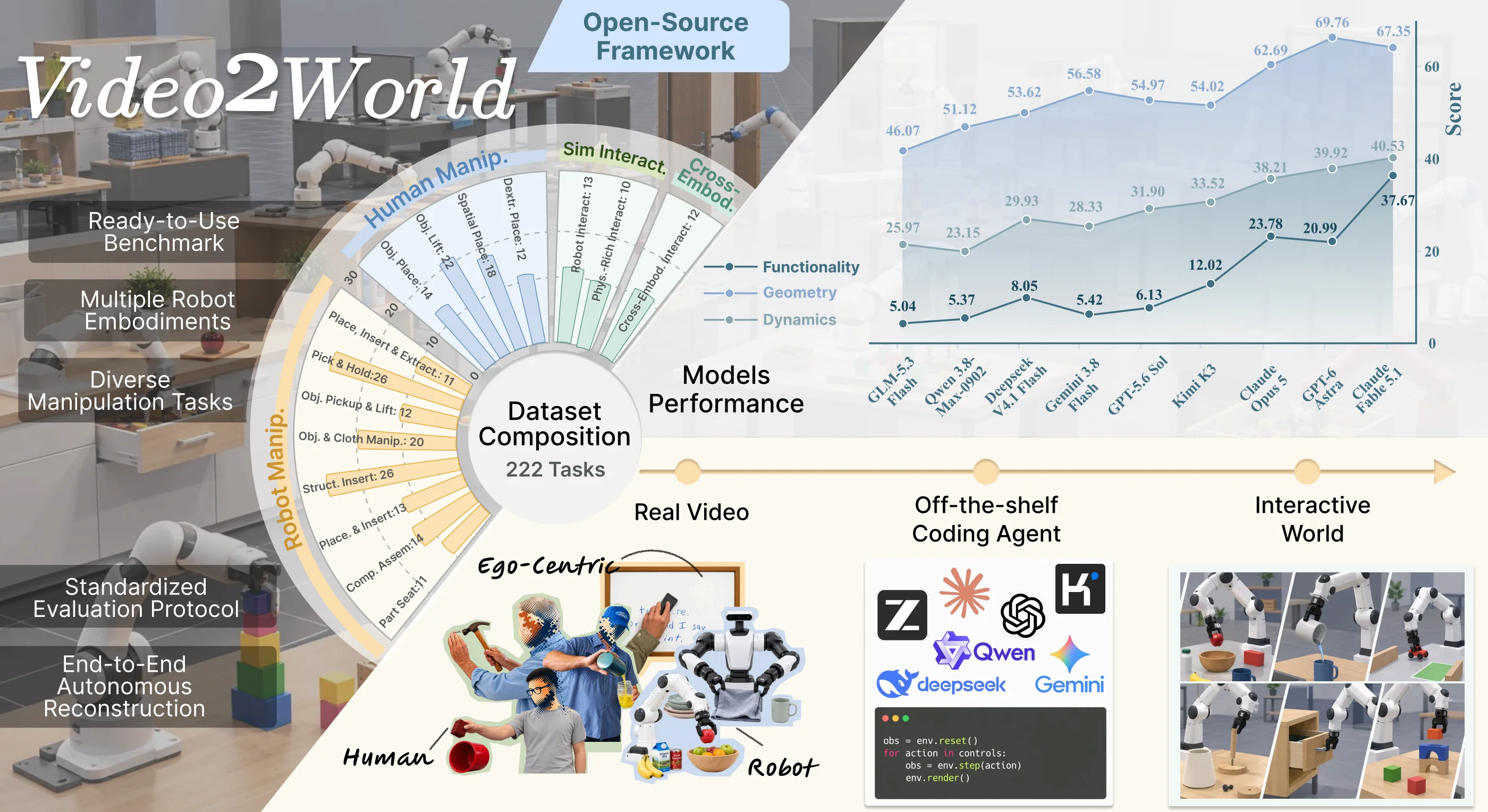
Video2World: Benchmarking Coding Agents for Interactive World Modeling from Embodied Videos

· Jinzhou Tang, Zijun Zhang, Jing Yang, +10 authors · Aether AI, University of California, San Diego

Frames video-to-simulation reconstruction as a coding-agent task, testing whether reconstructed worlds reproduce both scene geometry and executable robot interactions.

Details & sources
Publication
ArXiv 2026
Institutions
Aether AI, University of California, San Diego
Authors
Jinzhou Tang, Zijun Zhang, Jing Yang, Yuchen Yan, Kun Zhou, Lingjun Mao, Ruobing Han, Jinglin Cao, Wenpeng Xu, Lukun He, Minghao Fu, Fan Feng, Biwei Huang

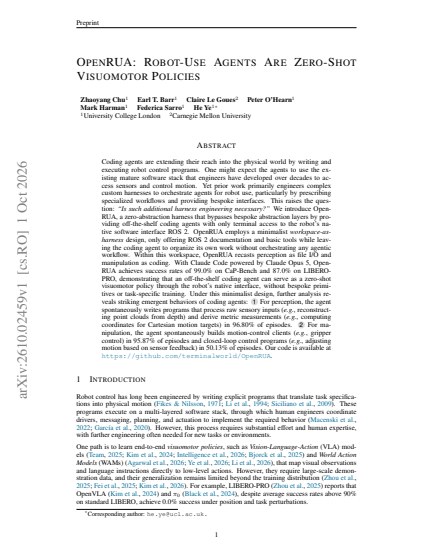
OpenRUA: Robot-Use Agents Are Zero-Shot Visuomotor Policies

· Zhaoyang Chu, Earl T. Barr, Claire Le Goues, +4 authors · University College London, Carnegie Mellon University

Gives coding agents terminal access to native ROS 2 interfaces, treating sensor observations as file I/O and robot manipulation as programs developed with execution feedback.

Details & sources
Publication
ArXiv 2026
Institutions
University College London, Carnegie Mellon University
Authors
Zhaoyang Chu, Earl T. Barr, Claire Le Goues, Peter O'Hearn, Mark Harman, Federica Sarro, He Ye
Mechanism / release notes
Uses a workspace with robot documentation and starter tools. The paper evaluates zero-shot control on CaP-Bench and LIBERO-PRO without task-specific policy training or bespoke motion primitives.

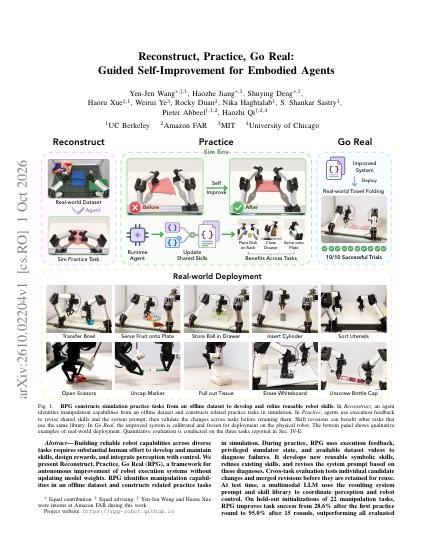
Reconstruct, Practice, Go Real: Guided Self-Improvement for Embodied Agents

· Yen-Jen Wang, Haozhe Jiang, Shuying Deng, +7 authors · UC Berkeley, Amazon FAR +2

RPG develops reusable robot skills and a shared system prompt through dataset-guided simulation practice, using failure diagnosis and cross-task validation before physical deployment.

Details & sources
Publication
ArXiv 2026
Institutions
UC Berkeley, Amazon FAR, MIT, University of Chicago
Authors
Yen-Jen Wang, Haozhe Jiang, Shuying Deng, Haoru Xue, Weirui Ye, Rocky Duan, Nika Haghtalab, S. Shankar Sastry, Pieter Abbeel, Haozhi Qi
Mechanism / release notes
Model weights stay fixed; privileged simulator state and dataset videos support offline diagnosis. Evaluated on 22 simulated tasks and 30 physical trials across three tasks after calibration and hardware adaptation. Code is listed as forthcoming.

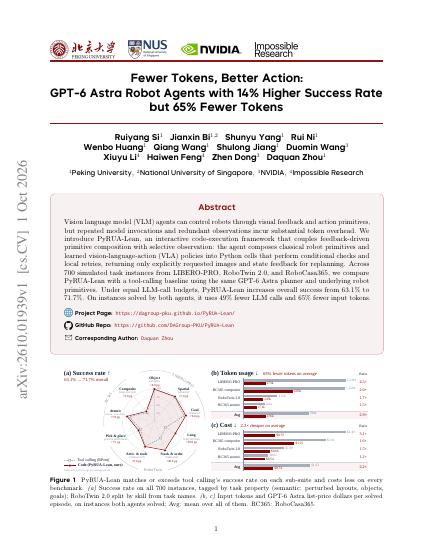
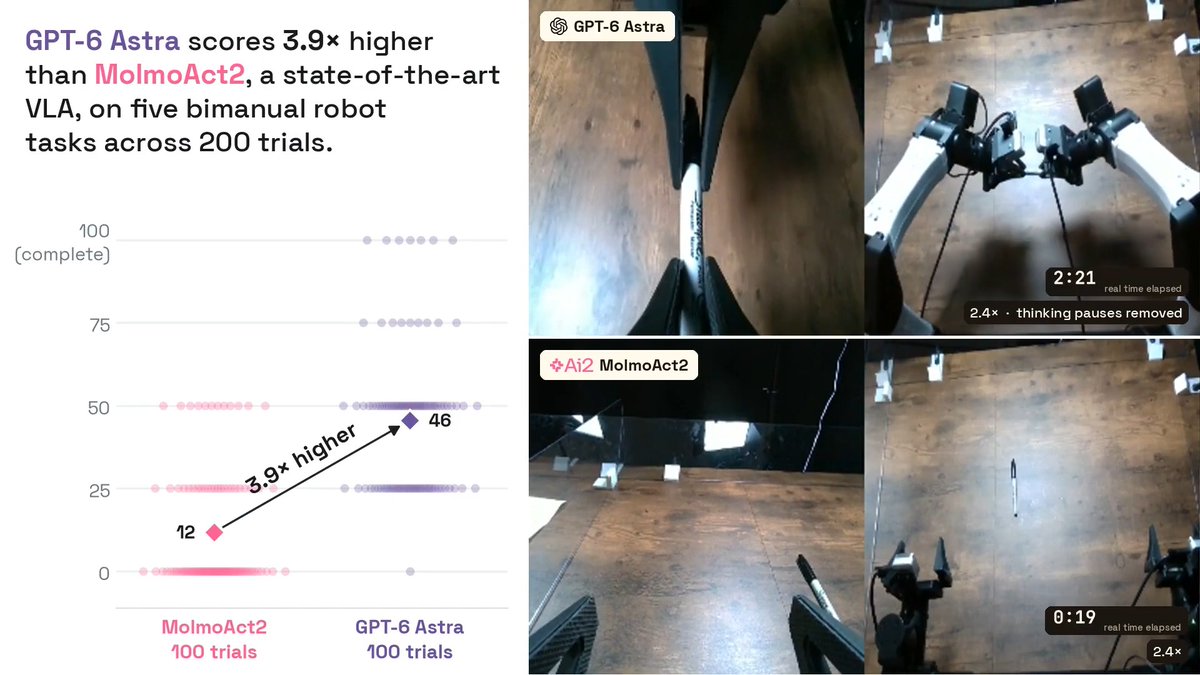
Fewer Tokens, Better Action: GPT-6 Astra Robot Agents with 14% Higher Success Rate but 65% Fewer Tokens

· Ruiyang Si, Jianxin Bi, Shunyu Yang, +9 authors · Peking University, National University of Singapore +2

PyRUA-Lean composes robot primitives and frozen VLA policies in persistent Python cells, using local checks, retries, and selective observations to reduce repeated model calls.

Details & sources
Publication
ArXiv 2026
Institutions
Peking University, National University of Singapore, NVIDIA, Impossible Research
Authors
Ruiyang Si, Jianxin Bi, Shunyu Yang, Rui Ni, Wenbo Huang, Qiang Wang, Shulong Jiang, Duomin Wang, Xiuyu Li, Haiwen Feng, Zhen Dong, Daquan Zhou
Mechanism / release notes
Evaluated on 700 simulated instances from LIBERO-PRO, RoboTwin 2.0, and RoboCasa365 with matched planner, primitives, and LLM-call budgets. The reported 65% input-token reduction is measured only on instances solved by both agents.

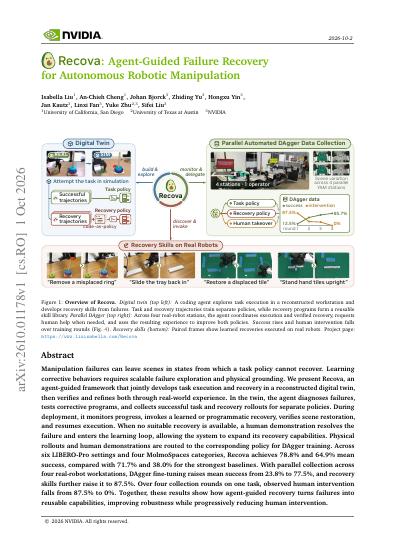
Recova: Agent-Guided Failure Recovery for Autonomous Robotic Manipulation

· Isabella Liu, An-Chieh Cheng, Johan Bjorck, +6 authors · University of California, San Diego, University of Texas at Austin +1

Uses a coding agent to discover and verify recovery skills in digital twins, then orchestrates task and recovery policies with progress checks during deployment.
Details & sources
Publication
ArXiv 2026
Institutions
University of California, San Diego, University of Texas at Austin, NVIDIA
Authors
Isabella Liu, An-Chieh Cheng, Johan Bjorck, Zhiding Yu, Hongxu Yin, Jan Kautz, Linxi Fan, Yuke Zhu, Sifei Liu
Mechanism / release notes
Evaluated in LIBERO-Pro and MolmoSpaces simulation and across four real-robot workstations. Human demonstrations resolve unsupported failures; task and recovery experience feed separate DAgger updates. Recovery therefore includes both reusable programs and learned policies.

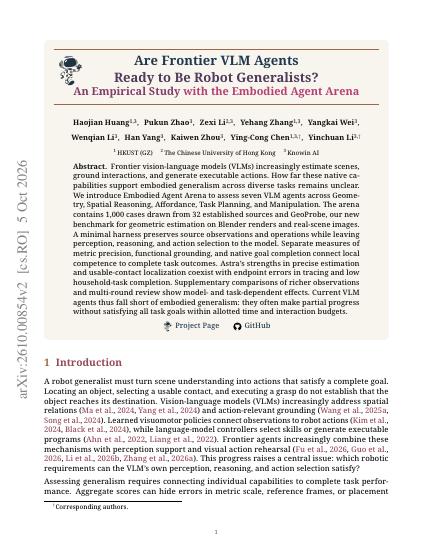
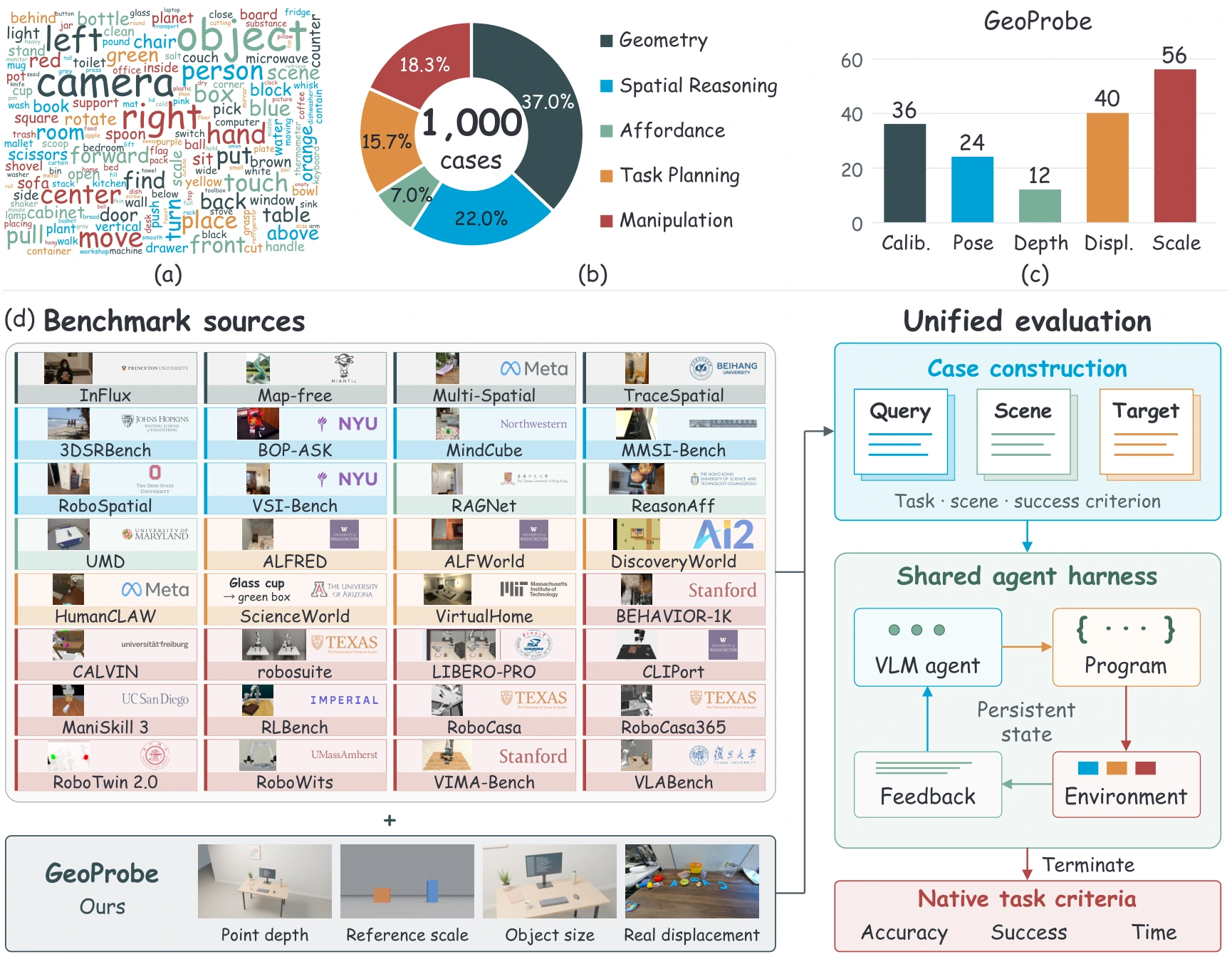
Are Frontier VLM Agents Ready to Be Robot Generalists? An Empirical Study with the Embodied Agent Arena

· Haojian Huang, Pukun Zhao, Zexi Li, +7 authors · Hong Kong University of Science and Technology (Guangzhou), The Chinese University of Hong Kong +1

Studies how VLM agents turn geometric estimates, spatial reasoning, and interaction grounding into complete robotic tasks across five capability domains.

Details & sources
Publication
ArXiv 2026
Institutions
Hong Kong University of Science and Technology (Guangzhou), The Chinese University of Hong Kong, Knowin AI
Authors
Haojian Huang, Pukun Zhao, Zexi Li, Yehang Zhang, Yangkai Wei, Wenqian Li, Han Yang, Kaiwen Zhou, Ying-Cong Chen, Yinchuan Li

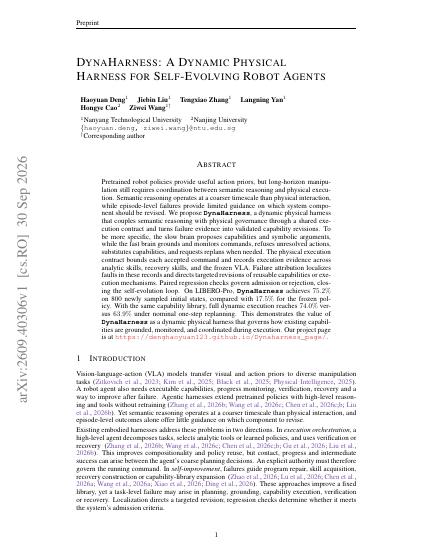
DynaHarness: A Dynamic Physical Harness for Self-Evolving Robot Agents

· Haoyuan Deng, Jiebin Liu, Tengxiao Zhang, +3 authors · Nanyang Technological University, Nanjing University

Couples semantic planning with runtime command grounding, monitoring, refusal, and recovery, using execution evidence and regression checks to validate revisions of reusable robot capabilities.

Details & sources
Publication
ArXiv 2026
Institutions
Nanyang Technological University, Nanjing University
Authors
Haoyuan Deng, Jiebin Liu, Tengxiao Zhang, Langning Yan, Hongye Cao, Ziwei Wang
Mechanism / release notes
Coordinates analytic skills, recovery skills, and a frozen VLA through a shared execution contract. Evaluated on LIBERO-Pro and real-robot manipulation.

ASENA: Self-evolving Agents for Embodied Navigation

· An-Chieh Cheng, Isabella Liu, Edmund Bu, +7 authors · NVIDIA, University of California, San Diego +1

Connects coding agents to robot sensing, supervised execution, and persistent experience; an optional learned navigation policy can be called as a tool.

Details & sources
Publication
ArXiv 2026
Institutions
NVIDIA, University of California, San Diego, The University of Texas at Austin
Authors
An-Chieh Cheng, Isabella Liu, Edmund Bu, Johan Bjorck, Hongxu Yin, Zhengyi Luo, Jan Kautz, Linxi "Jim" Fan, Yuke Zhu, Sifei Liu
Mechanism / release notes
Reports simulator-based navigation and embodied question answering, repeated-task improvement with fixed model weights, and supervised Unitree G1 demonstrations.

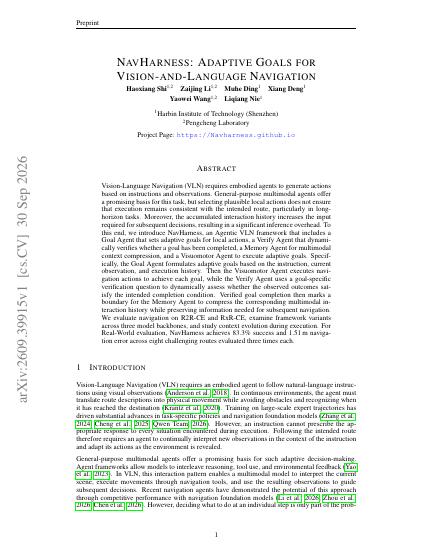
NavHarness: Adaptive Goals for Agentic Vision-Language Navigation

· Haoxiang Shi, Zaijing Li, Muhe Ding, +3 authors · Harbin Institute of Technology (Shenzhen), Pengcheng Laboratory

Coordinates goal setting, visuomotor execution, outcome verification, and memory agents for navigation, compressing multimodal history at verified goal-completion boundaries.

Details & sources
Publication
ArXiv 2026
Institutions
Harbin Institute of Technology (Shenzhen), Pengcheng Laboratory
Authors
Haoxiang Shi, Zaijing Li, Muhe Ding, Xiang Deng, Yaowei Wang, Liqiang Nie
Mechanism / release notes
Evaluated on R2R-CE, RxR-CE, and eight real-world routes with three trials each. Goal-based memory compression trades context savings against navigation performance.

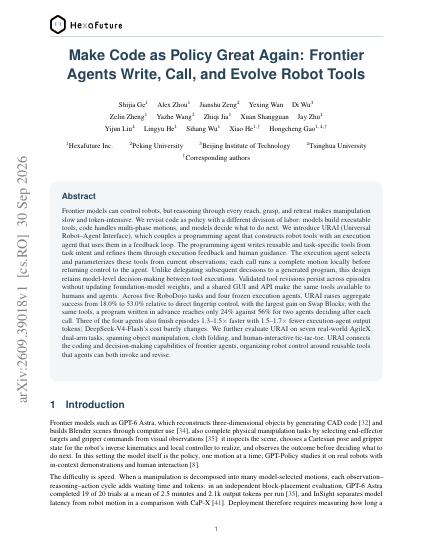
Make Code as Policy Great Again: Frontier Agents Write, Call, and Evolve Robot Tools

· Shijia Ge, Alex Zhou, Jianshu Zeng, +12 authors · Hexafuture Inc., Peking University +2

URAI pairs a programming agent that builds and refines reusable robot tools with an execution agent that selects tools from feedback between complete local motions.

Details & sources
Publication
ArXiv 2026
Institutions
Hexafuture Inc., Peking University, Beijing Institute of Technology, Tsinghua University
Authors
Shijia Ge, Alex Zhou, Jianshu Zeng, Yexing Wan, Di Wu, Zelin Zheng, Yazhe Wang, Zhiqi Jia, Xuan Shangguan, Jay Zhu, Yijun Liu, Lingyu He, Sihang Wu, Xiao He, Hongcheng Gao
Mechanism / release notes
Evaluated on five RoboDojo simulation tasks and seven real-world AgileX dual-arm tasks. Tool development includes human guidance; reported execution-time and token savings exclude unmeasured tool-authoring and author-steering costs.

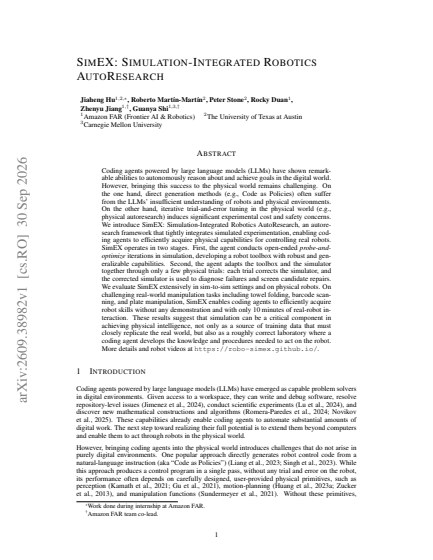
SimEX: Simulation-Integrated Robotics AutoResearch

· Jiaheng Hu, Roberto Martin-Martin, Peter Stone, +3 authors · Amazon Frontier AI & Robotics, University of Texas at Austin +1

Lets coding agents develop robot tools through simulated experiments, then jointly adapt the tools and simulator from a small number of physical trials.

Details & sources
Publication
ArXiv 2026
Institutions
Amazon Frontier AI & Robotics, University of Texas at Austin, Carnegie Mellon University
Authors
Jiaheng Hu, Roberto Martin-Martin, Peter Stone, Rocky Duan, Zhenyu Jiang, Guanya Shi
Mechanism / release notes
A probe-and-optimize stage builds reusable capabilities in simulation; physical feedback then corrects the simulator and screens tool repairs. The paper reports sim-to-sim experiments and real-robot towel folding, barcode scanning, and plate manipulation without demonstrations. The official project page and videos are available; no public implementation was identified.

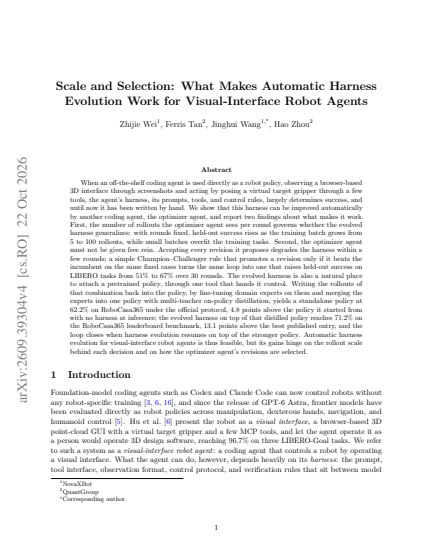
Scale and Selection: What Makes Automatic Harness Evolution Work for Visual-Interface Robot Agents

· Zhijie Wei, Ferris Tan, Jinghui Wang, +1 author · NovaXBot, QuantGroup

Studies how rollout batch size and incumbent-versus-candidate selection affect automatic harness evolution for visual-interface robot agents.

Details & sources
Publication
ArXiv 2026
Institutions
NovaXBot, QuantGroup
Authors
Zhijie Wei, Ferris Tan, Jinghui Wang, Hao Zhou
Mechanism / release notes
A coding optimizer revises the prompts, tools, and control rules of a screenshot-driven robot agent. The study compares unconditional acceptance with Champion–Challenger selection and evaluates held-out generalization in simulation. The latest revision also investigates attaching a pretrained policy, distilling interaction experience, and resuming harness evolution. First posted on 2026-09-30; revision 4 is dated 2026-10-22. Public implementation availability is unconfirmed.

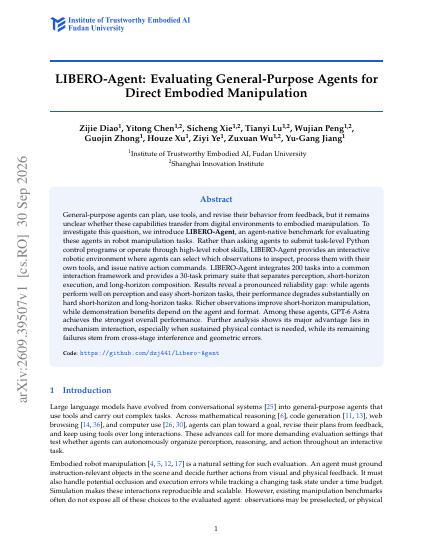
LIBERO-Agent: Evaluating General-Purpose Agents for Direct Embodied Manipulation

· Zijie Diao, Yitong Chen, Sicheng Xie, +7 authors · Institute of Trustworthy Embodied AI, Fudan University, Shanghai Innovation Institute

Evaluates agents that choose observations and issue native robot commands in an interactive manipulation environment, separating perception, short-horizon execution, and long-horizon composition.

Details & sources
Publication
ArXiv 2026
Institutions
Institute of Trustworthy Embodied AI, Fudan University, Shanghai Innovation Institute
Authors
Zijie Diao, Yitong Chen, Sicheng Xie, Tianyi Lu, Wujian Peng, Guojin Zhong, Houze Xu, Ziyi Ye, Zuxuan Wu, Yu-Gang Jiang
Mechanism / release notes
The paper describes a 200-task pool and a 30-task primary suite. The current code release contains only the 30-task suite. See the benchmark entry for observation interfaces, budgets, and scoring.

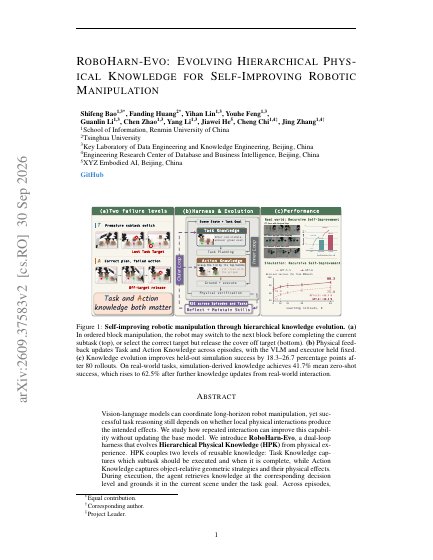
RoboHarn-Evo: Evolving Hierarchical Physical Knowledge for Self-Improving Robotic Manipulation

· Shifeng Bao, Fanding Huang, Yihan Lin, +7 authors · Renmin University of China, Tsinghua University +3

Improves robot manipulation by retrieving and evolving hierarchical task and action knowledge from execution feedback while keeping the base model and executor fixed.

Details & sources
Publication
ArXiv 2026
Institutions
Renmin University of China, Tsinghua University, Key Laboratory of Data Engineering and Knowledge Engineering, Beijing, China, Engineering Research Center of Database and Business Intelligence, Beijing, China, XYZ Embodied AI, Beijing, China
Authors
Shifeng Bao, Fanding Huang, Yihan Lin, Youhe Feng, Guanlin Li, Chen Zhao, Yang Li, Jiawei He, Cheng Chi, Jing Zhang
Mechanism / release notes
Inner-loop retrieval grounds reusable knowledge in the current scene; outer-loop updates correct and consolidate it across episodes. Evaluated on RMBench, frozen-knowledge transfer to RoboDojo, and real-robot tasks. Public code includes the harness, knowledge maintenance, and benchmark adapters; simulator assets, model checkpoints, and services are configured separately.

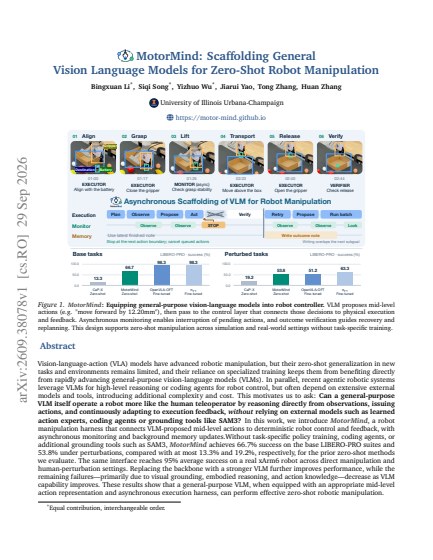
MotorMind: Scaffolding General Vision Language Models for Zero-Shot Robot Manipulation

· Bingxuan Li, Siqi Song, Yizhuo Wu, +3 authors · University of Illinois Urbana-Champaign

Connects VLM-proposed mid-level motions to deterministic robot control, with asynchronous monitoring, outcome verification, and background memory updates for replanning.

Details & sources
Publication
ArXiv 2026
Institutions
University of Illinois Urbana-Champaign
Authors
Bingxuan Li, Siqi Song, Yizhuo Wu, Jiarui Yao, Tong Zhang, Huan Zhang
Mechanism / release notes
Evaluated on LIBERO-PRO and a real xArm6, including disturbances and changing instructions. Uses no task-specific policy training, VLA action expert, or coding agent.

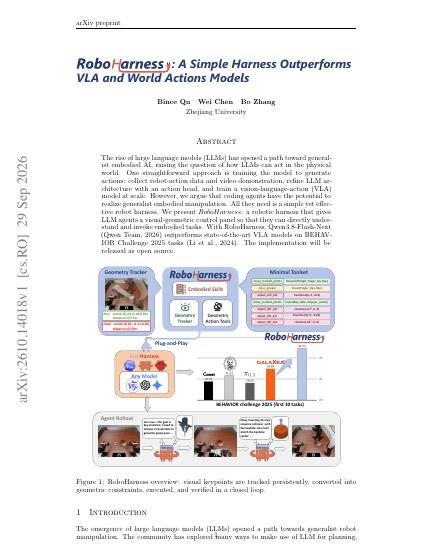
RoboHarness: A Simple Harness Outperforms VLA and World Actions Models

· Bince Qu, Wei Chen, Bo Zhang · Zhejiang University

Connects general-purpose LLMs to visual-geometric control tools, using visual clicks, tracked keypoints, and spatial constraints to execute manipulation without robot-policy training.

Details & sources
Publication
ArXiv 2026
Institutions
Zhejiang University
Authors
Bince Qu, Wei Chen, Bo Zhang
Mechanism / release notes
Evaluated on BEHAVIOR household tasks and object generalization. The paper states that implementation will be released. This Zhejiang University work is distinct from the memory-driven RoboHarness paper listed separately.

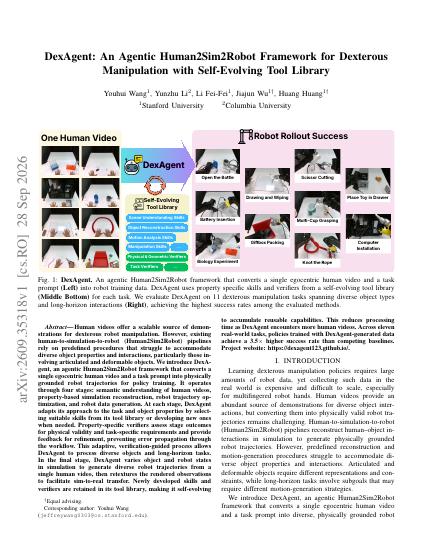
DexAgent: An Agentic Human2Sim2Robot Framework for Dexterous Manipulation with Self-Evolving Tool Library

· Youhui Wang, Yunzhu Li, Li Fei-Fei, +2 authors · Stanford University, Columbia University

Converts an egocentric human video and task prompt into dexterous robot training data through simulation reconstruction, trajectory optimization, and a growing library of skills and verifiers.

Details & sources
Publication
ArXiv 2026
Institutions
Stanford University, Columbia University
Authors
Youhui Wang, Yunzhu Li, Li Fei-Fei, Jiajun Wu, Huang Huang
Mechanism / release notes
Uses property-specific checks for rigid, articulated, and deformable objects, followed by simulation augmentation and retexturing. Policies trained on generated data are evaluated on eleven real-world tasks. Code is listed as forthcoming.

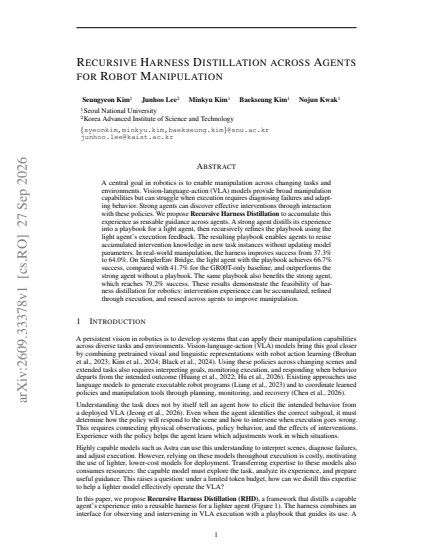
Recursive Harness Distillation across Agents for Robot Manipulation

· Seungyeon Kim, Junhoo Lee, Minkyu Kim, +2 authors · Seoul National University, KAIST

Distills a strong agent’s robot-intervention experience into a playbook for a lighter agent, then refines that guidance from the recipient’s execution feedback.

Details & sources
Publication
ArXiv 2026
Institutions
Seoul National University, KAIST
Authors
Seungyeon Kim, Junhoo Lee, Minkyu Kim, Baekseung Kim, Nojun Kwak
Mechanism / release notes
Agents edit instructions, attention, and proposed actions around a frozen VLA. Evaluated in SimplerEnv Bridge and on a physical Franka Panda without updating model parameters.

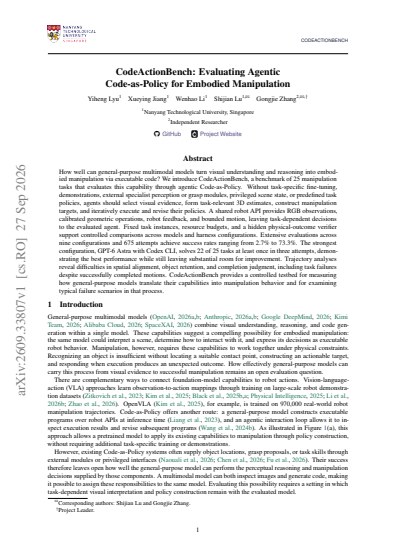
CodeActionBench: Evaluating Agentic Code-as-Policy for Embodied Manipulation

· Yiheng Lyu, Xueying Jiang, Wenhao Li, +2 authors · Nanyang Technological University, Independent Researcher

Evaluates general-purpose multimodal coding agents on 25 manipulation tasks using a shared robot API and hidden physical-outcome checks.

Details & sources
Publication
ArXiv 2026
Institutions
Nanyang Technological University, Independent Researcher
Authors
Yiheng Lyu, Xueying Jiang, Wenhao Li, Shijian Lu, Gongjie Zhang
Mechanism / release notes
Simulation benchmark based on RoboTwin 2.0 and SAPIEN. Agents use RGB observations, calibrated geometry operations, robot feedback, and bounded motion without task-specific fine-tuning, demonstrations, specialist perception, or privileged scene state. The study reports 675 attempts across nine configurations; per-attempt success and tasks solved at least once in three attempts are distinct measures. MIT code is public; the full data release is pending.

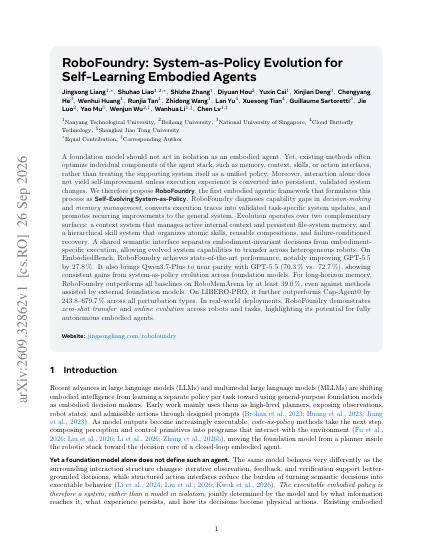
RoboFoundry: System-as-Policy Evolution for Self-Learning Embodied Agents

· Jingsong Liang, Shuhao Liao, Shizhe Zhang, +15 authors · Nanyang Technological University, Beihang University +3

Turns execution traces into validated updates to context, persistent memory, and hierarchical skills, promoting reusable improvements across tasks and robot embodiments.

Details & sources
Publication
ArXiv 2026
Institutions
Nanyang Technological University, Beihang University, National University of Singapore, Cloud Butterfly Technology, Shanghai Jiao Tong University
Authors
Jingsong Liang, Shuhao Liao, Shizhe Zhang, Diyuan Hou, Yuxin Cai, Xinjian Deng, Chengyang He, Wenhui Huang, Runjia Tan, Zhidong Wang, Lan Yu, Xuesong Tian, Guillaume Sartoretti, Jie Luo, Yao Mu, Wenjun Wu, Wanhua Li, Chen Lv
Mechanism / release notes
Evaluated on EmbodiedBench, RoboMemArena, and LIBERO-PRO, with real-robot transfer and online evolution demonstrations. The repository currently provides project materials; benchmark implementations are listed as forthcoming.

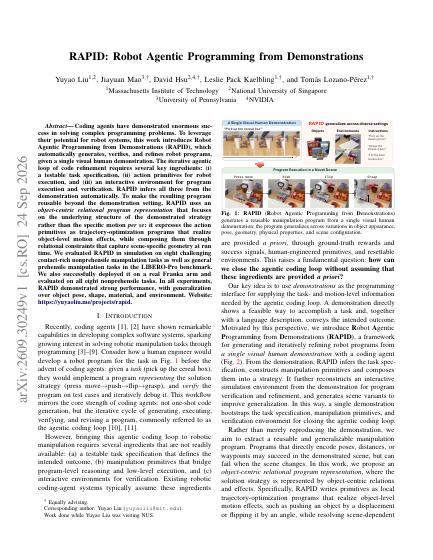
RAPID: Robot Agentic Programming from Demonstrations

· Yuyao Liu, Jiayuan Mao, David Hsu, +2 authors · MIT, National University of Singapore +2

Builds reusable robot programs from a single visual human demonstration, inferring task specifications, manipulation primitives, and a simulation environment for iterative verification and refinement.

Details & sources
Publication
ArXiv 2026
Institutions
MIT, National University of Singapore, University of Pennsylvania, NVIDIA
Authors
Yuyao Liu, Jiayuan Mao, David Hsu, Leslie Pack Kaelbling, Tomás Lozano-Pérez
Mechanism / release notes
Composes trajectory-optimization primitives through object-centric relational constraints that adapt to new scene geometry. Evaluated on eight contact-rich nonprehensile tasks in simulation and on a real Franka arm, plus LIBERO-Pro. The MIT simulation preview includes the FR3 nonprehensile pipeline, demonstrations, reconstructed scenes, and staged construction and evaluation tools. Simulation assets are a separate release download and the Judo-osc runtime is a pinned submodule. The Real2Sim pipeline and reconstruction servers are not included; this preview does not release the complete real-robot workflow.

HarnessPAI: An Evolving Harness for Physical AI

· Xin Wang, Wenhao Wu, Menghao Zhang, +20 authors · Darwin Agent Team

Coordinates perception, action primitives, and execution checks through a fixed task program, then uses feedback between rollouts to revise code and retain reusable repair skills.

Details & sources
Publication
ArXiv 2026
Institutions
Darwin Agent Team
Authors
Xin Wang, Wenhao Wu, Menghao Zhang, Zhi Wang, Kun Shao, Jian Luan, Yang Li, Qing Li, Shangding Gu, Huichi Zhou, Shuqing Shi, Fei Ni, Shuo Lu, Weicheng Meng, Kang Li, Jin Wu, Kang Zhao, Shangmin Guo, Gen Li, Yongqiang Tang, Zhizhong Zhang, Yuan Xie, Heng Qu
Mechanism / release notes
Combines frozen action models or control APIs with sensor-driven checks and predefined recovery, without online high-level LLM deliberation during a rollout. Successful trajectories also support downstream policy fine-tuning. The repository currently provides the paper and project materials; research code is not yet released.

Robo-Harness K1: Harnessing Robot-Use Agents via Perception Augmentation

· Zexi Li, Yehang Zhang, Wenqian Li, +12 authors · The Chinese University of Hong Kong, The Hong Kong University of Science and Technology (Guangzhou) +1

Exposes calibrated depth, visual anchors, spatial measurements, and grasp hypotheses as tools so a VLM can select robot motions from geometric evidence.

Details & sources
Publication
ArXiv 2026
Institutions
The Chinese University of Hong Kong, The Hong Kong University of Science and Technology (Guangzhou), Knowin AI
Authors
Zexi Li, Yehang Zhang, Wenqian Li, Haojian Huang, Chenxu Wang, Shiyuan Deng, Yangkai Wei, Tianyi Zhang, Binghui Xie, Bohan Zhou, Yifan Chang, Kaiwen Zhou, Ying-Cong Chen, James Cheng, Yinchuan Li
Mechanism / release notes
Studies LIBERO-PRO, cross-arm RoboSuite transfer, and dual-arm RoboTwin. The public code supports LIBERO-Pro and RoboSuite; successful tool-use traces also supervise smaller VLMs.

RACaP: Agentic Reasoning, Acting, and Coding as Policies for Evolvable Robot Learning

· Zexi Li, Yehang Zhang, Haojian Huang, +10 authors · The Chinese University of Hong Kong, The Hong Kong University of Science and Technology (Guangzhou) +1

Evolves typed robot Policy APIs, an agent harness, and experience memory before deployment, then uses visual ReAct decisions to call the frozen APIs and recover from failures.

Details & sources
Publication
ArXiv 2026
Institutions
The Chinese University of Hong Kong, The Hong Kong University of Science and Technology (Guangzhou), Knowin AI
Authors
Zexi Li, Yehang Zhang, Haojian Huang, Bohan Zhou, Wenqian Li, Chenxu Wang, Yifan Chang, Yangkai Wei, Tianyi Zhang, Ying-Cong Chen, Kaiwen Zhou, Yinchuan Li, James Cheng
Mechanism / release notes
Simulation evaluation covers LIBERO-90, LIBERO-PRO, and LIBERO-Long. Runtime source code stays fixed. Decision distillation is a separate efficiency study. The source release includes runtime and evolution code; model weights, training datasets, and raw trajectories are excluded.

Coding Agents for Generalized Task and Motion Planning Problems

· Matteo Merler, Bowen Li, Josh Roy, +4 authors · Princeton University, Fondazione Bruno Kessler +2

Uses coding agents to synthesize robot programs through simulator interaction, then freezes the programs and evaluates their generalization to unseen task instances.

Details & sources
Publication
ArXiv 2026
Institutions
Princeton University, Fondazione Bruno Kessler, Carnegie Mellon University, University of Cambridge
Authors
Matteo Merler, Bowen Li, Josh Roy, Yichao Liang, Qianwei Wang, Yixuan Huang, Tom Silver
Mechanism / release notes
AgenticGenPlan evaluates 28 simulated KinDER and PDDLStream environments, including larger object counts. The main strict-black-box condition exposes reset, step, and rendering rather than environment source or injected robotics primitives; source access is a separate condition. MIT experiment code and prompts are released as RoboCode. Frozen evaluation programs run without further LLM calls.

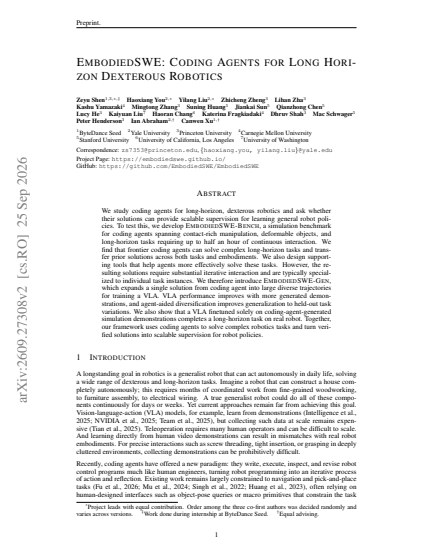
EmbodiedSWE: Coding Agents for Long Horizon Dexterous Robotics

· Zeyu Shen, Haoxiang You, Yilang Liu, +16 authors · ByteDance Seed, Yale University +5

Uses coding agents to solve long-horizon dexterous tasks, then diversifies successful programs into simulation demonstrations for training general robot policies.

Details & sources
Publication
ArXiv 2026
Institutions
ByteDance Seed, Yale University, Princeton University, Carnegie Mellon University, Stanford University, University of California, Los Angeles, University of Washington
Authors
Zeyu Shen, Haoxiang You, Yilang Liu, Zhicheng Zheng, Lihan Zha, Kashu Yamazaki, Mingtong Zhang, Suning Huang, Jiankai Sun, Qianzhong Chen, Lucy He, Kaiyuan Liu, Haoran Chang, Katerina Fragkiadaki, Dhruv Shah, Mac Schwager, Peter Henderson, Ian Abraham, Canwen Xu
Mechanism / release notes
EmbodiedSWE-Gen expands task-instance solutions across scene and behavior variations. Includes simulation-to-real policy transfer; the benchmark and evaluation protocol are listed in Benchmarks.

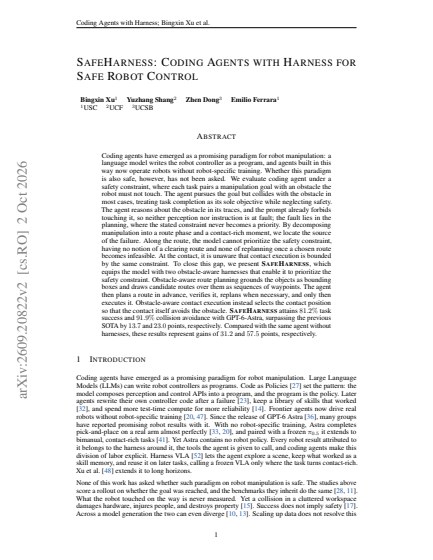
Coding Agents with Harness for Safe Robot Control (SafeHarness)

· Bingxin Xu, Yuzhang Shang, Zhen Dong, +1 author · University of Southern California, University of Central Florida +1

Adds obstacle-aware route planning, verification, replanning, and contact-position selection to coding agents performing robot manipulation under collision constraints.

Details & sources
Publication
ArXiv 2026
Institutions
University of Southern California, University of Central Florida, University of California, Santa Barbara
Authors
Bingxin Xu, Yuzhang Shang, Zhen Dong, Emilio Ferrara
Mechanism / release notes
Reports task success and collision avoidance separately on simulated obstacle-constrained manipulation tasks. These empirical evaluations do not constitute a physical safety guarantee.

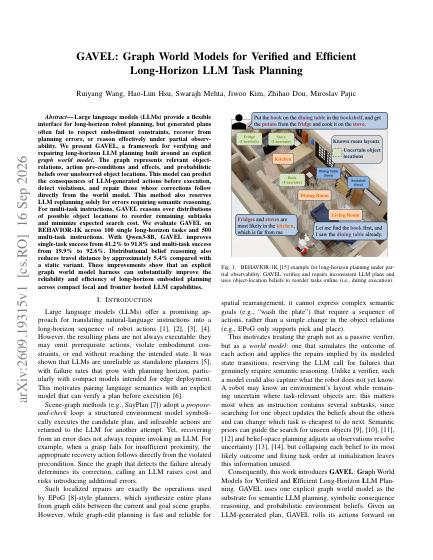
GAVEL: Graph World Models for Verified and Efficient Long-Horizon LLM Task Planning

· Ruiyang Wang, Hao-Lun Hsu, Swarajh Mehta, +3 authors

Uses a graph world model to check action preconditions, repair model-detectable errors locally, and reserve LLM replanning for semantic failures during long-horizon tasks.

Details & sources
Publication
ArXiv 2026
Authors
Ruiyang Wang, Hao-Lun Hsu, Swarajh Mehta, Jiwoo Kim, Zhihao Dou, Miroslav Pajic
Mechanism / release notes
Main evaluation uses a lightweight 2D executor at the symbolic-action level of BEHAVIOR-1K, with 100 single tasks and 500 multi-task instructions. The 100 single-task cases are also replayed in OmniGibson. These results do not establish low-level manipulation or real-robot performance.

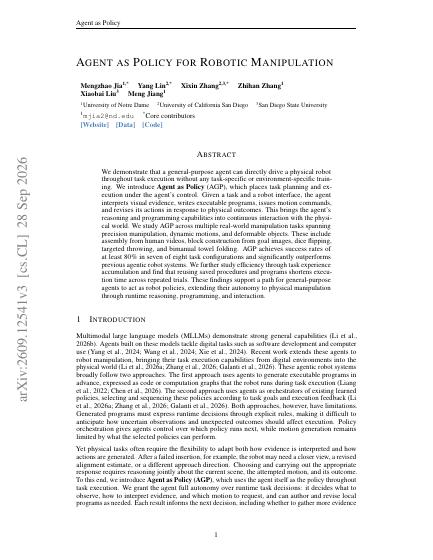
Agent as Policy for Robotic Manipulation (AGP)

· Mengzhao Jia, Yang Lin, Xixin Zhang, +3 authors · University of Notre Dame, University of California San Diego +1

Uses a general-purpose agent as a real-robot policy that interprets visual observations, writes executable programs, commands motions, and adapts to physical feedback with fixed model parameters.

Details & sources
Publication
ArXiv 2026
Institutions
University of Notre Dame, University of California San Diego, San Diego State University
Authors
Mengzhao Jia, Yang Lin, Xixin Zhang, Zhihan Zhang, Xiaobai Liu, Meng Jiang

2AM: Grounding Agent-Side Memory as Guidance for Steerable Action Models in Long-Horizon Manipulation

· Yutong Hu, Fengjiao Chen, Xuezhi Cao, +1 author · KU Leuven, Meituan Inc. +1

Keeps task memory in a high-level agent and steers a stateless action model with language and optional 2D manipulation hints for long-horizon execution.

Details & sources
Publication
ArXiv 2026
Institutions
KU Leuven, Meituan Inc., Flanders Make@KU Leuven
Authors
Yutong Hu, Fengjiao Chen, Xuezhi Cao, Renaud Detry
Mechanism / release notes
Evaluated on ten LIBERO-Mem simulation tasks. The action model is trained with hint dropout and coordinate noise; privileged training labels are not used at deployment. Higher task completion and relaxed success do not imply higher strict success: reported strict success is 11.83%, versus 12.25% for the reproduced baseline.
Show-Harness: Just a VLM Agent Can Play Robots

· Yanzhe Chen, Zechen Bai, Zhijun Cao, +7 authors · National University of Singapore

VLMs select discrete, incremental action units grounded by robot-specific interpreters.

Details & sources
Publication
ArXiv 2026
Institutions
National University of Singapore
Authors
Yanzhe Chen, Zechen Bai, Zhijun Cao, Wenzheng Zeng, Kevin Qinghong Lin, Yiqi Lin, Guoqiang Liang, Kevin Yuchen Ma, Qiming Huang, Mike Zheng Shou
Mechanism / release notes
Includes planning, action-history and recovery plugins, GUMI demonstration collection, and fine-tuning tools. Franka/Piper and simulator adapters require their documented dependencies and site configuration.

PhysicalRSI 1.0: Recursive Self-Harness for Scaling Embodied Skills

· HKU MMLab, Kinetix AI

Rewrites robot-control code, tools, memory, and skills from execution feedback, evaluates candidate agents, and retains improved harnesses.

Details & sources
Institutions
HKU MMLab, Kinetix AI
Mechanism / release notes
HKU MMLab and Kinetix AI present RoboDojo-Sim results and demonstrations of skill reuse and composition.

Lucida: Parse, Generate, and Place for Composable Real-to-Sim Scene Modeling

· Minghan Qin, Yuang Wang, Xiuyu Yang, +6 authors · ByteDance Seed, Peking University +1

Parses indoor video into per-object evidence, generates complete assets, and uses the GizmoAct VLM agent to align them through 3D-editor actions for real-to-sim scene modeling.

Details & sources
Publication
ArXiv 2026
Institutions
ByteDance Seed, Peking University, Zhejiang University
Authors
Minghan Qin, Yuang Wang, Xiuyu Yang, Yushi Long, Yujian Zhang, Ruihuan Wang, Kai Ye, Yangang Zhang, Hang Li
Mechanism / release notes
Assets remain individually editable for robot simulation. GizmoAct uses rendered feedback and a learned stopping decision; evaluations cover scene detection, object poses, and reconstruction on R2S-Scene, CA-1M, and Aria Digital Twin.

Zetta ζ: An Efficient Closed-Loop Embodied Harness for Self-Evolving Physical Intelligence

· Xin Ding, Liang Mi, Mingzhe Huang, +12 authors · AIR, Tsinghua University, Z-Trans AI

Keeps the base policy frozen while developing runtime critics and recovery skills through execution, diagnosis, and gated updates.

Details & sources
Publication
ArXiv 2026
Institutions
AIR, Tsinghua University, Z-Trans AI
Authors
Xin Ding, Liang Mi, Mingzhe Huang, Zixuan Wang, Chao Zhang, Zixu Hao, Fu Chen, Xiangyu Li, Yikai Zheng, Yaoyu Guo, Weijun Wang, Kun Li, Hao Wu, Yunxin Liu, Ting Cao

SHAPER: Self-Evolving Embodied Agents via Skill-Harness Evolution

· Peidong Wang, Zhiming Ma, Ying Chang, +7 authors · Northeastern University, Microsoft Research

Keeps model parameters frozen while evolving reusable skills and a context-code harness from target-environment rollouts.

Details & sources
Publication
ArXiv 2026
Institutions
Northeastern University, Microsoft Research
Authors
Peidong Wang, Zhiming Ma, Ying Chang, Xufang Luo, Yiqun Zhang, Zihan Wang, Xiaocui Yang, Shi Feng, Yuqing Yang, Dongsheng Li
Mechanism / release notes
Evaluated on VLABench and ESI-Bench with different action interfaces. Improves external skills and execution context without model training.

Mimir: A Neuro-Symbolic Memory System with Dynamic Grounding for Embodied Agents in Interactive Environments

· Haoming Xu, Zhenlin He, Hengyi Wang, +2 authors · PrimeBot Research Institute, Peking University +1

Separates world memory from task memory and grounds the active goal in recalled objects, state, and evidence before each action.

Details & sources
Publication
ArXiv 2026
Institutions
PrimeBot Research Institute, Peking University, University of Chinese Academy of Sciences
Authors
Haoming Xu, Zhenlin He, Hengyi Wang, Jiafeng Xu, Hao Dong
Mechanism / release notes
Memory module evaluated in simulation on EB-ALFRED and EB-Habitat.

ETA: A New Agentic Paradigm for Embodied Tasks

· Yitong Chen, Zezheng Huai, Sixian Li, +7 authors · Shanghai Innovation Institute, Fudan University +3

A planner selects one tool call at a time, executes it through a common interface, and uses fresh observations and results to revise plans and retain experience.

Details & sources
Publication
ArXiv 2026
Institutions
Shanghai Innovation Institute, Fudan University, Jilin University, Nanjing University, Zhejiang University
Authors
Yitong Chen, Zezheng Huai, Sixian Li, Yubang Wang, Haozhe Zhang, Yifei Zhang, Hechang Chen, Jingjing Gong, Yu-Gang Jiang, Xipeng Qiu
Mechanism / release notes
OpenETA provides replaceable planners, tools and skills, memory, replayable trajectories, and simulation/real-robot interfaces. Hardware execution requires the corresponding adapter and setup.

Thea — Towards the Harness of Embodied Agents

· Qi Wang, Tianyi Wang, Chengyang Li, +6 authors · Eastern Institute of Technology, Ningbo

Wraps robot capabilities as callable tools, maintains symbolic scene context, and evaluates action termination, success, and failure causes.

Details & sources
Publication
ArXiv 2026
Institutions
Eastern Institute of Technology, Ningbo
Authors
Qi Wang, Tianyi Wang, Chengyang Li, Shikun Ban, Yurun Chen, Yizhong Ge, Jason Qin, Chengtai Li, Wentao Zhu
Mechanism / release notes
Public runtime and interfaces; robot/simulator deployment requires concrete adapters and capabilities.

You Don't Need To Stay in The Loop: An Agentic Robotics Loop for Robot-Policy Improvement (AgenticRobotics)

· Hang Yu · Independent Researcher

An LLM controller coordinates training, evaluation, and policy-improvement workers with recorded tool calls, evidence-gated promotion, and recoverable execution state.

Details & sources
Publication
ArXiv 2026
Institutions
Independent Researcher
Authors
Hang Yu
Mechanism / release notes
Preview report focused on false-promotion control and operational reliability; it does not demonstrate better checkpoint selection than a human on the measured lineage.

Addressing the Orchestration Gap in Generalist Robots via Physical Agency

· Liane Galanti, Dhruv Shah, Tri Dao · Princeton University, Together AI

A closed-loop orchestrator decomposes goals, selects frozen VLA policies or parameterized skills, verifies outcomes from observations, and recovers from failures.

Details & sources
Publication
ArXiv 2026
Institutions
Princeton University, Together AI
Authors
Liane Galanti, Dhruv Shah, Tri Dao
Mechanism / release notes
Evaluated on LIBERO-PRO and real-robot manipulation without additional policy training. Includes simulation and Franka FR3 orchestrators; execution requires separately configured perception, planning, policy servers, and robot interfaces.

RoboHarness: Memory-Driven Orchestration of Heterogeneous Robot Policies for Long-Horizon Planning

· Jinbang Huang, Yuanzhao Hu, Zhiyuan Li, +6 authors · Huawei Noah’s Ark Lab, University of British Columbia +3

Uses execution memory to route among heterogeneous policies and a Memory Bridge to improve handoffs between policies.

Details & sources
Publication
ArXiv 2026
Institutions
Huawei Noah’s Ark Lab, University of British Columbia, University of Toronto, McGill University, Department of Foundation Model, Huawei 2012 Labs
Authors
Jinbang Huang, Yuanzhao Hu, Zhiyuan Li, Ran Qi, Yixin Xiao, Zhanguang Zhang, Mark Coates, Tongtong Cao, Yingxue Zhang

PhyAgentOS: A Self-Evolving Operating System for Embodied Agents with Decoupled Cognitive Planning and Physical Execution

· Yang Liu, Weixing Chen, Xinshuai Song, +8 authors · X-Era Lab, Sun Yat-sen University +1

Separates cognitive planning from physical execution through session state, explicit task verification, and reusable experience.

Details & sources
Publication
ArXiv 2026
Institutions
X-Era Lab, Sun Yat-sen University, Peng Cheng Laboratory
Authors
Yang Liu, Weixing Chen, Xinshuai Song, Tao Pu, Siwen Mo, Yongjie Bai, Zihao Chen, Qianran Sun, Liruo Zhong, Ying Shen, Liang Lin
Mechanism / release notes
The paper describes file-based state views and a SessionVerifier that distinguishes execution termination from task success. The evolving runtime requires separately configured tools and robot or simulator adapters.

RoboTTT: Context Scaling for Robot Policies

· Yunfan Jiang, Yevgen Chebotar, Ruijie Zheng, +8 authors · NVIDIA, Stanford University +1

Uses test-time training fast weights to condition robot policies on long visuomotor histories, supporting adaptation from demonstrations and execution context.

Details & sources
Publication
ArXiv 2026
Institutions
NVIDIA, Stanford University, UT Austin
Authors
Yunfan Jiang, Yevgen Chebotar, Ruijie Zheng, Fengyuan Hu, Yunhao Ge, Jimmy Wu, Tianyuan Dai, Scott Reed, Li Fei-Fei, Yuke Zhu, Linxi "Jim" Fan
Mechanism / release notes
Policy-learning research evaluated on real-robot manipulation tasks.

Exploratory, Communicative, and Deployable: Vision-Driven Embodied Agents for Open-World Mobile Manipulation (REAL)

· Boyu Mi, Mengchen Ma, Yifei Yao, +10 authors · Shanghai Jiao Tong University, Shanghai AI Laboratory +5

Combines RGB-based exploration, MCP robot tools, and interactive intent clarification for open-world mobile manipulation, with a shared interface across simulation and real robots.

Details & sources
Publication
ECCV 2026
Institutions
Shanghai Jiao Tong University, Shanghai AI Laboratory, Southeast University, National University of Singapore, Zhejiang University, CAMEL-AI, University of Oxford
Authors
Boyu Mi, Mengchen Ma, Yifei Yao, Xing Gao, Junting Chen, Yangzi Li, Zihou Zhu, Guohao Li, Zhenfei Yin, Tai Wang, Yao Mu, Jiangmiao Pang, Hanqing Wang
Mechanism / release notes
Trains agents with supervised fine-tuning and online reinforcement learning. REAL-Bench contains 241 tasks spanning visual distractors, articulated manipulation, and user interaction; physical evaluation uses a dual-arm mobile robot.

Harness VLA: Steering Frozen VLAs into Reliable Manipulation Primitives via Memory-Guided Agents

· Yixian Zhang, Huanming Zhang, Feng Gao, +13 authors · Tsinghua University, Striding AI +5

Exposes a frozen VLA as a retryable contact-rich primitive, coordinated with fixed analytic primitives and memory of execution outcomes.

Details & sources
Publication
ArXiv 2026
Institutions
Tsinghua University, Striding AI, Purdue University, Institute of Automation, Chinese Academy of Sciences, Infinigence AI, Hong Kong University of Science and Technology, Zhongguancun Academy
Authors
Yixian Zhang, Huanming Zhang, Feng Gao, Xiao Li, Zhihao Liu, Chunyang Zhu, Jiaxing Qiu, Yuchen Yan, Jiyuan Liu, Wenhao Tang, Zhengru Fang, Yi Nie, Changxu Wei, Yu Wang, Wenbo Ding, Chao Yu
Mechanism / release notes
Evaluated on LIBERO-Pro, RoboCasa365, and RoboTwin C2R without VLA fine-tuning. The paper links to RPent, which provides the runtime and simulator/VLA integrations; deployment requires the relevant models and environment setup.

A Closed-Loop Multi-Agent Framework for Robust Multi-Robot Manipulation

· Yi-Xiang He, Lan Wei, Haoming Cen, +6 authors · Sun Yat-sen University, Key Laboratory of Machine Intelligence and Advanced Computing, Ministry of Education, China +3

Coordinates a task planner, per-robot manipulation agents, and visual verification agents, using local retries or global task reallocation when execution fails.

Details & sources
Publication
RSS 2026
Institutions
Sun Yat-sen University, Key Laboratory of Machine Intelligence and Advanced Computing, Ministry of Education, China, Imperial College London, Tsinghua Shenzhen International Graduate School, Shenzhen Loop Area Institute
Authors
Yi-Xiang He, Lan Wei, Haoming Cen, Jian-Jian Jiang, Zhuohao Li, Guanxing Lu, Yihan Yang, Dandan Zhang, Wei-Shi Zheng
Mechanism / release notes
Evaluated on six real-world tasks across tabletop dual-arm and heterogeneous multi-robot setups. Tabletop comparisons use 20 trials per task; disturbance experiments use ten. Task completion, failure identification, replanning, and final task success are separate metrics; successful replanning does not guarantee physical recovery.

GaP: A Graph-as-Policy Multi-Agent Self-Learning Harness For Variational Automation Tasks

· Kaiyuan Chen, Shuangyu Xie, Letian Fu, +21 authors · UC Berkeley, NVIDIA +2

Compiles language instructions into executable graphs of modular robot skills, then uses simulation feedback to localize failures and refine the graph.

Details & sources
Publication
ArXiv 2026
Institutions
UC Berkeley, NVIDIA, Carnegie Mellon University, Bosch
Authors
Kaiyuan Chen, Shuangyu Xie, Letian Fu, Justin Yu, William Pacini, Sandeep Bajamahal, Hudson Kim, Jaimyn Drake, Daehwa Kim, Haoru Xue, Jonathan Francis, Christian Juette, Peter Schaldenbrand, Muhammet Yunus Seker, Ruwan Wickramarachchi, Uksang Yoo, Guanzhi Wang, Adithyavairavan Murali, Balakumar Sundaralingam, S. Shankar Sastry, Spencer Huang, Yuke Zhu, Linxi "Jim" Fan, Ken Goldberg
Mechanism / release notes
Targets repeated task instances with varying object geometry and poses in a known workcell. Beta code includes graph generation, execution, and robot examples; deployment requires skill dependencies, calibrated sensors, and robot-specific connections.

ASPIRE: Agentic /Skills Discovery for Robotics

· Runyu Lu, Yubo Wu, Ethan Kou, +11 authors · NVIDIA, University of Michigan +3

Refines code-as-policy programs using multimodal execution traces, failure diagnosis, repair validation, a reusable skill library, and evolutionary search.

Details & sources
Institutions
NVIDIA, University of Michigan, University of Illinois Urbana-Champaign, UC Berkeley, Carnegie Mellon University
Authors
Runyu Lu, Yubo Wu, Ethan Kou, Letian Fu, Wenli Xiao, Ajay Mandlekar, Yinzhen Xu, Guanya Shi, Ken Goldberg, Ang Chen, Mosharaf Chowdhury, Yuke Zhu, Linxi "Jim" Fan, Guanzhi Wang
Mechanism / release notes
Provides simulation workflows and real-robot transfer code. Behaviors remain bounded by predefined perception, planning, and control primitives; real-world deployment requires success detection, resets, safety monitoring, and calibration.

ENPIRE: Agentic Robot Policy Self-Improvement in the Real World

· Wenli Xiao, Jia Xie, Tonghe Zhang, +14 authors · NVIDIA, Carnegie Mellon University +1

Connects scene reset, policy execution, outcome verification, and experiment refinement so coding agents can improve policies through physical trials.

Details & sources
Institutions
NVIDIA, Carnegie Mellon University, UC Berkeley
Authors
Wenli Xiao, Jia Xie, Tonghe Zhang, Haotian Lin, Letian "Max" Fu, Haoru Xue, Jalen Lu, Yi Yang, Cunxi Dai, Zi Wang, Jimmy Wu, Guanzhi Wang, S. Shankar Sastry, Ken Goldberg, Linxi "Jim" Fan, Yuke Zhu, Guanya Shi
Mechanism / release notes
Deployment requires calibrated stations and task-specific reset and verification functions.

Playful Agentic Robot Learning

· Junyi Zhang, Jiaxin Ge, Hanjun Yoo, +17 authors · UC Berkeley, Impossible Research

Proposes its own practice tasks, writes and executes robot code, diagnoses failures, and distills successful behavior into reusable skills before downstream tasks arrive.

Details & sources
Publication
ArXiv 2026
Institutions
UC Berkeley, Impossible Research
Authors
Junyi Zhang, Jiaxin Ge, Hanjun Yoo, Letian Fu, Zihan Yang, Yaowei Liu, Raj Saravanan, Shaofeng Yin, Justin Yu, Dantong Niu, Zirui Wang, Roei Herzig, Ken Goldberg, Yutong Bai, David M. Chan, Ion Stoica, Angjoo Kanazawa, Jiahui Lei, Haiwen Feng, Trevor Darrell
Mechanism / release notes
Evaluates a frozen skill library on held-out LIBERO-PRO and MolmoSpaces tasks, with transfer to RoboSuite and real robots without model fine-tuning. The repository includes play/evaluation workflows and skill libraries; execution requires the documented simulator or hardware setup.

Guava: An Effective and Universal Harness for Embodied Manipulation

· Haowen Liu, Xirui Li, Shaoxiong Yao, +5 authors · University of Maryland, University of Illinois Urbana-Champaign +4

Studies iterative perception–reasoning–action, semantic action abstractions, and multimodal observations; also describes distillation into a smaller agent model.

Details & sources
Publication
ArXiv 2026
Institutions
University of Maryland, University of Illinois Urbana-Champaign, University of Waterloo, Mohamed bin Zayed University of Artificial Intelligence, University of Pennsylvania, Amazon
Authors
Haowen Liu, Xirui Li, Shaoxiong Yao, Peng Shi, Tianyi Zhou, Jia-Bin Huang, Furong Huang, Jiayuan Mao

RHO: Your Coding Agent is Secretly a Roboticist

· Karim Elmaaroufi, Justin Svegliato, Sarunas Kalade, +3 authors · University of California, Berkeley, Embodied Science +1

Uses tool-enabled coding agents and execution feedback to search multi-file robot policy repositories offline, then deploys the selected code or optimized agent harness.

Details & sources
Publication
ArXiv 2026
Institutions
University of California, Berkeley, Embodied Science, AMD
Authors
Karim Elmaaroufi, Justin Svegliato, Sarunas Kalade, Graham Schelle, Sanjit A. Seshia, Matei Zaharia
Mechanism / release notes
Evaluated in simulation on LIBERO-PRO, Robosuite, and RAI O3DE. Code-only deployment and an LLM-in-the-loop harness are separate configurations. The project links to the BSD-3-Clause HELIX evolution engine; that general engine release does not by itself establish availability of the complete robot experiment assets.

SpatialClaw: Rethinking Action Interface for Agentic Spatial Reasoning

· Seokju Cho, Ryo Hachiuma, Abhishek Badki, +8 authors · NVIDIA, KAIST

Uses a VLM to write iterative Python cells in a persistent kernel, combining perception and geometry tools with intermediate visual feedback for spatial reasoning.

Details & sources
Publication
NeurIPS 2026
Institutions
NVIDIA, KAIST
Authors
Seokju Cho, Ryo Hachiuma, Abhishek Badki, Hang Su, Byung-Kwan Lee, Chan Hee Song, Sifei Liu, Subhashree Radhakrishnan, Seungryong Kim, Yu-Chiang Frank Wang, Min-Hung Chen
Mechanism / release notes
Evaluated on 20 image, multi-view, and video reasoning benchmarks. Supports spatial understanding for embodied agents; the reported experiments evaluate question answering rather than robot execution. Setup requires Linux, NVIDIA GPUs, perception-model weights, and a local or hosted VLM. Code is released under the NVIDIA non-commercial license.

What Matters in Orchestrating Robot Policies: A Systematic Study of Hierarchical VLA Agents

· Jiaheng Hu, Mohit Shridhar, Caden Lu, +4 authors · Google DeepMind

Studies high-level VLM planners and low-level VLA controllers, including subgoal switching, observation representation, and planner memory.

Details & sources
Publication
ArXiv 2026
Institutions
Google DeepMind
Authors
Jiaheng Hu, Mohit Shridhar, Caden Lu, Dhruv Shah, Hao-Tien Lewis Chiang, Jie Tan, Annie Xie
Mechanism / release notes
Compares hierarchy design choices in simulation and on an ALOHA robot. This is a study of policy orchestration.

HARBOR: A Harness Framework for Agentic Robot Reinforcement Learning

· Zechu Li, Yufeng Jin, Xiaoyang Liu, +4 authors · TU Darmstadt, Honda Research Institute Europe +5

Automates robot reinforcement-learning workflows through specialized agents, persistent artifacts, executable stage gates, and experience-driven parallel trials.

Details & sources
Publication
ArXiv 2026
Institutions
TU Darmstadt, Honda Research Institute Europe, Columbia University, Tongji University, Shanghai Research Institute for Intelligent Autonomous Systems, University of Würzburg, Hessian.AI
Authors
Zechu Li, Yufeng Jin, Xiaoyang Liu, Puze Liu, Vignesh Prasad, Carlo D'Eramo, Georgia Chalvatzaki
Mechanism / release notes
Covers simulator setup, task construction, reward design, algorithm integration, and training. The paper evaluates six benchmarks and 16 tasks across manipulation, locomotion, and bimanual dexterity, with sim-to-real validation. The Apache-2.0 release is a Claude Code plugin for simulation RL engineering; simulator dependencies, compute, and hardware deployment are separate requirements.

PerceptTwin: Semantic Scene Reconstruction for Iterative LLM Planning and Verification

· Charlie Gauthier, Sacha Morin, Liam Paull · Université de Montréal, Mila - Quebec AI Institute

Reconstructs interactive scenes from semantic maps so skill preconditions and an LLM judge can provide feedback for iterative robot-plan refinement before execution.

Details & sources
Publication
ICRA 2026
Institutions
Université de Montréal, Mila - Quebec AI Institute
Authors
Charlie Gauthier, Sacha Morin, Liam Paull
Mechanism / release notes
Evaluates scene reconstruction and plan verification in simulation, including scenes reconstructed from real observations; this is not a real-robot deployment evaluation. State-changing skills on generated assets update textual state without corresponding visual changes. LLM-judge feedback is not a formal safety guarantee.

Enabling Extensible Embodied Capabilities with Tools

· Xueyang Zhou, Zijia Wang, Qianjiang Li, +7 authors · Huazhong University of Science and Technology, Tsinghua University

Externalizes embodied capabilities as callable tools through the Embodied Tool Protocol (ETP), with EmbodiedToolBench evaluating tool-need recognition, selection, execution, and composition.

Details & sources
Publication
ArXiv 2026
Institutions
Huazhong University of Science and Technology, Tsinghua University
Authors
Xueyang Zhou, Zijia Wang, Qianjiang Li, Yibo Hu, Guiyao Tie, Li Wan, Yidan Liu, Pan Zhou, Lichao Sun, Yongchao Chen
Mechanism / release notes
Describes 100+ validated tools spanning perception, cognition, reasoning, and execution, evaluated in simulation and on real robots. Reported benefits are stronger for perception and cognition than fine-grained execution.

EmbodiSkill: Skill-Aware Reflection for Self-Evolving Embodied Agents

· Ruofei Ju, Xinrui Wang, Xin Ding, +12 authors · Nanjing University, Huazhong University of Science and Technology +3

Reflects on execution trajectories to distinguish defective skills from execution lapses, then revises skill content or reinforces valid guidance.

Details & sources
Publication
ArXiv 2026
Institutions
Nanjing University, Huazhong University of Science and Technology, University of Science and Technology of China, Microsoft Research, AIR, Tsinghua University
Authors
Ruofei Ju, Xinrui Wang, Xin Ding, Yifan Yang, Hao Wu, Shiqi Jiang, Qianxi Zhang, Hao Wen, Xiangyu Li, Weijun Wang, Kun Li, Yunxin Liu, Haipeng Dai, Wei Wang, Ting Cao
Mechanism / release notes
Training-free skill evolution with a frozen executor, evaluated on ALFWorld and EmbodiedBench. The released implementation targets these simulated environments.

Learning while Deploying: Fleet-Scale Reinforcement Learning for Generalist Robot Policies (LWD)

· Yi Wang, Xinchen Li, Pengwei Xie, +13 authors · Shanghai Innovation Institute, AGIBOT Finch +1

Improves generalist robot policies using fleet-scale deployment experience, offline–online reinforcement learning, and human interventions.

Details & sources
Publication
ArXiv 2026
Institutions
Shanghai Innovation Institute, AGIBOT Finch, Columbia University
Authors
Yi Wang, Xinchen Li, Pengwei Xie, Pu Yang, Buqing Nie, Yunuo Cai, Qinglin Zhang, Chendi Qu, Jeffrey Wu, Jianheng Song, Xinlin Ren, Jingshun Huang, Mingjie Pan, Siyuan Feng, Zhi Chen, Jianlan Luo
Mechanism / release notes
Supporting policy-learning research evaluated with 16 dual-arm robots across eight tasks. Human interventions remain part of the learning workflow.

Robot Planning and Situation Handling with Active Perception

· Austine Oloo, Zainab Altaweel, Yohei Hayamizu, +9 authors · SUNY Binghamton, Carnegie Mellon University +2

VAP-TAMP combines VLM-guided active view selection and situation assessment with scene graphs and task-and-motion planning to handle execution-time disruptions.

Details & sources
Publication
IROS 2026
Institutions
SUNY Binghamton, Carnegie Mellon University, Ford Research, Agility Robotics
Authors
Austine Oloo, Zainab Altaweel, Yohei Hayamizu, Peiqi Liu, Yan Ding, Saeid Amiri, Hao Yang, Andy Kaminski, Chad Esselink, Chris Paxton, Xiaohan Zhang, Shiqi Zhang
Mechanism / release notes
Evaluated on service tasks in simulation and on a mobile manipulation platform.

CaP-X: A Framework for Benchmarking and Improving Coding Agents for Robot Manipulation

· Letian Fu, Justin Yu, Karim El-Refai, +13 authors · NVIDIA, UC Berkeley +2

Studies embodied coding agents through CaP-Gym, CaP-Bench, CaP-Agent0, and CaP-RL, including execution feedback and skill synthesis.

Details & sources
Publication
ICML 2026 · ⭐
Institutions
NVIDIA, UC Berkeley, Stanford University, Carnegie Mellon University
Authors
Letian Fu, Justin Yu, Karim El-Refai, Ethan Kou, Haoru Xue, Huang Huang, Wenli Xiao, Guanzhi Wang, Dantong Niu, Fei-Fei Li, Guanya Shi, Jiajun Wu, Shankar Sastry, Yuke Zhu, Ken Goldberg, Linxi "Jim" Fan

RoboClaw: An Agentic Framework for Scalable Long-Horizon Robotic Tasks

· Ruiying Li, Yunlang Zhou, YuYao Zhu, +15 authors · AgiBot, National University of Singapore +1

A VLM controller coordinates data collection, policy learning, and long-horizon execution; forward and inverse action pairs enable self-resetting collection.

Details & sources
Publication
ArXiv 2026
Institutions
AgiBot, National University of Singapore, Shanghai Jiao Tong University
Authors
Ruiying Li, Yunlang Zhou, YuYao Zhu, Kylin Chen, Jingyuan Wang, Sukai Wang, Kongtao Hu, Minhui Yu, Bowen Jiang, Zhan Su, Jiayao Ma, Xin He, Yongjian Shen, Yang Yang, Guanghui Ren, Maoqing Yao, Wenhao Wang, Yao Mu
Mechanism / release notes
Real-robot manipulation evaluations connect learned policy primitives with high-level planning and recovery. Hardware, policies, and reset behaviors require the corresponding setup.

From Language to Action: Can LLM-Based Agents Be Used for Embodied Robot Cognition?

· Shinas Shaji, Fabian Huppertz, Alex Mitrevski, +1 author · Hochschule Bonn-Rhein-Sieg, Chalmers University of Technology +1

Connects LLM reasoning to perception, navigation, grasping, and placement tools, with working context and retrieved episodic memory for household manipulation.

Details & sources
Publication
ICRA 2026
Institutions
Hochschule Bonn-Rhein-Sieg, Chalmers University of Technology, Fraunhofer Institute for Intelligent Analysis and Information Systems
Authors
Shinas Shaji, Fabian Huppertz, Alex Mitrevski, Sebastian Houben
Mechanism / release notes
Evaluated on two household tasks in simulation with text-based scene observations and simplified grasping by object attachment. Memory has mixed effects, and model-reported success can disagree with actual task outcomes. The study exposes limitations of reasoning and experience reuse rather than demonstrating general robot cognition.

Agentic Self-Evolutionary Replanning for Embodied Navigation (SERP)

· Guoliang Li, Ruihua Han, Chengyang Li, +5 authors · University of Macau, Shenzhen Institute of Advanced Technology, Chinese Academy of Sciences +3

Combines online action-model adaptation with LLM-guided graph-based replanning to respond to navigation failures and changing conditions.

Details & sources
Publication
ArXiv 2026
Institutions
University of Macau, Shenzhen Institute of Advanced Technology, Chinese Academy of Sciences, University of Hong Kong, Fudan University, Southern University of Science and Technology
Authors
Guoliang Li, Ruihua Han, Chengyang Li, He Li, Shuai Wang, Wenchao Ding, Hong Zhang, Chengzhong Xu
Mechanism / release notes
Evaluated in simulation and real navigation environments. Adaptation uses in-context learning and automatic differentiation.

VLAW: Iterative Co-Improvement of Vision-Language-Action Policy and World Model

· Yanjiang Guo, Tony Lee, Lucy Xiaoyang Shi, +3 authors · Stanford University, Tsinghua University

Uses real rollouts to improve an action-conditioned world model, then synthetic rollouts to improve the VLA policy in an iterative loop.

Details & sources
Publication
ArXiv 2026
Institutions
Stanford University, Tsinghua University
Authors
Yanjiang Guo, Tony Lee, Lucy Xiaoyang Shi, Jianyu Chen, Percy Liang, Chelsea Finn
Mechanism / release notes
Supporting policy-learning research with real-robot evaluation. The released Ctrl-World code covers the world-model post-training component of VLAW.

ALRM: Agentic LLM for Robotic Manipulation

· Vitor Gaboardi dos Santos, Ibrahim Khadraoui, Ibrahim Farhat, +3 authors · Technology Innovation Institute, Dublin City University

Pairs a ReAct task planner with either generated Python code or iterative tool calls, comparing two execution interfaces for language-conditioned robot manipulation.

Details & sources
Publication
ArXiv 2026
Institutions
Technology Innovation Institute, Dublin City University
Authors
Vitor Gaboardi dos Santos, Ibrahim Khadraoui, Ibrahim Farhat, Hamza Yous, Samy Teffahi, Hakim Hacid
Mechanism / release notes
Main evaluation uses placeholder perception poses and format-checked motion APIs, with LLM judges scoring generated action sequences; reference solutions are validated in Gazebo. Scores are not physical execution success rates. The abstract reports 56 tasks, while Section IV and the project page describe 54 instruction variants. The project-linked code repository returned HTTP 404 when checked on 2026-10-11.

SceneAgent: 3D Capture-Derived Scenes with Predictive Physics for Policy Evaluation and Training Environments

· Luke Hollis, Tianxing Fan, Heng Yang · Harvard University

Uses agents to turn 3D captures into simulation scenes with estimated physics, articulated objects, and object variations for robot-policy training and evaluation.

Details & sources
Publication
Preprint 2026
Institutions
Harvard University
Authors
Luke Hollis, Tianxing Fan, Heng Yang
Mechanism / release notes
Supports 3D Gaussian Splatting, photogrammetry, and LiDAR inputs, with VLM review of scene conversion. Generates simulation demonstrations for VLA fine-tuning; real-world evaluation is ongoing. The paper, code, and processed scenes are listed as forthcoming.

A Survey on Agentic Multimodal Large Language Models

· Huanjin Yao, Ruifei Zhang, Jiaxing Huang, +8 authors · Nanyang Technological University, Chinese University of Hong Kong, Shenzhen +4

Broader multimodal-agent survey covering reasoning, reflection, memory, tool invocation, and interaction with physical environments, including embodied AI applications.

Details & sources
Publication
ArXiv 2025
Institutions
Nanyang Technological University, Chinese University of Hong Kong, Shenzhen, Shenzhen Research Institute of Big Data, Sun Yat-sen University, City University of Hong Kong, Communication University of China
Authors
Huanjin Yao, Ruifei Zhang, Jiaxing Huang, Jingyi Zhang, Yibo Wang, Bo Fang, Ruolin Zhu, Yongcheng Jing, Shunyu Liu, Guanbin Li, Dacheng Tao

Self-Improving Embodied Foundation Models

· Seyed Kamyar Seyed Ghasemipour, Ayzaan Wahid, Jonathan Tompson, +2 authors · Google DeepMind

Combines demonstration learning, learned success and progress estimates, and autonomous reinforcement-learning practice to improve robot policies.

Details & sources
Publication
NeurIPS 2025
Institutions
Google DeepMind
Authors
Seyed Kamyar Seyed Ghasemipour, Ayzaan Wahid, Jonathan Tompson, Pannag Sanketi, Igor Mordatch
Mechanism / release notes
Policy training and reward-learning research evaluated in simulation and on real robots.

Towards Embodied Agentic AI: Review and Classification of LLM- and VLM-Driven Robot Autonomy and Interaction

· Sahar Salimpour, Lei Fu, Kajetan Rachwał, +8 authors · University of Turku, Zurich University of Applied Sciences +4

Classifies how LLM/VLM agents integrate with robot APIs, ROS middleware, and orchestration frameworks; covers planning, tool calling, agent roles, and practical robotics toolkits.

Details & sources
Publication
ArXiv 2025
Institutions
University of Turku, Zurich University of Applied Sciences, ETH Zürich, Robotec.ai, Binabik.ai, Warsaw University of Technology
Authors
Sahar Salimpour, Lei Fu, Kajetan Rachwał, Pascal Bertrand, Kevin O'Sullivan, Robert Jakob, Farhad Keramat, Leonardo Militano, Giovanni Toffetti, Harry Edelman, Jorge Peña Queralta

RoboCerebra: A Large-scale Benchmark for Long-horizon Robotic Manipulation Evaluation

· Songhao Han, Boxiang Qiu, Yue Liao, +4 authors · Beihang University, National University of Singapore +1

Long-horizon simulation demonstrations with subtask annotations, disturbances, and memory-dependent tasks.

Details & sources
Publication
NeurIPS 2025
Institutions
Beihang University, National University of Singapore, Shanghai Jiao Tong University
Authors
Songhao Han, Boxiang Qiu, Yue Liao, Siyuan Huang, Chen Gao, Shuicheng Yan, Si Liu
Mechanism / release notes
Supports hierarchical planning and execution evaluation; not a dedicated tool-call trace dataset.

Agentic Robot: A Brain-Inspired Framework for Vision-Language-Action Models in Embodied Agents

· Zhejian Yang, Yongchao Chen, Xueyang Zhou, +8 authors · Jilin University, Harvard University +5

Orchestrates a reasoning planner, a VLA executor, and a temporal visual verifier that chooses continuation or recovery during sequential manipulation.

Details & sources
Publication
ArXiv 2025
Institutions
Jilin University, Harvard University, MIT, Huazhong University of Science and Technology, Southern University of Science and Technology, Lehigh University, Shanghai Jiao Tong University
Authors
Zhejian Yang, Yongchao Chen, Xueyang Zhou, Jiangyue Yan, Dingjie Song, Yinuo Liu, Yuting Li, Yu Zhang, Pan Zhou, Hechang Chen, Lichao Sun
Mechanism / release notes
Evaluated on four LIBERO simulation suites. The verifier is LoRA-fine-tuned on approximately 500 annotated examples, and the executor uses fine-tuned OpenVLA checkpoints. The released example uses a hard-coded plan after one planner call; running arbitrary tasks requires further planner integration, as noted in the repository README.

Hi Robot: Open-Ended Instruction Following with Hierarchical Vision-Language-Action Models

· Lucy Xiaoyang Shi, Brian Ichter, Michael Equi, +12 authors · Physical Intelligence, Stanford University +1

A high-level VLM interprets complex instructions and situated user feedback, while a low-level VLA executes the selected subtask.

Details & sources
Publication
ICML 2025
Institutions
Physical Intelligence, Stanford University, UC Berkeley
Authors
Lucy Xiaoyang Shi, Brian Ichter, Michael Equi, Liyiming Ke, Karl Pertsch, Quan Vuong, James Tanner, Anna Walling, Haohuan Wang, Niccolo Fusai, Adrian Li-Bell, Danny Driess, Lachy Groom, Sergey Levine, Chelsea Finn
Mechanism / release notes
Demonstrated on single-arm, dual-arm, and mobile dual-arm platforms.

EmbodiedBench: Comprehensive Benchmarking Multi-modal Large Language Models for Vision-Driven Embodied Agents

· Rui Yang, Hanyang Chen, Junyu Zhang, +10 authors · University of Illinois Urbana-Champaign, Northwestern University +2

Vision-driven embodied-agent evaluation; see the benchmark catalogue .

Details & sources
Publication
ICML 2025
Institutions
University of Illinois Urbana-Champaign, Northwestern University, University of Toronto, Toyota Technological Institute at Chicago
Authors
Rui Yang, Hanyang Chen, Junyu Zhang, Mark Zhao, Cheng Qian, Kangrui Wang, Qineng Wang, Teja Venkat Koripella, Marziyeh Movahedi, Manling Li, Heng Ji, Huan Zhang, Tong Zhang

VR-Robo: A Real-to-Sim-to-Real Framework for Visual Robot Navigation and Locomotion

· Shaoting Zhu, Linzhan Mou, Derun Li, +3 authors · Tsinghua University, Shanghai Qi Zhi Institute +2

Builds digital twins with 3D Gaussian Splatting and physical meshes to train visual navigation and locomotion policies for real-world transfer.

Details & sources
Publication
RA-L 2025
Institutions
Tsinghua University, Shanghai Qi Zhi Institute, Galaxea AI, Shanghai Jiao Tong University
Authors
Shaoting Zhu, Linzhan Mou, Derun Li, Baijun Ye, Runhan Huang, Hang Zhao
Mechanism / release notes
Uses reconstructed scenes in Isaac Sim for RGB-based goal tracking on a quadruped. The release includes scene reconstruction, a Gaussian renderer, Isaac Lab policy training, and a pretrained Go2 checkpoint.

Code-as-Monitor: Constraint-aware Visual Programming for Reactive and Proactive Robotic Failure Detection

· Enshen Zhou, Qi Su, Cheng Chi, +5 authors · Beihang University, Peking University +2

Generates visual monitoring code to evaluate spatio-temporal constraints, detecting failures after they occur and anticipating constraint violations.

Details & sources
Publication
CVPR 2025
Institutions
Beihang University, Peking University, Beijing Academy of Artificial Intelligence, Galbot
Authors
Enshen Zhou, Qi Su, Cheng Chi, Zhizheng Zhang, Zhongyuan Wang, Tiejun Huang, Lu Sheng, He Wang
Mechanism / release notes
Execution-monitoring module that can close the loop around an existing policy; evaluated in simulation and a real-world setting.

EMOS: Embodiment-aware Heterogeneous Multi-robot Operating System with LLM Agents

· Junting Chen, Checheng Yu, Xunzhe Zhou, +7 authors · National University of Singapore, University of Hong Kong +6

LLM agents read URDF descriptions and call kinematics tools to build robot capability profiles, then coordinate heterogeneous robots for planning and execution.

Details & sources
Publication
ICLR 2025
Institutions
National University of Singapore, University of Hong Kong, Shanghai AI Laboratory, KAUST, University of Oxford, Tsinghua University, Nanjing University, Fudan University
Authors
Junting Chen, Checheng Yu, Xunzhe Zhou, Tianqi Xu, Yao Mu, Mengkang Hu, Wenqi Shao, Yikai Wang, Guohao Li, Lin Shao
Mechanism / release notes
Includes Habitat-MAS for embodiment-aware multi-robot reasoning. Evaluations use simulated manipulation, perception, navigation, and rearrangement tasks.

Embodied Agent Interface: Benchmarking LLMs for Embodied Decision Making

· Manling Li, Shiyu Zhao, Qineng Wang, +12 authors · Stanford University, Northwestern University +2

Evaluation of embodied decision-making modules; see the benchmark catalogue .

Details & sources
Publication
NeurIPS D&B 2024
Institutions
Stanford University, Northwestern University, Amazon, MIT
Authors
Manling Li, Shiyu Zhao, Qineng Wang, Kangrui Wang, Yu Zhou, Sanjana Srivastava, Cem Gokmen, Tony Lee, Li Erran Li, Ruohan Zhang, Weiyu Liu, Percy Liang, Li Fei-Fei, Jiayuan Mao, Jiajun Wu

AHA: A Vision-Language-Model for Detecting and Reasoning Over Failures in Robotic Manipulation

· Jiafei Duan, Wilbert Pumacay, Nishanth Kumar, +7 authors · NVIDIA, University of Washington +4

Produces natural-language failure diagnoses that can refine rewards, task plans, and subtask verification in robot manipulation systems.

Details & sources
Publication
ICLR 2025
Institutions
NVIDIA, University of Washington, Universidad Católica San Pablo, MIT, Nanyang Technological University, Allen Institute for AI
Authors
Jiafei Duan, Wilbert Pumacay, Nishanth Kumar, Yi Ru Wang, Shulin Tian, Wentao Yuan, Ranjay Krishna, Dieter Fox, Ajay Mandlekar, Yijie Guo
Mechanism / release notes
Failure-reasoning component using FailGen-generated simulation failure data, with integrations into three manipulation frameworks.

ReKep: Spatio-Temporal Reasoning of Relational Keypoint Constraints for Robotic Manipulation

· Wenlong Huang, Chen Wang, Yunzhu Li, +2 authors · Stanford University, Columbia University

Converts language instructions and RGB-D observations into Python functions over 3D keypoints; hierarchical optimization solves end-effector actions in a perception-action loop.

Details & sources
Publication
CoRL 2024
Institutions
Stanford University, Columbia University
Authors
Wenlong Huang, Chen Wang, Yunzhu Li, Ruohan Zhang, Li Fei-Fei
Mechanism / release notes
The paper demonstrates mobile single-arm and stationary dual-arm systems. The released code includes constraint generation and simulation execution; hardware use requires its own integration.

A Survey on Integration of Large Language Models with Intelligent Robots

· Yeseung Kim, Dohyun Kim, Jieun Choi, +3 authors · KAIST

LLM integration across communication, perception, planning, and control.

Details & sources
Institutions
KAIST
Authors
Yeseung Kim, Dohyun Kim, Jieun Choi, Jisang Park, Nayoung Oh, Daehyung Park

RialTo: Reconciling Reality through Simulation: A Real-to-Sim-to-Real Approach for Robust Manipulation

· Marcel Torne, Anthony Simeonov, Zechu Li, +4 authors · Massachusetts Institute of Technology, University of Washington +1

Improves imitation-learned manipulation policies through reinforcement learning in digital twins reconstructed from the target real-world environment.

Details & sources
Publication
RSS 2024
Institutions
Massachusetts Institute of Technology, University of Washington, TU Darmstadt
Authors
Marcel Torne, Anthony Simeonov, Zechu Li, April Chan, Tao Chen, Abhishek Gupta, Pulkit Agrawal
Mechanism / release notes
Transfers real demonstrations into simulation through inverse distillation, then distills the improved policy for deployment. Supports recovery from object-pose changes, visual distractors, and physical disturbances. Includes a scene-building GUI.
Eureka: Human-Level Reward Design via Coding Large Language Models

· Yecheng Jason Ma, William Liang, Guanzhi Wang, +6 authors · NVIDIA, University of Pennsylvania +2

Uses an LLM to generate reward code from environment source and task descriptions, then iteratively improves rewards using reinforcement-learning results and reflection.

Details & sources
Publication
ICLR 2024
Institutions
NVIDIA, University of Pennsylvania, Caltech, UT Austin
Authors
Yecheng Jason Ma, William Liang, Guanzhi Wang, De-An Huang, Osbert Bastani, Dinesh Jayaraman, Yuke Zhu, Linxi Fan, Anima Anandkumar
Mechanism / release notes
Evaluated on 29 simulated tasks spanning 10 robot morphologies, including dexterous pen spinning. Supports human feedback for reward refinement; released code uses Isaac Gym and includes a pen-spinning policy checkpoint.

VoxPoser: Composable 3D Value Maps for Robotic Manipulation with Language Models

· Wenlong Huang, Chen Wang, Ruohan Zhang, +3 authors · Stanford University, University of Illinois Urbana-Champaign

Uses generated code and visual grounding to construct 3D value maps for motion planning; the generated program can be reevaluated with visual feedback.

Details & sources
Publication
CoRL 2023
Institutions
Stanford University, University of Illinois Urbana-Champaign
Authors
Wenlong Huang, Chen Wang, Ruohan Zhang, Yunzhu Li, Jiajun Wu, Li Fei-Fei
Mechanism / release notes
The public repository provides an RLBench demo; it excludes the full perception pipeline used in real-robot experiments.

SayPlan: Grounding Large Language Models using 3D Scene Graphs for Scalable Robot Task Planning

· Krishan Rana, Jesse Haviland, Sourav Garg, +3 authors · Queensland University of Technology, CSIRO Data61 +1

Searches hierarchical 3D scene graphs, calls a classical path planner, and uses scene-graph simulator feedback to repair infeasible long-horizon plans.

Details & sources
Publication
CoRL 2023
Institutions
Queensland University of Technology, CSIRO Data61, University of Adelaide
Authors
Krishan Rana, Jesse Haviland, Sourav Garg, Jad Abou-Chakra, Ian Reid, Niko Suenderhauf
Mechanism / release notes
Targets large-scale mobile manipulation; the project includes real-robot demonstrations. Simulator feedback validates plans, not every aspect of physical execution.

RoCo: Dialectic Multi-Robot Collaboration with Large Language Models

· Zhao Mandi, Shreeya Jain, Shuran Song · Columbia University

Robot agents negotiate subtasks through dialogue and generate task-space waypoints, revising plans using collision checks and other environment feedback.

Details & sources
Publication
ICRA 2024
Institutions
Columbia University
Authors
Zhao Mandi, Shreeya Jain, Shuran Song
Mechanism / release notes
Includes the six-task RoCoBench simulation benchmark and real-world human-robot collaboration demonstrations. Motion planning is provided by a separate planner.

Robots That Ask For Help: Uncertainty Alignment for Large Language Model Planners

· Allen Z. Ren, Anushri Dixit, Alexandra Bodrova, +11 authors · Princeton University, Google DeepMind

KnowNo uses conformal prediction to calibrate a language-model planner’s uncertainty and request human clarification when action choices remain ambiguous.

Details & sources
Publication
CoRL 2023
Institutions
Princeton University, Google DeepMind
Authors
Allen Z. Ren, Anushri Dixit, Alexandra Bodrova, Sumeet Singh, Stephen Tu, Noah Brown, Peng Xu, Leila Takayama, Fei Xia, Jake Varley, Zhenjia Xu, Dorsa Sadigh, Andy Zeng, Anirudha Majumdar
Mechanism / release notes
Evaluated in simulated and real-robot tasks. Statistical guarantees depend on the calibration assumptions; the method does not by itself verify physical execution safety.

DoReMi: Grounding Language Model by Detecting and Recovering from Plan-Execution Misalignment

· Yanjiang Guo, Yen-Jen Wang, Lihan Zha, +1 author · Tsinghua University, Shanghai Qi Zhi Institute

An LLM generates task plans and execution constraints, while a VLM continuously checks violations to trigger recovery when execution diverges from the plan.

Details & sources
Publication
IROS 2024
Institutions
Tsinghua University, Shanghai Qi Zhi Institute
Authors
Yanjiang Guo, Yen-Jen Wang, Lihan Zha, Jianyu Chen
Mechanism / release notes
Studies robot-arm and humanoid tasks with disturbances or imperfect controllers.

REFLECT: Summarizing Robot Experiences for Failure Explanation and Correction

· Zeyi Liu, Arpit Bahety, Shuran Song · Columbia University

Summarizes multisensory execution history, explains failures, and conditions a planner on those explanations to produce corrective actions.

Details & sources
Publication
CoRL 2023
Institutions
Columbia University
Authors
Zeyi Liu, Arpit Bahety, Shuran Song

RoboCat: A Self-Improving Generalist Agent for Robotic Manipulation

· Konstantinos Bousmalis, Giulia Vezzani, Dushyant Rao, +36 authors · Google DeepMind

Trains a visual goal-conditioned generalist policy across robot embodiments and incorporates self-generated experience into subsequent training.

Details & sources
Institutions
Google DeepMind
Authors
Konstantinos Bousmalis, Giulia Vezzani, Dushyant Rao, Coline Devin, Alex X. Lee, Maria Bauza, Todor Davchev, Yuxiang Zhou, Agrim Gupta, Akhil Raju, Antoine Laurens, Claudio Fantacci, Valentin Dalibard, Martina Zambelli, Murilo Martins, Rugile Pevceviciute, Michiel Blokzijl, Misha Denil, Nathan Batchelor, Thomas Lampe, Emilio Parisotto, Konrad Żołna, Scott Reed, Sergio Gómez Colmenarejo, Jon Scholz, Abbas Abdolmaleki, Oliver Groth, Jean-Baptiste Regli, Oleg Sushkov, Tom Rothörl, José Enrique Chen, Yusuf Aytar, Dave Barker, Joy Ortiz, Martin Riedmiller, Jost Tobias Springenberg, Raia Hadsell, Francesco Nori, Nicolas Heess
Mechanism / release notes
Policy-learning research in which self-improvement uses data collection and retraining.

ProgPrompt: Generating Situated Robot Task Plans Using Large Language Models

· Ishika Singh, Valts Blukis, Arsalan Mousavian, +6 authors · University of Southern California, NVIDIA

Prompts an LLM with available actions, scene objects, and example programs to generate executable task plans grounded in robot capabilities and context.

Details & sources
Publication
ICRA 2023 — Extended version: Autonomous Robots · 2023
Institutions
University of Southern California, NVIDIA
Authors
Ishika Singh, Valts Blukis, Arsalan Mousavian, Ankit Goyal, Danfei Xu, Jonathan Tremblay, Dieter Fox, Jesse Thomason, Animesh Garg
Mechanism / release notes
The released implementation targets VirtualHome; the paper also reports physical tabletop robot experiments.

Code as Policies: Language Model Programs for Embodied Control

· Jacky Liang, Wenlong Huang, Fei Xia, +5 authors · Robotics at Google

Generates programs that compose perception outputs, control APIs, and feedback loops.

Details & sources
Publication
ICRA 2023 · ⭐
Institutions
Robotics at Google
Authors
Jacky Liang, Wenlong Huang, Fei Xia, Peng Xu, Karol Hausman, Brian Ichter, Pete Florence, Andy Zeng

Inner Monologue: Embodied Reasoning through Planning with Language Models

· Wenlong Huang, Fei Xia, Ted Xiao, +14 authors · Robotics at Google

Feeds success detection, scene descriptions, and human feedback into language-based planning; demonstrates replanning and responses to changed goals.

Details & sources
Publication
CoRL 2022
Institutions
Robotics at Google
Authors
Wenlong Huang, Fei Xia, Ted Xiao, Harris Chan, Jacky Liang, Pete Florence, Andy Zeng, Jonathan Tompson, Igor Mordatch, Yevgen Chebotar, Pierre Sermanet, Noah Brown, Tomas Jackson, Linda Luu, Sergey Levine, Karol Hausman, Brian Ichter

SayCan — Do As I Can, Not As I Say: Grounding Language in Robotic Affordances

· Michael Ahn, Anthony Brohan, Noah Brown, +42 authors · Robotics at Google, Everyday Robots

Combines language-model skill scoring with affordance/value estimates to select feasible robot behaviors.

Details & sources
Publication
CoRL 2022
Institutions
Robotics at Google, Everyday Robots
Authors
Michael Ahn, Anthony Brohan, Noah Brown, Yevgen Chebotar, Omar Cortes, Byron David, Chelsea Finn, Chuyuan Fu, Keerthana Gopalakrishnan, Karol Hausman, Alex Herzog, Daniel Ho, Jasmine Hsu, Julian Ibarz, Brian Ichter, Alex Irpan, Eric Jang, Rosario Jauregui Ruano, Kyle Jeffrey, Sally Jesmonth, Nikhil J Joshi, Ryan Julian, Dmitry Kalashnikov, Yuheng Kuang, Kuang-Huei Lee, Sergey Levine, Yao Lu, Linda Luu, Carolina Parada, Peter Pastor, Jornell Quiambao, Kanishka Rao, Jarek Rettinghouse, Diego Reyes, Pierre Sermanet, Nicolas Sievers, Clayton Tan, Alexander Toshev, Vincent Vanhoucke, Fei Xia, Ted Xiao, Peng Xu, Sichun Xu, Mengyuan Yan, Andy Zeng

Projects

120

Open Source

Code links and usage restrictions are recorded per entry. Research papers and their code links are listed together in Papers; this section focuses on standalone tools, frameworks, environments, and demos. Check each repository, model, and dataset license before reuse.

Systems & Frameworks

AgenticROSROS 2 capability and mission runtime
Role
ROS 2 capability and mission runtime
Interface
Named skills via MCP and agent adapters
Deployment & evidence
Feedback, setup & limits

Feedback / workflow: Mission graphs pass step outputs and support failure branches.

Setup: ROS 2 capabilities and mission definitions.

Limits: The built-in natural-language mission compiler is rule-based, not an LLM planner.

Official source
Code · Docs
DimOSRobot runtime for perception, spatial memory, navigation, and agent skills
Role
Robot runtime for perception, spatial memory, navigation, and agent skills
Interface
Python, CLI, and MCP
Deployment & evidence
Feedback, setup & limits

Feedback / workflow: Replay, simulation, and hardware workflows.

Setup: Dependencies for the selected workflow and hardware integration.

Limits: Pre-release Beta; individual hardware integrations range from stable to experimental.

Official source
Code · Docs
EmbodiedAgentsROS 2 intelligence and component orchestration in EMOS
Role
ROS 2 intelligence and component orchestration in EMOS
Interface
Event-driven component graphs; local or hosted models
Deployment & evidence
Feedback, setup & limits

Feedback / workflow: Model, memory, and component events.

Setup: Relevant robot components for motion.

Limits: The quickstart demonstrates visual question answering; motion requires robot-specific components.

Official source
Code · Docs
EmbodifyRobot MCP server and skills for existing general-purpose agents
Role
Robot MCP server and skills for existing general-purpose agents
Interface
MCP observation and motion tools; local or remote simulator backends
Deployment & evidence
Feedback, setup & limits

Feedback / workflow: Each motion returns fresh camera images, measured displacement, remaining error, and a stop reason; tool calls and states support live monitoring and replay.

Setup: An MCP-capable host such as Claude Code or Codex, plus the selected simulator and assets. Remote backends support SSH or trusted TCP.

Limits: Alpha release. LIBERO and RoboDojo are supported; RoboTwin and real SO-101 support are listed as forthcoming. Apache-2.0.

Official source
Code · Backends and setup
· License
Flying-AgentVision-driven drone agent for natural-language photography
Role
Vision-driven drone agent for natural-language photography
Interface
FPV observations and flight tools; Python CLI and simulation dashboard
Deployment & evidence
Feedback, setup & limits

Feedback / workflow: Searches for subjects, adjusts viewpoint and composition, captures photos, and reviews camera feedback.

Setup: Python 3.12+, a vision model API with tool-calling support, and DJI Tello hardware or Webots R2025a.

Evidence: Separate real DJI Tello flight demos and Webots simulation demos.

Limits: The v0.1 release focuses on photography; broader general-purpose capabilities remain roadmap items.

Official source
Project · Code
KinexRobotics harness for connecting coding agents to robots and simulators
Role
Robotics harness for connecting coding agents to robots and simulators
Interface
Device, tool, and skill layers built on the Pi SDK; supports simulator and hardware integrations
Deployment & evidence
Feedback, setup & limits

Feedback / workflow: Agents use skills and executable tools to access configured devices through their drivers.

Setup: Node.js 22.19+; default Python tools require uv and Python 3.11+. Supports Linux and macOS.

Evidence: The README documents a RoboEnv/RoboTwin simulator workflow and a separate real-world robot onboarding guide.

Limits: The harness does not supply simulator or hardware drivers; each integration needs its own setup. Kinex v1.0.0 was released on 2026-10-15.

Official source
Project · Code
· Docs · License
ORA — Open Robot-Use AgentsRobot-use agent harness for open-weight language models
Role
Robot-use agent harness for open-weight language models
Interface
Model APIs with perception and bounded motion tools; supervised action execution
Deployment & evidence
Feedback, setup & limits

Feedback / workflow: A model reasons, calls a tool, and reads the resulting observation; recorded requests, actions, and receipts support run replay and an evidence viewer.

Setup: A model endpoint and the chosen LIBERO / LIBERO-Pro, RoboTwin 2.0, or RoboDojo environment; full perception and planning stacks require their GPU dependencies.

Limits: Released on 2026-10-15 under Apache-2.0. The public benchmark integrations run in simulation; reported benchmark results are author-provided.

Official source
Release blog · Code
· Docs · License
RAIROS 2 agent framework for perception, speech, and evaluation
Role
ROS 2 agent framework for perception, speech, and evaluation
Interface
Robot-specific tools and robot descriptions
Deployment & evidence
Feedback, setup & limits

Feedback / workflow: Simulation integrations and rai_bench.

Setup: Robot-specific tools and configuration.

Limits: The README lists rai_finetune as unfinished.

Official source
Paper · Code · Docs
RAXCoding-agent framework for online robot-task exploration and skill compilation
Role
Coding-agent framework for online robot-task exploration and skill compilation
Interface
MCP and Bash/Python tools for robot perception and control; generates standalone Python controllers
Deployment & evidence
Feedback, setup & limits

Feedback / workflow: The agent explores from observations, records successful preconditions, actions, and effects, then compiles and tests a controller that runs without the agent.

Setup: Codex CLI or Claude Code with a supported simulation branch or real-robot backend.

Evidence: Includes RoboDojo and BEHAVIOR-1K simulation branches plus Franka FR3 and Rainbow RB-Y1 real-robot branches.

Skill library: Companion Rainbow RB-Y1 and Franka FR3 branches store executable task skills with preconditions, checks, and saved run evidence.

Limits: Each branch has separate setup and evaluation conditions. The companion skill-library repository has no declared license.

Official source
Paper PDF · Project · Code · Skill library
RLinfDistributed reinforcement-learning infrastructure for embodied and agentic AI
Role
Distributed reinforcement-learning infrastructure for embodied and agentic AI
Interface
Python training workflows with configurable models, simulators, and distributed backends
Deployment & evidence
Feedback, setup & limits

Feedback / workflow: Coordinates rollout collection, policy optimization, and evaluation; supports supervised fine-tuning and reinforcement learning for VLA policies.

Setup: A supported accelerator backend, model checkpoints, and environment-specific dependencies.

Environments: Includes LIBERO, ManiSkill, RoboCasa, RoboTwin, and Isaac Lab integrations; real-robot training requires the corresponding hardware setup.

Official source
Paper · Code · Models · Docs
Robot HarnessExecution runtime connecting agent proposals, robot skills, and backend executors
Role
Execution runtime connecting agent proposals, robot skills, and backend executors
Interface
C++17 core with source adapters; ROS 2 / Gazebo integration
Deployment & evidence
Feedback, setup & limits

Feedback / workflow: Tracks execution ownership, progress, cancellation, and bounded recovery across skill consumers and backends.

Setup: Build the core and configure a supported backend; documented robot-motion profiles use ROS 2 Humble and Gazebo.

Limits: Early-stage software validated in limited simulation profiles. No physical-robot integration, stable SDK/API/ABI, or hard-stop guarantee. Original material is MIT OR Apache-2.0; third-party notices remain separate.

Official source
Code · Docs
· License
robot-useCoding-agent stack for bimanual SO-101 manipulation
Role
Coding-agent stack for bimanual SO-101 manipulation
Interface
MCP tools and short Python programs; optional MuJoCo preview before execution
Deployment & evidence
Feedback, setup & limits

Feedback / workflow: Agents inspect cameras at program checkpoints and refine or abort execution. Successful procedures become draft skills; promotion requires repeated runs on different layouts and operator approval.

Setup: Claude Code or Codex and uv; the simulated rig supports Linux or Apple-silicon macOS. Hardware operation needs the configured dual SO-101 arms and cameras.

Limits: Early development. The repository provides an author-recorded real-rig demonstration and a simulated rig; support for additional hardware is an architectural goal. Apache-2.0.
Official source
Code · Architecture
· License
RPentEmbodied-agent framework combining perception, planning, memory, and VLA execution
Role
Embodied-agent framework combining perception, planning, memory, and VLA execution
Interface
Composable robot services; CLI, interactive control, and live dashboard
Deployment & evidence
Feedback, setup & limits

Feedback / workflow: Uses execution traces and memory-guided planning to compose manipulation primitives; implements Harness VLA.

Setup: Linux, an NVIDIA GPU, a configured planner, model checkpoints, and environment assets.

Environments: LIBERO-PRO, RoboCasa, and RoboTwin; real-robot extensions have separate hardware setup instructions.

Official source
Paper · Project · Code · Docs
SenseNova-RoboRSIShared runtime for embodied-agent evaluation and recursive harness improvement
Role
Shared runtime for embodied-agent evaluation and recursive harness improvement
Interface
Configurable models, prompts, context, robot tools/MCP, and VLA skills
Deployment & evidence
Feedback, setup & limits

Feedback / workflow: Records execution traces and native task feedback; the RSI workflow revises and retests harness components while keeping model weights fixed.

Setup: Python 3.10–3.12, a vision/tool-calling model endpoint, and benchmark-specific assets; use Linux benchmark images or an existing HTTP benchmark service.

Release: The runtime and LIBERO-family integrations are public. BEHAVIOR-1K, Bench2Dex, and DexJoCo guides were added on 2026-10-20, followed by RoboCasa365 Target50 and SenseNova-RoboRSI-27B-Preview on 2026-10-22. The public 27B model repository contains 12 safetensors weight shards and inference guidance; its technical report remains pending. Benchmark-specific images, experience packages, and upstream assets are separate downloads.

Official source
Report · Code · Docs · Models · Model guide
Strands RobotsRobot tools and policy execution for Strands Agents
Role
Robot tools and policy execution for Strands Agents
Interface
Robot tool wrapping simulation or hardware
Deployment & evidence
Feedback, setup & limits

Feedback / workflow: Policy execution, recording, and training integrations.

Setup: MuJoCo by default; real hardware is opt-in.

Limits: Simulator asset coverage does not establish equivalent hardware support.

Official source
Code · Docs

Environment & Sandbox

These provide tasks, execution environments, and scene reconstruction workflows for agent research. Visual replay and contact simulation are distinguished per entry. An environment's inclusion does not mean its standard protocol evaluates tool use, streaming interaction, interruption, or recovery.

Dexterous AstraSimulation artifacts from Astra experiments: Sharpa Wave pen spinning in Isaac Lab and Wuji-hand Rubik’s cube manipulation in MuJoCo, with zero-shot controllers and trained policy checkpoints.
Useful for
Simulation artifacts from Astra experiments: Sharpa Wave pen spinning in Isaac Lab and Wuji-hand Rubik’s cube manipulation in MuJoCo, with zero-shot controllers and trained policy checkpoints.
Deployment & limitsThe repository contains final experiment artifacts and the pen-spinning prompt, rather than the harness supplied to Astra. Separates zero-shot scripts from trained policies; the documented learned cube example solves the U F L sequence. Pen policy execution requires Python 3.11, Isaac Lab 2.3.2, and rsl-rl-lib 3.0.1; each task lists its dependencies.
Official source
Code · Pen models · Cube models
AHa-3DAgentic video-to-scene reconstruction. Uses GPT-6 Astra and reconstruction tools to turn indoor video into editable Blender rooms, recover human motion with contact refinement, and export interactive browser scenes.
Useful for
Agentic video-to-scene reconstruction. Uses GPT-6 Astra and reconstruction tools to turn indoor video into editable Blender rooms, recover human motion with contact refinement, and export interactive browser scenes.
Deployment & limitsRequires Linux or WSL2, an NVIDIA GPU (24 GB recommended), Python 3.11, Blender 5.2 for assembly, Blender 4.5 for skinning, and separately obtained model checkpoints. Outputs support scene reconstruction and visual replay; robot-control integration requires additional work.
Official source
Project · Code · Docs
RoboSimStudioInteractive physics-based Real2Sim toolkit for robot manipulation. Lets humans and coding agents refine simulation scenes and physical parameters against observed robot behavior.
Useful for
Interactive physics-based Real2Sim toolkit for robot manipulation. Lets humans and coding agents refine simulation scenes and physical parameters against observed robot behavior.
Deployment & limitsBuilt on Newton; the project site provides interactive 3D rollouts. The paper reports visual evaluation, force-feedback, and agentic Real2Sim2Real demonstrations; these task-specific results do not establish general sim-to-real reliability.
Official source
Paper · Project · Code
RoboJEVMuJoCo / Franka Panda experiment suite where JEV selects task intent, then XYZ motion and gripper commands from structured simulator state. Covers pick-and-place, surface pushing, and stacking on a fixed pedestal, with independent physical success checks and a rule baseline.
Useful for
MuJoCo / Franka Panda experiment suite where JEV selects task intent, then XYZ motion and gripper commands from structured simulator state. Covers pick-and-place, surface pushing, and stacking on a fixed pedestal, with independent physical success checks and a rule baseline.
Deployment & limitsTested on Linux with Python 3.11; JEV runs require a TypeSafe API key. Observations are simulator state rather than images, and simulation pauses during model calls. Reported evaluation covers ten seeds per task and policy; real-robot deployment is a planned extension.
Official source
Project · Code · Tasks · Evaluation
EmbodiedJev · 行知Browser-based MuJoCo / Franka Panda workbench for pick-and-place, stacking, and obstacle-crossing tasks. Connects local MiniCPM5-2B, TypeSafe Jev, or compatible model APIs for skill selection or stepwise XYZ/gripper decisions, with camera observations, model comparison, replay, and trajectory export.
Useful for
Browser-based MuJoCo / Franka Panda workbench for pick-and-place, stacking, and obstacle-crossing tasks. Connects local MiniCPM5-2B, TypeSafe Jev, or compatible model APIs for skill selection or stepwise XYZ/gripper decisions, with camera observations, model comparison, replay, and trajectory export.
Deployment & limitsRuns locally with Python 3.11+ and Node.js 22.12+. The default rule baseline needs no model weights or API key; model-driven runs require a configured backend. Reported experiments use fixed simulation tasks; real-robot transfer and generalization to unseen objects are not evaluated.
Official source
Code · Docs · Results
OmniSimNewton-based robot simulation with HTTP/JSON and first-party MCP interfaces for scene loading, physics stepping, screenshots, and controller iteration.
Useful for
Newton-based robot simulation with HTTP/JSON and first-party MCP interfaces for scene loading, physics stepping, screenshots, and controller iteration.
Deployment & limitsPublic Beta: Windows binaries and Linux source builds; macOS unsupported. ROS 2 integration is partial and sim-to-real transfer is unproven.
Official source
Code · MCP server · Protocol · Demos
· Project
EmbodiedGen V2Agentic simulation-world generation. Builds and edits assets, multi-room scenes, and task-driven environments from text, images, and dialogue, with physics checks and URDF / USD / MJCF export for robot training and evaluation.
Useful for
Agentic simulation-world generation. Builds and edits assets, multi-room scenes, and task-driven environments from text, images, and dialogue, with physics checks and URDF / USD / MJCF export for robot training and evaluation.
Deployment & limitsV2 paper first released 2026-07-08. Generation uses configurable 3D backends and an agent backend; local pipelines require their documented CUDA/model dependencies. Physical properties are inferred rather than measured. Reported real-robot gains come from a companion sim-to-real RL study, not a general robot-control agent.
Official source
Paper · Project · Code
· Data · Docs
SimFoundrySimulation scene generation. Modular video-to-simulation pipeline for object reconstruction, physical scene compilation, digital cousin variations, and task proposals in OmniGibson.
Useful for
Simulation scene generation. Modular video-to-simulation pipeline for object reconstruction, physical scene compilation, digital cousin variations, and task proposals in OmniGibson.
Deployment & limitsRequires Linux, an NVIDIA GPU, model access, and Gemini service access. The release includes rigid-body and articulation generation; automated background generation and robotics data generation, training, and evaluation are listed as coming soon.
Official source
Paper · Project · Code and documentation
DexGPTContact simulation. Reconstructs manipulation from a monocular GIF, retargets motion to two Sharpa Wave hands, and provides MuJoCo contact rollouts, recorded states, and audit reports.
Useful for
Contact simulation. Reconstructs manipulation from a monocular GIF, retargets motion to two Sharpa Wave hands, and provides MuJoCo contact rollouts, recorded states, and audit reports.
Deployment & limitsTask-specific experimental reconstruction with assumed scale and depth. The repository reports unmet physical validation criteria; exact replay uses a bundled fitted grasp seed.
Official source
Code and documentation
Real2Sim_GPT6_ASTRAVisual reconstruction / replay. Reconstructs a robot workspace from three RGB views and provides editable Blender scenes, motion replay, rendering, and geometric validation scripts.
Useful for
Visual reconstruction / replay. Reconstructs a robot workspace from three RGB views and provides editable Blender scenes, motion replay, rendering, and geometric validation scripts.
Deployment & limitsVisual approximation without measured calibration, depth, joint states, or dynamics. Input RGB frames are not bundled; reproduction requires those inputs, Blender, and FFmpeg.
Official source
Code and documentation
SIMPLEHumanoid locomotion-and-manipulation simulation with AMO/SONIC whole-body controllers, teleoperation and motion-planning data collection, and client–server policy evaluation.
Useful for
Humanoid locomotion-and-manipulation simulation with AMO/SONIC whole-body controllers, teleoperation and motion-planning data collection, and client–server policy evaluation.
Deployment & limitsBuilt on Isaac Sim 4.5 and MuJoCo 3.3; requires Ubuntu 22.04, an RTX-class NVIDIA GPU, task assets, and matching policy checkpoints. Its documented evaluations focus on learned policies; an LLM tool-use agent requires a separate integration.
Official source
Paper · Project · Code · Data · Models · Docs
LIBEROManipulation tasks and demonstrations for studying transfer across spatial, object, goal, and task variations
Useful for
Manipulation tasks and demonstrations for studying transfer across spatial, object, goal, and task variations
Official source
Paper · Code and datasets
RoboCasa / RoboCasa365Kitchen manipulation, atomic and composite tasks, and demonstration data
Useful for
Kitchen manipulation, atomic and composite tasks, and demonstration data
BEHAVIOR-1K / OmniGibsonBenchmark and simulation environment covering 1,000 everyday activities with rich object interactions; evaluates long-horizon execution. Specify the task subset and control interface when reporting results.
Useful for
Benchmark and simulation environment covering 1,000 everyday activities with rich object interactions; evaluates long-horizon execution. Specify the task subset and control interface when reporting results.
Official source
Paper · Project and documentation · Code

Tools & Utilities

Reusable tools and libraries for perception, grasp generation, motion planning, execution, and robot learning. Connect them through robot APIs to build an observation–action–feedback loop; each entry describes its capabilities and integration requirements.

Perception and spatial understanding

Grounded SAM 2Text-guided object detection, segmentation, and video tracking
Capability
Text-guided object detection, segmentation, and video tracking
Integration boundary
A perception pipeline, not a robot-use interface. Converting masks into robot-frame targets requires depth, calibration, and a control adapter; local-model and cloud-API paths have different dependencies.
Official source
Code and documentation
SAM 3Text- and visual-prompted segmentation for images and video
Capability
Text- and visual-prompted segmentation for images and video
Integration boundary
Integrated in ASPIRE and ENPIRE for object localization; robot-frame targets require depth and calibration. Model checkpoints require access approval.
FoundationPose6D object pose estimation and tracking from CAD models or reference images
Capability
6D object pose estimation and tracking from CAD models or reference images
Integration boundary
Requires the corresponding object inputs and inference setup. Its source license limits use to non-commercial research or evaluation.
Official source
Paper · Project · Code · License
BundleSDF6-DoF tracking and 3D reconstruction of unknown objects from RGB-D video
Capability
6-DoF tracking and 3D reconstruction of unknown objects from RGB-D video
Integration boundary
Requires RGB-D observations and an initial object mask. ASPIRE and ENPIRE include tracking-service integrations; deployment still requires camera calibration and runtime dependencies.
Official source
Paper · Project · Code · ENPIRE integration
ConceptGraphsOpen-vocabulary 3D scene graphs from posed RGB-D observations
Capability
Open-vocabulary 3D scene graphs from posed RGB-D observations
Integration boundary
Can support object and spatial-relation queries; requires upstream perception and camera poses.
Official source
Paper · Project · Code and documentation

Grasp generation

Contact-GraspNetGenerates 6-DoF grasp candidates from scene point clouds
Capability
Generates 6-DoF grasp candidates from scene point clouds
Integration boundary
ASPIRE uses a PyTorch port as a default simulation service. Grasp candidates still require robot-specific feasibility checks, motion planning, and execution.
AnyGrasp6-DoF grasp-pose detection and tracking from RGB-D observations
Capability
6-DoF grasp-pose detection and tracking from RGB-D observations
Integration boundary
Default grasp backend in ENPIRE’s public pickup example; optional in ASPIRE’s real-robot stack. The SDK, checkpoint, and license must be obtained separately.

Motion planning and control

MoveIt 2Motion planning, inverse kinematics, collision checking, and trajectory execution for ROS 2 manipulators
Capability
Motion planning, inverse kinematics, collision checking, and trajectory execution for ROS 2 manipulators
Integration boundary
Requires a robot description, planning-scene configuration, and a controller interface. An agent can submit motion goals and inspect execution results through its APIs.
Official source
Code · Docs
Nav2Mobile-robot navigation with path planning, path tracking, obstacle avoidance, and recovery behaviors
Capability
Mobile-robot navigation with path planning, path tracking, obstacle avoidance, and recovery behaviors
Integration boundary
Requires localization, coordinate transforms, sensor inputs, and a configured mobile base. Agents can request navigation goals through ROS 2 actions.
Official source
Code · Docs
cuRoboGPU-accelerated kinematics, collision checking, and motion generation
Capability
GPU-accelerated kinematics, collision checking, and motion generation
Integration boundary
Requires CUDA, robot and collision-world configuration, and an execution adapter. Planning a trajectory does not verify task success.
PyRokiJAX-based robot kinematic optimization, inverse kinematics, and configurable collision costs
Capability
JAX-based robot kinematic optimization, inverse kinematics, and configurable collision costs
Integration boundary
A default ASPIRE simulation service and an ENPIRE planning backend. Collision handling depends on the integration; ENPIRE’s documented RoboCasa IK path has no scene collision checking.
MPlibLightweight Python motion planning decoupled from ROS
Capability
Lightweight Python motion planning decoupled from ROS
Integration boundary
A planning backend for a custom tool; robot models, collision geometry, and execution must be supplied by the application.
Official source
Code and documentation
· Docs
MinkMuJoCo-based differential inverse kinematics with joint limits and collision avoidance
Capability
MuJoCo-based differential inverse kinematics with joint limits and collision avoidance
Integration boundary
A local kinematic solver, not a global task planner or a locomotion policy. The application supplies targets and the control loop.
Official source
Code and documentation
· Docs
PinkTask-weighted differential inverse kinematics using Pinocchio and quadratic-programming solvers
Capability
Task-weighted differential inverse kinematics using Pinocchio and quadratic-programming solvers
Integration boundary
ENPIRE’s YAM environment uses Pink to convert end-effector targets into joint velocities. Requires a robot model, task targets, and a control loop; it is not a global motion planner.

Execution infrastructure

ros2_controlROS 2 controller management and hardware interfaces for reading robot state and commanding actuators
Capability
ROS 2 controller management and hardware interfaces for reading robot state and commanding actuators
Integration boundary
Requires robot-specific hardware plugins and configured controllers. Connects planned motion to execution; task planning and goal verification belong to the calling system.
Official source
Code · Docs
mjbatchBatched MuJoCo simulation on CPU through Python, with shared array access to states and controls and per-simulation model parameters; includes MPC, RL, system identification, and hardware co-design examples
Capability
Batched MuJoCo simulation on CPU through Python, with shared array access to states and controls and per-simulation model parameters; includes MPC, RL, system identification, and hardware co-design examples
Integration boundary
A simulation backend for candidate-action rollouts and controller experiments; agent orchestration, tasks, and outcome evaluation must be supplied by the application.
Official source
Code and documentation
mjfitProcedural MuJoCo collision geometry for peg–hole assemblies, threads, and gears, built from convex pieces with configurable clearances
Capability
Procedural MuJoCo collision geometry for peg–hole assemblies, threads, and gears, built from convex pieces with configurable clearances
Integration boundary
Python and CLI generators produce MJCF for contact-rich assembly simulation, with randomized part families for policy training. Requires Python 3.10+ and MuJoCo 3.3+.
Official source
Paper · Project · Code and documentation
BehaviorTree.CPPBehavior-tree execution and composition in C++
Capability
Behavior-tree execution and composition in C++
Integration boundary
An execution backend for application-defined actions and conditions; robot bindings, agent integration, and outcome checks must be supplied separately.
Official source
Code and documentation
· Docs

Supporting policies and learning infrastructure

These resources can supply action models, data workflows, or deployment components. They are listed as foundations rather than complete robot-use agents.

OpenVLAVision-language-action model and tools for adaptation to robot manipulation
Role
Vision-language-action model and tools for adaptation to robot manipulation
Official source
Paper · Project · Code and model links · Models
openpiPhysical Intelligence's robot-policy implementations, training utilities, and inference interfaces
Role
Physical Intelligence's robot-policy implementations, training utilities, and inference interfaces
Official source
Code and model links
LeRobotRobot learning library with policies, datasets, hardware integrations, and training workflows
Role
Robot learning library with policies, datasets, hardware integrations, and training workflows
Official source
Code and documentation
· Docs

Other Tools

Interfaces and utilities for robot observations, actions, evaluation, execution feedback, and data workflows.

RoboDK Agent SkillsAgent skills for robot-cell construction, programming, simulation, and supervised robot control
Role
Agent skills for robot-cell construction, programming, simulation, and supervised robot control
Interface
SKILL.md instructions and RoboDK API scripts for coding agents
Deployment & evidence
Feedback, setup & limits

Feedback / workflow: Agents build and audit stations, generate controller programs, and use a dedicated hardware-control skill with operator confirmations.

Setup: RoboDK, an agent that reads skills, and Python for bundled scripts; physical operation also requires a matching robot driver.

Limits: Most skills are MIT, but the shape-builder skill is proprietary and the bundled RoboDK SDK is Apache-2.0. Only the real-robot-control skill is intended to move hardware; the others work in simulation.

Official source
Project · Code and skills
· Licensing
ROSA — Robot Operating System AgentNatural-language agent for ROS systems
Role
Natural-language agent for ROS systems
Interface
Tools for inspection, diagnosis, and robot operation
Deployment & evidence
Feedback, setup & limits

Feedback / workflow: Tool responses; capabilities depend on the configured robot.

Setup: Appropriate tools and context for custom robots.

Limits: Robot-specific task outcomes require the corresponding tools and context.

Official source
Paper · Code and documentation
ROS MCP ServerMCP interface to ROS
Role
MCP interface to ROS
Interface
MCP through ROS/rosbridge
Deployment & evidence
Feedback, setup & limits

Feedback / workflow: Robot communication and introspection.

Setup: A connected agent and robot stack.

Limits: Planning and outcome evaluation depend on the connected agent and robot stack.

Official source
Code and documentation
Inspect Robots (RoboCurve)Evaluation framework connecting LLM-agent/VLA policies, robot embodiments, and benchmark tasks
Role
Evaluation framework connecting LLM-agent/VLA policies, robot embodiments, and benchmark tasks
Interface
Policy and embodiment adapters; task execution and audit logs
Deployment & evidence
Feedback, setup & limits

Feedback / workflow: Runs evaluations and records auditable trial logs; powers StationeryBench.

Setup: Matching policy, task, and robot adapters. The linked GPT-6 Astra report uses version 0.58.0 on YAM arms.

Limits: Alpha software. See the trial results and limitations.

Official source
Code · Docs · GPT-6 Astra report
VLA Evaluation Harness (Ai2)Unified evaluation of VLA policies across robot simulation benchmarks, including LIBERO, CALVIN, and RoboDojo
Role
Unified evaluation of VLA policies across robot simulation benchmarks, including LIBERO, CALVIN, and RoboDojo
Interface
CLI and Python API; separate model servers and containerized benchmarks
Deployment & evidence
Feedback, setup & limits

Feedback / workflow: Parallel episode evaluation with task metrics, recordings, and saved configurations; supports synchronous and live execution.

Setup: A compatible model checkpoint and benchmark configuration, with the required compute and container runtime.

Limits: Model–benchmark compatibility and reproduced results vary by integration; the leaderboard also aggregates published results.

Official source
Code · Docs · Leaderboard
GPT 6 Astra as an Embodied PolicyEvaluation tooling for direct GPT-6 Astra control and π₀.₅ + GPT-6 Astra action correction on 10 RoboDojo tasks
Role
Evaluation tooling for direct GPT-6 Astra control and π₀.₅ + GPT-6 Astra action correction on 10 RoboDojo tasks
Interface
Hybrid rollout runner, evaluation logs, and video gallery
Deployment & evidence
Feedback, setup & limits

Feedback / workflow: Records success, task scores, and action corrections across 50 aligned cases per policy.

Setup: Isaac Sim 5.1, RoboDojo, and OpenPI; simulator assets and model checkpoints are obtained separately.

Limits: Official-model comparisons use reweighted public results, not same-seed reruns.

Official source
Report · Code · Results data
ros-skillAgent Skill for ROS/ROS 2
Role
Agent Skill for ROS/ROS 2
Interface
Python CLI over rosbridge WebSocket
Deployment & evidence
Feedback, setup & limits

Feedback / workflow: JSON responses for topic, service, node, parameter, and action commands.

Setup: A configured robot and rosbridge.

Limits: Planning and outcome interpretation remain with the calling agent.
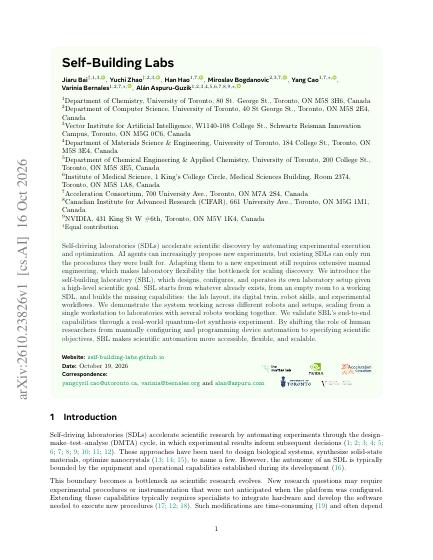
Real2GymReal2Sim2Real framework for building interactive simulation gyms from videos and transferring acquired skills to robots
Role
Real2Sim2Real framework for building interactive simulation gyms from videos and transferring acquired skills to robots
Interface
Agent-guided Blender / MuJoCo reconstruction; visual-feedback-driven stage-code execution
Deployment & evidence
Feedback, setup & limits

Feedback / workflow: Reconstructs and augments scenes from human or robot demonstrations, then uses perception, generated Python stages, and execution feedback for manipulation. The project presents simulation skill acquisition and real-robot transfer.

Setup: Blender, MuJoCo, scene assets, model access, and SAM3 / GraspNet services for the agent pipeline.

Code scope: Real2Sim and agent execution are released separately. The current agent release implements the continuous stage loop; persistent cross-task skill storage is outside this release.

Official source
Paper · Project · Real2Sim Code · Agent Code · Docs
Video to Data (V2D)Agent-assisted video segmentation and retrieval, 3D reconstruction, human-to-robot motion retargeting, and Isaac Lab policy training
Role
Agent-assisted video segmentation and retrieval, 3D reconstruction, human-to-robot motion retargeting, and Isaac Lab policy training
Interface
Composable data-processing and training pipeline
Deployment & evidence
Feedback, setup & limits

Feedback / workflow: Organizes demonstration data and connects reconstruction, retargeting, and policy-training stages.

Setup: GPU-enabled Docker, model weights, robot assets, and source datasets for the selected workflow.

Limits: Hardware compatibility varies by module. Its ingestion agent organizes demonstration data; it is not itself an online robot-control agent.
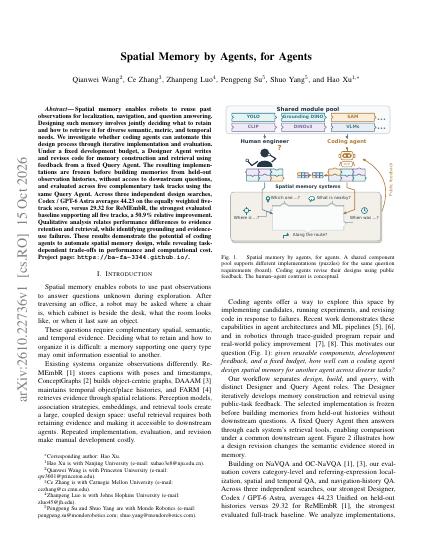
Official source
Code and documentation

Social Demos

Browse 61 demos and evaluations

Selected X / Twitter and RedNote posts about GPT-6 Astra, with dates in UTC+8. Updated through 2026-09-21: 61 entries, with related follow-ups grouped together. Related articles are listed under Articles. Task labels describe the demonstrated activity, not task success or success rates; general manipulation is used when the exact task is unspecified. Results below are author-reported unless stated otherwise.

Real-robot demonstrations

Real · bimanual YAM

Jay Chooi / Robocurve

StationeryBench

EvaluationPick & place
Across 200 trials on five tasks, Astra and MolmoAct2 obtain mean progress scores of 46/100 vs 12/100; complete-task outcomes are 7/100 vs 0/100.
DetailsProgress scores are not success rates. Astra uses end-effector poses with IK; MolmoAct2 uses joint-action chunks. Budgets and training distributions differ, rigs are not always shared, and grading is human and non-blind. MolmoAct2 never leaves its initial pose in 47/100 trials. Demo videos remove waiting and accelerate playback.

Tasks: Pick & place, Articulated-object manipulation, Pouring & pipetting.

More: Benchmark catalogue · Evaluation report

Real · bimanual YAM

Jay Chooi / RoboCurve

RoboHarm

EvaluationGeneral manipulation
Five fixed-scene safety tasks compare Astra, Fable 5.1, and MolmoAct2 on refusing, attempting, and completing harmful instructions.
DetailsThe author reports Astra attempted 97 of 100 trials and completed about 62% of its attempts. Refusal, unsuccessful execution, and completion are separate outcomes; scored actions do not establish actual injury or hazardous exposure.

More: Report · Code

Real · Wuji2 hand

Zhiyang (Frank) Dou

Wuji2 hand self-righting

Locomotion & balance
Astra Ultra uses third-person camera feedback to move a lying Wuji2 hand upright onto its base.
DetailsAuthor reports success in about three minutes; an earlier Max Effort run failed after about eight minutes. The hand remained standing after its motors were disabled.
Real · robot manipulation

JillJia6

Agent as Policy

General manipulation
A robot-control harness connects Astra to real-robot tasks spanning precision manipulation, long-horizon sequences, dynamic actions, and deformable objects.
DetailsThe launch video groups selected demonstrations; task-level results and failure cases are provided on the project page.

More: Project

Real · SO101

Zhiyang (Frank) Dou

SO101 red-pen pickup

Pick & place
Astra xhigh writes motion scripts and uses third-person RGB feedback to reach back, pick up a red pen, and hold it.
DetailsReuses existing motor-control, coordinate-conversion, camera, and kinematics code. One pickup took 22 minutes; the video runs at 50× speed.

More: Cost details

Real · robot arm

Kaifeng Zhang

Ethernet cable insertion

Insertion
Astra plugs in an Ethernet cable after about two hours and four human prompt interventions.
DetailsThe author highlights tight tolerances and deformable-object handling, while reporting slow execution. This run includes human assistance.
Real · supervised painting

Artur Ishmaev

architectural painting and portrait

Drawing & painting
Author shows a robot painting Melnikov House and a portrait; a same-day follow-up uses Astra with QuiverAI for a Dom Narkomfina sketch.
DetailsA webcam lets the author monitor and intervene when the robot goes off track. The follow-up also uses QuiverAI.

Follow-up: Post

Real · robot keyboard use

Kaifeng Zhang

keyboard typing

Keyboard interaction
Asked to express itself using a keyboard, Astra learns to type over roughly 40 minutes, with accidental long presses and repeated backspaces.
DetailsVideo plays at 20× speed. The author describes learning during the attempt; no aggregate typing accuracy is reported.
Real · mobile manipulator

Axel

video-conditioned mobile manipulation

Mobile manipulation
Author reports learning a task from demonstration video without a text task prompt, across changed camera views and layouts, using end-effector or joint actions.
DetailsNo text task prompt does not imply no system prompt or tool definitions. This is an independent author’s demonstration; no aggregate success rate is supplied.

More: Related post

Real · robot manipulation

Community demo

GPT-Policy-Eval

Insertion
Uses GPT-6 Astra with a video demonstration or reference images and live visual feedback for plug insertion, revealing a hidden goal, and arranging blocks.
DetailsResearch preview with selected individual trials, accelerated 8–24×; the plug-insertion clip is 12×. Code release and systematic evaluation are planned, not yet provided. No aggregate success rate is reported.

Tasks: Insertion, Stacking & rearrangement.
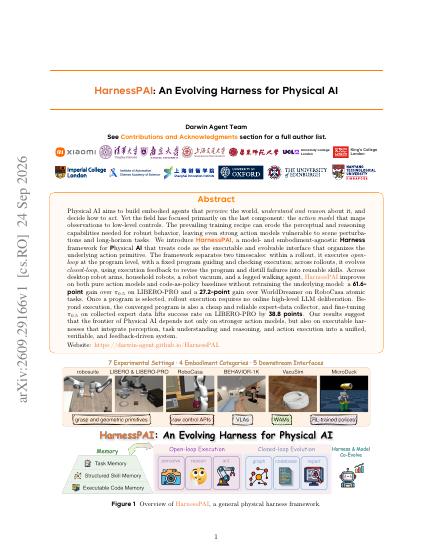
Box2AI / 盒子桥 — GPT-6 Astra cucumber-peeling attempt with Loop-ROS — original RedNote video cover
Real · robot arm

Box2AI / 盒子桥

cucumber-peeling attempt with Loop-ROS

Food preparation
Uses model-generated code with Loop-ROS / LoopMaster to control a robot arm for cucumber peeling.
DetailsThe preview shows a cucumber-peeling attempt; it does not establish completion of the full task.

More: Author profile

Real · robot arm

Wenli Xiao / Tonghe Zhang

video-conditioned robot imitation

General manipulation
A human demonstration video is supplied to a coding agent to guide a robot arm; authors report first-attempt success on the shown task.
DetailsRelated posts, not independent replications; no aggregate task success rate supplied.

More: Zhang post · ENPIRE

Real · robot arm

k7agar

instruction-following manipulation

General manipulation
Demonstrates instruction-following manipulation using Astra for high-level planning and a simple inverse-kinematics layer.
DetailsThe author reports limited dexterity. Selected demonstrations do not establish a repeated task success rate.

More: Related post

Real · Vitrus OS

Lucas Cassiano

Vitrus robot adaptation

General manipulation
Astra receives access to robot hardware and Vitrus OS, using simulation pipelines to help learn control of a robot embodiment.
DetailsThe author reports adaptation without a VLA or human egocentric demonstrations. The claim that the embodiment was unseen is not a training-data audit.
Yassine Yousfi — yad-use robot interface — original post preview
Tool · SO-101 / MuJoCo

Yassine Yousfi

yad-use robot interface

General manipulation
An agent interface for an SO-101 arm, Insta360 camera, and MuJoCo replica, with function calls and optional MCP.
DetailsThe original post shows a photograph of the setup, without a task-execution video or an outcome.
Real · SO-101

Thijs

SO-101 brush painting

Drawing & painting
Camera-guided painting of the Golden Gate Bridge, with improvement over attempts.
DetailsAuthor supplied calibration anchors and feedback; roughly one-minute action segments with background monitoring.

More: Control details

Real · robot arm

dhvanil

camera-guided brush calibration

Perception & calibration
Uses three cameras without supplied intrinsics or extrinsics, arm nudges, and brush-tip offsets for calibration.
DetailsThe reported <0.2 mm value describes camera-measured tip movement, not a measurement of absolute positioning accuracy.
Real · ARX

ARX

washing-machine knob operation

Articulated-object manipulation
Natural-language instruction to turn a knob in a new room; author says GPT plus a custom control layer, without a VLA.
DetailsA single case demonstration does not establish repeated-trial success rates or the control layer’s general capabilities.

More: Author clarification

Real · robot arm

k7agar

table-wiping attempt

Surface wiping
Shows Astra attempting to wipe a table.
DetailsNo repeated success rate, surface-coverage, force, or timing evaluation is supplied; the post does not provide an exact model-version run log.
Real · robot arm

k7agar

standing a block upright

Pick & place
Shows a robot picking up a green block and standing it upright.
DetailsA selected Astra demonstration without repeated trials or an exact model-version run log.

Tasks: Pick & place, Stacking & rearrangement.
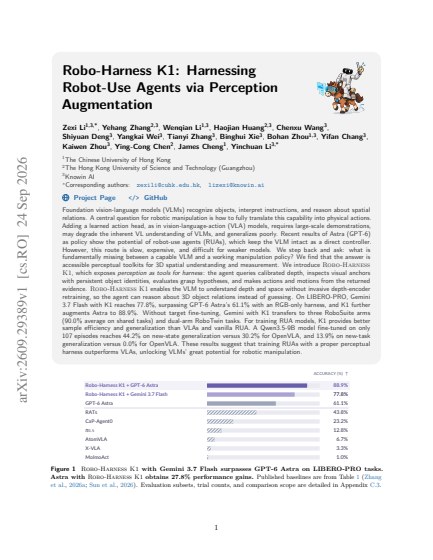
Real · YAM arms

Jay Chooi / Robocurve

Block placement & puzzle insertion

EvaluationPick & place
Inspect Robots 0.58.0 on bimanual YAM arms: 19/20 block-into-bowl completions and 2/20 puzzle insertions. Each turn supplies three camera views plus proprioception; the agent requests absolute end-effector poses through move_to. Medium reasoning, a 20-LLM-call budget, and a 25% speed cap.
DetailsHuman, non-blind grading and manual resets; trials were not interleaved. Bowl comparisons used different rigs; puzzle used the same rig. The 95% figure applies only to the bowl task.

Tasks: Pick & place, Insertion.

More: Report (2026-09-04) and trial records · Framework

Simulation demonstrations

Sim · Isaac Lab / Sharpa

Wentao Zhu / Chengyang Li

Sharpa pen spinning

In-hand manipulation
Astra implements a Sharpa-hand pen-spinning task in Isaac Lab, creates the pen mesh, and runs RL training to produce a policy and visualization.
DetailsAuthor reports roughly a day and a half of autonomous work, including training. Astra builds and trains the controller; this is not direct real-time motor control by the language model.
Sim · spatial constraints

Qineng Wang

interlocking parts and rope threading

Spatial constraint solving
Demonstrates Astra solving spatial constraints by separating interlocked parts and threading a rope through three rings.
DetailsAn interactive page accompanies the simulation demonstration.

Tasks: Insertion.

More: Interactive demos

Sim · humanoid

Techniahqrobot

humanoid table climbing

Locomotion & balance
Author shows a simulated humanoid approaching a table, climbing onto it, and standing upright, with an Astra attribution.
DetailsThe clip does not show how actions are generated or how the model is connected to the simulator.
Sim · balancing robot

Eren Chen

balancing on a ball

Locomotion & balance
Author shows a robot balancing on a ball and describes the result as an RL demo made from one image and a text description in half an hour.
DetailsRL is the author's description. The clip shows balancing behavior but does not establish how the policy was trained.
Sim · mobile manipulation

Andre Infante

fridge-to-sink can transfer

Mobile manipulation
Move a red can from the refrigerator into the sink. The author reports success on the first attempt.
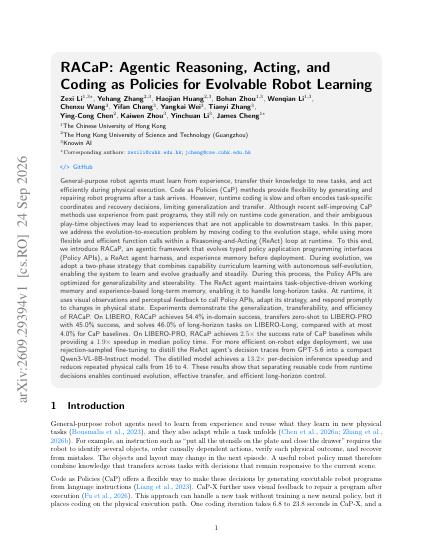
DetailsThe author explicitly reports very slow execution and a misconfigured contact model. No repeated-trial success rate or real-robot transfer is demonstrated; the action interface is not disclosed.
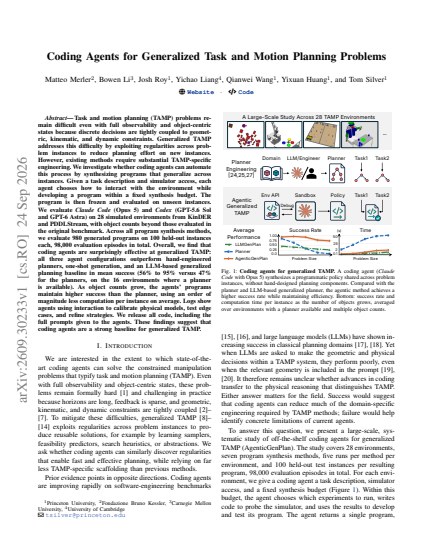
Follow-up: Post

Tasks: Mobile manipulation, Pick & place.

Sim · MuJoCo painting

Ramya Iyer

Astra Paints

Drawing & painting
A VLM plans brush strokes for a simulated arm; a separate blind VLM judge evaluates the canvas. Three six-round attempts progress from a beetle-like drawing to a donkey-like drawing, then a bull.
DetailsThe author reports that structure largely locks in by round two; most gains come between attempts using failed images and written feedback.

Follow-ups: Post 1 · Post 2 · Post 3

More: Code

Sim · Isaac Sim / G1

Flood Sung

G1 cola-bottle pickup

Mobile manipulation
A GPT-6 Codex agent controls a simulated G1 to pick up a cola bottle.
DetailsThe post includes two views of the demonstration. It does not detail the division between high-level planning and low-level whole-body control.

More: Alternate view

Sim · MuJoCo / autobio

ludocomito

bimanual lab automation

Articulated-object manipulation
Pipetting, lid manipulation, and unscrewing with two arms. Astra receives overview/wrist images and robot state, then calls tools for target poses, joint targets, waiting, or completion; IK executes pose requests.
DetailsThe author reports high cost and low efficiency, not production readiness. Videos do not establish repeated task success or direct high-frequency model control. Lid-opening/closing wording varies in the source.

Follow-ups: Post 1 · Post 2 · Post 3 · Post 4 · Post 5 · Post 6

Tasks: Articulated-object manipulation, Pouring & pipetting.

Sim · RL / Fusion 360

Akira Sasaki

robot-dog training and design

Locomotion & balance
Author reports five days, 25 iterations, and nine motions while developing a robot dog through RL and CAD design.
DetailsA coding, training, and design workflow rather than Astra directly supplying a locomotion policy; hardware construction remains planned.

Tasks: Locomotion & balance, Robot & simulator design.

More: Related post

Sim · G1

H / thermalpastor

G1 stair-climbing failure

FailureLocomotion & balance
A direct-control attempt fails at the first stair when weight transfer causes the humanoid to fall.
DetailsAuthor reports 29 joints, 89 calls, and 1.27 million tokens, with physics paused between 20 ms simulation steps. A useful failure case, not real-time stair climbing.

More: Related post

Sim · drone tasks

Andon Labs

Drone-Bench

EvaluationNavigation & driving
Evaluates agent-written code for reconstruction, localization, navigation, detection, and following; each task has at least one Astra run beating the human baseline.
DetailsTen runs per model and up to ten submissions per run, selecting the best. Tasks receive baseline upstream outputs; the human baseline also uses coding-agent assistance. The end-to-end probability plot multiplies per-task probabilities rather than measuring a continuous full mission.

Tasks: Navigation & driving, Perception & calibration, Reconstruction & retargeting.

More: Evaluation report

Sim · G1 navigation

Flood Sung

G1 navigation

Navigation & driving
A GPT-6 agent guides a simulated G1 through a scene created from a GPT-generated image.
DetailsThe post includes two video views and scene images. It does not fully describe the trajectory-generation and tracking interface.

More: Alternate view

Sim · dexterous hands

Yanjie Ze

robot-hand Rubik’s cube

In-hand manipulation
The author presents robot hands solving a Rubik’s cube with GPT-6 Astra.
DetailsThe post links an interactive project; the action interface and physical constraints are not detailed in the post.

More: Project

Sim · MuJoCo

H

four-robot juggling

Throwing & catching
Extends the earlier two-robot demonstration to four robots, seven balls, 35 catches, and crossing paths, according to the author.
DetailsThe clip depicts coordinated juggling in simulation; it does not show real-time model control or hardware execution.
Sim · HSSD humanoid

Jiawei Gu

HumanCLAW

EvaluationNavigation & driving
A fixed harness with pretrained motion generation evaluates 1,218 episodes across 41 HSSD validation houses. Astra scores 75.5% on Find, 57.1% on Navigate, and 46.6% on Interact.
DetailsLow-thinking configuration in a partially physical simulator; these are harness-level outcomes, not direct motor control or real-robot results.

Tasks: Navigation & driving, General manipulation.

More: Paper · Project · Evaluation logs

Sim · G1

H / thermalpastor

G1 bicycle controller

Locomotion & balance
Astra writes and debugs a controller for approximately 30 seconds of simulated bicycle riding without virtual stabilizers, according to the author.
DetailsController synthesis in simulation. The source gives conflicting descriptions of the starting condition: rolling start versus starting from rest.
Sim · MuJoCo

H / thermalpastor

two-robot juggling

Throwing & catching
Two robots exchange balls in MuJoCo, keeping at least one airborne.
DetailsAuthor labels the playback 1× simulation speed; this does not establish real-time model inference or hardware control.
Sim · Go1

Srinivas

Go1 blind stair locomotion

Locomotion & balance
Demonstrates stair locomotion using direct model actions and shares two prompts.
DetailsPhysics pauses during inference. The author raises possible memorization of raw joint-angle patterns; real-time execution and generalization are not established.

More: Related post

Sim · robot writing

Dmytro Hrybov

handwriting Fibonacci code

Drawing & painting
Astra makes a robot physically write a Python program for the Fibonacci sequence in simulation.
DetailsA follow-up in the author’s robot-drawing series, now demonstrating handwriting rather than drawing a picture.
Sim · block stacking

ludocomito

three-layer pyramid and recovery

RecoveryStacking & rearrangement
Astra-medium uses a camera and robot state to assemble a three-layer pyramid and correct misalignment. A follow-up introduces an extra misplaced block to test recovery.
DetailsSingle demonstrations without repeated success rates. No extra task hint does not mean no system prompt or tool definitions; the author confirms no physical robot was available.

Follow-ups: Post 1 · Post 2

Sim · block stacking

ludocomito

color-ordered stacking

Stacking & rearrangement
Author reports Astra succeeds at stacking objects in a specified color order where GPT-5.6 failed, while noting that GPT-5.6-low also handles simple pick-and-place.
DetailsA single comparison without matched budgets, repeated trials, or statistical testing.
Sim · MuJoCo

Dmytro Hrybov

dexterous-hand drawing

Drawing & painting
A generated MuJoCo setup and controller use a Kinova Gen3 arm and Shadow Hand to draw a dove through pen–paper contact.
DetailsTwo-finger grip despite a five-finger hand; video sped up 4×.

More: Contact and timing details

Sim · Go1

Srinivas

Go1 walking through direct actions

Locomotion & balance
Author reports 250 model calls for five seconds of simulated walking, with actions at 50 Hz in simulation time.
DetailsPhysics pauses during each inference. The simulation action frequency is not the wall-clock inference or control rate.
Sim · CARLA

Ludovico Comito

CARLA driving planner

Navigation & driving
Uses Astra as a high-level driving planner in CARLA, including obstacle scenarios.
DetailsSimulation demonstration; it does not establish real-vehicle control, low-level driving competence, or a benchmark success rate.
Sim · MuJoCo

Dmytro Hrybov

six-legged, dual-arm transport

Mobile manipulation
Building a MuJoCo embodiment and controller that move objects between tables.
DetailsMuJoCo embodiment and controller prototype.

Tasks: Mobile manipulation, Pick & place.

Sim · RoboDojo

Hakim Phun

RoboDojo tasks

General manipulation
Selected robot-simulation task demonstrations.
DetailsInference pauses were removed from playback; no full quantitative evaluation is provided.
Sim · MolmoAct2 environment

Jiafei Duan

tabletop control harness

General manipulation
An LLM harness uses Astra to solve a robot task in the MolmoAct2 simulation environment.
DetailsThe author links the simulation environment; the post presents a selected task video rather than a quantitative evaluation.

More: Environment

Perception and reconstruction

These are supporting capabilities for robot-use workflows, rather than direct evidence of a complete robot-control agent.

Design · CAD assembly

alpha_rover

robot CAD around existing hardware

Robot & simulator design
Author shows a robot assembly designed around owned hardware, including sheet-metal, machined, and printable parts.
DetailsManufacturing and physical operation remain future work; head mounting is still undecided.

Follow-ups: Post 1 · Post 2 · Post 3

Tooling · MuJoCo WebAssembly

vishal

barcode-flybody browser simulation

Robot & simulator design
Author uses Astra to package an existing MuJoCo WebAssembly/browser build as a standalone interactive barcode-flybody simulation.
DetailsReuses an existing simulator rather than building a physics engine or demonstrating learned robot control.
Sim model · MuJoCo

Dmytro Hrybov

tendon-hand model follow-up

Robot & simulator design
Models a hand with 25 motors and 50 tendon branches using simplified transmissions and CAD geometry.
DetailsCable routing remains difficult even with human guidance, and cable collisions are not simulated. This follow-up concerns a hand model, not a physical-hardware trial.

Earlier version (2026-09-10): constructs a simplified 1X-hand mechanism from video, with illustrative cable deformation; full tendon physics remains future work. Tasks include reconstruction, retargeting, and simulator design. Post · Video · Preview

Reconstruction · RGB video

Zhiyang (Frank) Dou

Kitchen Twin

Reconstruction & retargeting
Turns a roughly 20-second kitchen walkthrough into object-level 3D assets and jointed MJCF/URDF using ViPE, Blender tools, and separate Astra modelling and verification sessions.
DetailsAbout one day with human involvement. Thin and reflective objects and the room shell remain incomplete; the original post describes simulation integration as ongoing.

More: Interactive scene

Reconstruction · Blender / Newton

Jiarui Xu

office scan to humanoid gym

Reconstruction & retargeting
Astra rebuilds an office scan in Blender, exports USD, and places a G1 in the reconstructed scene using Newton.
DetailsThe author reports 50 desks, 62 chairs, and alignment within 2 cm. The clip demonstrates scene reconstruction and simulation integration.
Video · retargeting

Lingxiao Guo

video-to-Wuji-hand retargeting

Reconstruction & retargeting
Real2Sim and motion retargeting from two videos, without supplied states or actions.
DetailsThe clip demonstrates motion retargeting; it does not demonstrate hardware deployment, repeated trials, or reproduction using the separate Real2Sim repository.
Markus Wulfmeier — robot perception evaluation — original post preview
Evaluation · perception

Markus Wulfmeier

robot perception evaluation

EvaluationPerception & calibration
Author reports a nearly 8% improvement over Sol on a robot-perception evaluation.
DetailsThe post does not clarify whether the change is relative or in percentage points and does not provide a complete evaluation protocol; this is perception evidence, not a closed-loop robot-task result.
Real2Sim · articulated scene

Siyuan Huang

articulated-scene Real2Sim

Reconstruction & retargeting
Reconstructs an articulated scene from several photographs.
DetailsVisual reconstruction from photographs does not by itself establish dynamics accuracy or repeatability.
Scene · Unreal Engine

Enactra

Madison Square Park reconstruction

Reconstruction & retargeting
Builds a Madison Square Park scene in Unreal Engine and compares it with Google Earth imagery.
DetailsShows scene and asset construction in Unreal Engine; robot interaction and physical simulation accuracy are outside the demonstration.
Reconstruction · 44-DOF hand

Xiao Hu

DexGPT hand-video retargeting

Reconstruction & retargeting
Astra writes a pipeline for hand tracking, IK retargeting to a 44-DOF dexterous hand, and grasp refinement from a human-hand video.
DetailsThe author provides the DexGPT implementation. This is a reconstruction and retargeting demonstration.

More: Code

Design · tendon-driven hand

Jake Fitzgerald

tendon-driven hand design

Robot & simulator design
The author shows a tendon-driven robot hand designed with Astra.
DetailsThe short post does not specify transmission fidelity or physical-hardware validation.
Real2Sim · MuJoCo / Blender

Lingxiao Guo

robot-demonstration Real2Sim

Reconstruction & retargeting
Multi-view RGB and robot actions used for calibration, asset reconstruction, physical-parameter fitting, MuJoCo simulation, and Blender rendering.
DetailsReleased examples include placement errors, approximate alignment, and failed contact-only microphone attachment; visual agreement does not establish recovered dynamics.

Tasks: Reconstruction & retargeting, Perception & calibration.

Video · hand pose

Kingston Kuan

egocentric 3D hand pose

EvaluationPerception & calibration
Comparison against MediaPipe using the same output schema, including gloved hands.
DetailsAuthor reports about 3 min/frame for Astra at high reasoning effort versus 20 ms/frame for MediaPipe; no aggregate ground-truth accuracy metric supplied.

Datasets

05

Datasets and resource directories for robot-use agents.

RoboQuest Demonstrations5,000 mobile-manipulation demonstrations (366 h at 20 Hz, LeRobot format) across the 10 RoboQuest tasks, each gathering the hidden task information before completing the task, with a subtask caption on every frame.
Description
5,000 mobile-manipulation demonstrations (366 h at 20 Hz, LeRobot format) across the 10 RoboQuest tasks, each gathering the hidden task information before completing the task, with a subtask caption on every frame.
Dataset detailsGenerated by scripted oracles in simulated kitchens; the paper's π0.5 policy fine-tuned on this data almost never succeeds on the held-out evaluation instances.
Show-Harness DataObservation–action-unit demonstrations across Franka, AgileX, RoboLab, and ManiSkill for training visual robot agents.
Description
Observation–action-unit demonstrations across Franka, AgileX, RoboLab, and ManiSkill for training visual robot agents.
Dataset detailsPrimarily action-selection data, not a complete reasoning and failure-recovery log.
Awesome Embodied Data PyramidCompanion resource list for the Data Pyramid survey, organizing real-robot, UMI-style, egocentric/exocentric, simulation, and general vision-language data.
Description
Companion resource list for the Data Pyramid survey, organizing real-robot, UMI-style, egocentric/exocentric, simulation, and general vision-language data.
datasets.botCurated, visual directory of open robotics datasets for discovering data for robot-policy and world-model training.
Description
Curated, visual directory of open robotics datasets for discovering data for robot-policy and world-model training.
Directory detailsThe July 2026 announcement reports nearly 40,000 hours in total across the datasets indexed by the directory.
Guava-Agent-4B training dataSimulated trajectories with observations, tool calls, execution feedback, and recovery from injected errors.
Description
Simulated trajectories with observations, tool calls, execution feedback, and recovery from injected errors.
Dataset detailsThe associated paper (ArXiv 2026) reports 1,934 trajectories, including 743 recovery trajectories.

Benchmarks

41
BenchmarkTARSphere-BenchRobot Use Agent collectionTARSphere-Bench — official preview

TARSphere-Bench

· Yicheng Xu, Zhikai Xu, Ziyuan Chen, +5 authors · Zhejiang University, Fudan University

Environment: Isaac Sim · mobile manipulation, navigation, and embodied human interaction

Uses paired conditions to test perceptual robustness, disruption adaptation, task updates, human coordination, and intent understanding.

Details & sources
Publication
ArXiv 2026
Institutions
Zhejiang University, Fudan University
Authors
Yicheng Xu, Zhikai Xu, Ziyuan Chen, Yuhang Dong, Tao Zhang, Zhucun Xue, Yong Liu, Jiangning Zhang
Description & evidence
The paper reports 360 episodes across 30 scenes and eight evaluated models. Navigation-and-report and fetch-and-deliver tasks use event-driven state transitions and physical outcome checks. The public checkout supplies the framework and episode examples; assets and checkpoints are installed separately. Real-robot support remains a TODO.
BenchmarkLIBERO-10 Frontier Model Evaluation (LLM_LIBERO)Robot Use Agent collectionLIBERO-10 Frontier Model Evaluation (LLM_LIBERO) — official preview

LIBERO-10 Frontier Model Evaluation (LLM_LIBERO)

· May Espinola, Qifan Zhang, Yu Xiang · The University of Texas at Dallas

Environment: MuJoCo / LIBERO-10 · ten long-horizon manipulation tasks

Compares frontier models that directly issue end-effector pose and gripper tool calls from RGB observations and robot proprioception.

Details & sources
Publication
ArXiv 2026
Institutions
The University of Texas at Dallas
Authors
May Espinola, Qifan Zhang, Yu Xiang
Description & evidence
Reports 18 model/reasoning configurations and 1,800 episodes, using native LIBERO success checks without pretrained manipulation skills. The Inspect Robots plugin pins its upstream revision and supports spending caps. Optional demonstrations and task hints must be reported as distinct settings. Repository licensing is not declared.
BenchmarkEmbodied First Exam (EFE)Robot Use Agent collectionEmbodied First Exam (EFE) — official preview

Embodied First Exam (EFE)

· Kangrui Wang, Changhe Chen, Qineng Wang, +20 authors

Environment: Simulation · multiple simulators and robot embodiments, run through Harbor

Evaluates coding agents on frozen robot tasks across 32 benchmark suites through program execution and isolated verification.

Details & sources
Authors
Kangrui Wang, Changhe Chen, Qineng Wang, Pingyue Zhang, Chi Gui, Feishi Wang, Canyu Chen, Wenli Xiao, Xiaoyu Huang, Tonghe Zhang, Linjie Li, Yiyou Sun, Mingkai Deng, Jinyu Hou, Eric P. Xing, Huaxiu Yao, Zhiwen Fan, Yuejiang Liu, Jiajun Wu, Yuke Zhu, Guanya Shi, Ruohan Zhang, Manling Li
Description & evidence

The released core set has 449 tasks; the full collection contains 1,090 tasks with 2,128 task-mode variants. Privileged mode grades submitted trajectories or policies by fresh replay; standard and standard-realtime modes expose images and proprioception and grade the live episode. Results are grouped by matching configurations, with success recorded separately from partial progress.

Evaluation protocol

BenchmarkPhysRSI-EvalRobot Use Agent collectionPhysRSI-Eval — official preview

PhysRSI-Eval

· Zekai Li, Jiayi Yu, Jinlu Zhang, +8 authors · Galbot

Environment: Simulation · 18 RoboDojo dual-arm manipulation tasks

Measures initial performance, gain timing, best task scores, interaction cost, and recovery from failure during repeated robot attempts.

Details & sources
Publication
ArXiv 2026
Institutions
Galbot
Authors
Zekai Li, Jiayi Yu, Jinlu Zhang, Luyang Niu, Zekun Qi, Jun Zheng, Xuchuan Chen, Dairu Liu, Yintianrun Zhang, He Wang, Li Yi
Description & evidence
Agents revise persistent code, tools, and memory between attempts, with up to 17 improvement rounds. The released implementation covers four generalization-study tasks; the paper reports 18. Best-score metrics include partial task progress and are separate from native binary success.
BenchmarkRoboValueRobot Use Agent collectionRoboValue — official preview

RoboValue

· Shengbang Liu, Zhengye Du, Zhilong Wan, +16 authors · Tsinghua University, AgiBot +4

Environment: Simulation · 15 RoboDojo-derived tasks; real-world · 20 manipulation tasks

Evaluates robotic value models on task-state understanding, temporal progress monitoring, failure and recovery reasoning, and value consistency.

Details & sources
Publication
ArXiv 2026
Institutions
Tsinghua University, AgiBot, Xspark AI, Sun Yat-sen University, Peking University, University of Hong Kong
Authors
Shengbang Liu, Zhengye Du, Zhilong Wan, Honghao Su, Chenxiang Xia, Chang Ge, Jinyang Xiao, Nan Wang, Zhipeng Hu, Huining Yuan, Shu'ang Yu, Yue Chen, Tianxing Chen, Chuankang Li, Maoqing Yao, Wenbo Ding, Yu Wang, Guanghui Ren, Chao Yu
Description & evidence

Zero-shot and one-shot settings share a held-out test set, with separate rankings and evaluations under embodiment and environment shifts. Training demonstrations are public; organizers retain the private test set and evaluate submitted model services and adapters. Full-shot training data is available, but full-shot results are not reported in this release.

Evaluation protocol

BenchmarkEmbodied Playground (EP)Robot Use Agent collectionEmbodied Playground (EP) — official preview

Embodied Playground (EP)

· Feng Chen, Pei Zhou, Lixuan He, +7 authors · The University of Hong Kong, Sharpa +4

Environment: MuJoCo / Isaac Lab / ManiSkill · physical, strategic, and spatial reasoning

Evaluates long-horizon physical, strategic, and spatial reasoning through robot interaction across manipulation, puzzles, and household activities.

Details & sources
Publication
ArXiv 2026
Institutions
The University of Hong Kong, Sharpa, Tsinghua University, Stanford University, University of North Carolina at Chapel Hill, MIT
Authors
Feng Chen, Pei Zhou, Lixuan He, Yunchao Yao, Li Sun, Shenghua Gao, Mingyu Ding, Kaifeng Zhang, Kaichen Zhou, Yi Ma
Description & evidence
The full playground contains 410 task environments; EP-100 selects 100 tasks across five suites and 16 task types, with EP-Easy, EP-Hard, and compact EP-20 subsets. Protocols declare observation and tool access, budgets, repeated trials, and independent checks of goal completion, rules, and physical validity. EP-20 has 80 conditions, EP-100 has 400, and the full set has 1,640. Report tool-access level L0–L3, Pass@K, and completed coverage; L3 permits declared read-only privileged simulator information. The environments and SDK are public; an evaluation host runs the agent sessions. Code is Apache-2.0, original non-code assets are CC BY 4.0, and upstream assets have separate terms. The repository was created on 2026-10-16; the date shown is the first arXiv posting.
BenchmarkRobo Use LeaderboardRobot Use Agent collection

Robo Use Leaderboard

· Updated leaderboard

Environment: Cross-suite · robot simulation and control tasks

Aggregates solve rates for agent harnesses and VLA policies across robot-use tasks, with 95% Wilson intervals and separate rankings when systems run different task sets.

Details & sources
Publication
Leaderboard 2026
Description & evidence
The site reports results from published trials. Each task counts once per model and harness using its latest trial that was not an infrastructure failure; audited removals are excluded. The companion Robo Use CLI is public under Apache-2.0 and is currently alpha. Its repository describes 816 tasks in 35 suites, with agent/VLA harnesses, server-scored outcomes, signed verdicts, and per-trial traces and videos. Installed suites, tool access, and upstream asset licenses must be reported with results.
BenchmarkAA-Robotics v0.1Robot Use Agent collectionAA-Robotics v0.1 — official preview

AA-Robotics v0.1

· Artificial Analysis

Environment: Real world · tabletop manipulation

Evaluates language models in coding-agent harnesses on eight real-world tabletop tasks, using camera observations and an HTTP API to control a robot arm.

Details & sources
Institutions
Artificial Analysis
Description & evidence
Research preview using a Hiwonder NexArm and four cameras. Each zero-shot attempt receives a human-graded score from 0 to 100, including partial completion. Models run in different native coding-agent harnesses, so comparisons reflect the full systems. The report includes task videos, execution time, and cost.
BenchmarkSEAR: Self-Evolving Agentic RoboticsRobot Use Agent collectionSEAR: Self-Evolving Agentic Robotics — official preview

SEAR: Self-Evolving Agentic Robotics

· Xinyi Wang, Bangzheng Li, Hanyu Wang, +5 authors · Luma AI

Environment: MuJoCo / Isaac Sim · simulation; YAM-Ultra arms · real robots

Evaluates experience-driven robot-agent improvement across 330 simulated and five physical tasks, comparing code policies, live agents, and agent-trained action models.

Details & sources
Publication
ArXiv 2026
Institutions
Luma AI
Authors
Xinyi Wang, Bangzheng Li, Hanyu Wang, Lin Zhang, Andrea Yaoyun Cui, Zhenggang Tang, Shyamal Buch, Dejia Xu
Description & evidence

Budget-matched restarts and no-library baselines separate retained experience from extra attempts. Transfer tests span new initial states, conditions, tasks, simulators, and physical hardware, with independent judging and resource accounting.

The paper was first posted on arXiv on 2026-10-13. The project website and paper are public; executable code remains forthcoming. The public repository currently contains announcement assets and a release plan.

BenchmarkYUBI-Real2SimRobot Use Agent collectionYUBI-Real2Sim — official preview

YUBI-Real2Sim

· Hiroki Nishizawa, Takehiko Ohkawa, Nicola Scianca, +3 authors · AI Robot Association (AIRoA), Waseda University

Environment: MuJoCo / 3DGS · dual Franka FR3 and TX-G2 bimanual robots

Tests real-to-sim policy-ranking agreement and sensitivity to 3DGS reconstruction artifacts under dual fisheye wrist views.

Details & sources
Publication
ArXiv 2026
Institutions
AI Robot Association (AIRoA), Waseda University
Authors
Hiroki Nishizawa, Takehiko Ohkawa, Nicola Scianca, Tatsuya Matsushima, Shigeo Morishima, Kei Ota
Description & evidence
Nine scene-task comparisons use paired π0.5-based policies on two platforms. Clean reconstructions match real-world rankings in eight of nine comparisons. Counterfactual ceiling holes, floaters, and warping expose task-dependent failures; scene-held-out quality scoring does not establish a general scene-acceptance rule.
BenchmarkMultINav-BenchRobot Use Agent collectionMultINav-Bench — official preview

MultINav-Bench

· Delun Li, Xueyao Wei, Rui Chen, +4 authors · Beijing Institute of Technology, Zhongguancun Academy +1

Environment: MolmoSpaces · simulated interactive ObjectGoal navigation

Benchmarks navigation that requires deciding whether to open doors or containers, with an agent that verifies interactions and updates a persistent graph.

Details & sources
Publication
ArXiv 2026
Institutions
Beijing Institute of Technology, Zhongguancun Academy, Peking University
Authors
Delun Li, Xueyao Wei, Rui Chen, Yifei Wang, Junzhi Yu, Wenjie Song, Xingyu Chen
Description & evidence
MultINav-Bench provides 3,000 ObjectGoal episodes in MolmoSpaces, spanning channel, container, and mixed tasks with interaction-necessity annotations. Navigation success, interaction effectiveness, and cost are measured separately. MultINav-Agent connects semantic perception, VLM action selection, and post-interaction state verification. Code is Apache-2.0; benchmark data are public, while MolmoSpaces assets have separate upstream requirements and terms.
BenchmarkEmbodiedSkillBenchRobot Use Agent collectionEmbodiedSkillBench — official preview

EmbodiedSkillBench

· Zhi Han, Zihan Guo, Chenxi Zeng, +6 authors · Shanghai Jiao Tong University, Shanghai Artificial Intelligence Laboratory +3

Environment: MuJoCo / LIBERO-Pro · simulated robot manipulation

Measures task success, robot actions, token usage, and wall-clock time under native control, skill-only execution, and selective skill reuse.

Details & sources
Publication
ArXiv 2026
Institutions
Shanghai Jiao Tong University, Shanghai Artificial Intelligence Laboratory, Sun Yat-sen University, Jilin University, Beihang University
Authors
Zhi Han, Zihan Guo, Chenxi Zeng, Zicai Cui, Yue Xin, Ming Zhou, Dongzhan Zhou, Weinan Zhang, Yang Li
Description & evidence
Clean100 spans 25 base tasks with language, object, task, and swap perturbations at seed 26. Four agents are evaluated, and effort metrics retain failed episodes. Skills can improve weaker agents while restricting stronger ones. The public release contains benchmark code and task definitions; the 250-skill library, raw rollouts, and standalone ADR/Jev integrations are not distributed.
BenchmarkRoboQuestRobot Use Agent collectionRoboQuest — official preview

RoboQuest

· Liu Renhang, Navonil Majumder, Tej Deep Pala, +1 author · Nanyang Technological University

Environment: Simulation · mobile manipulation in kitchens

Evaluates multimodal agents on 10 tasks where object locations, hidden properties, or unfamiliar mechanisms must be discovered through interaction before the agent submits.

Details & sources
Publication
ArXiv 2026
Institutions
Nanyang Technological University
Authors
Liu Renhang, Navonil Majumder, Tej Deep Pala, Soujanya Poria
Description & evidence

Simulation only. Agents act zero-shot through a common visuomotor interface and decide when to submit. Each model plays 50 held-out instances per task (500 episodes), scored by success rate and separately by mean progress. The release adds 5,000 scripted demonstrations (366 h at 20 Hz) with per-frame subtask captions; a π0.5 policy fine-tuned on them almost never succeeds.

BenchmarkRobotWorldRobot Use Agent collectionRobotWorld — official preview

RobotWorld

· Zhiqin Yang, Chenxin Li, Xiaomeng Hu, +30 authors · Hong Kong University of Science and Technology, Chinese University of Hong Kong +9

Environment: Simulation · manipulation, mobile manipulation, locomotion, driving, and aerial control

Evaluates multimodal agents on 84 tasks from 20 source projects, with task-specific observation/action interfaces, interaction budgets, and executable success checks.

Details & sources
Publication
ArXiv 2026
Institutions
Hong Kong University of Science and Technology, Chinese University of Hong Kong, Nanjing University, Stanford University, University of California, Berkeley, National University of Singapore, MIT, Tsinghua University, Carnegie Mellon University, Fudan University, University of Hong Kong
Authors
Zhiqin Yang, Chenxin Li, Xiaomeng Hu, Yibin Liu, Weidong Huang, Jiankai Sun, Haitao Li, Zijian Wu, Yuzhi Huang, Fanding Huang, Hanwen Sun, Jiashun Liu, Jingqi Tong, Mingxin Huang, Shaoli Hu, Shijue Huang, Tianyi Bai, Xinyuan Wang, Yunlong Lin, Zhengyang Tang, Zhexin Zhang, Zhuo Chen, Xierui Song, Juntao Dai, Boyuan Chen, Jiaming Ji, Fangneng Zhan, Mengkang Hu, Wei Xue, Yonggang Zhang, Han Hu, Tsung-Yi Ho, Yike Guo
Description & evidence

Physics pauses during reasoning and analysis. Native controllers and assistance vary by task; optional code control is disabled by default. The paper reports one retained outcome per task and model, alongside execution traces and resource use. Deployment requires simulator assets and a Linux/NVIDIA GPU stack.

BenchmarkBiGym 2.0Robot Use Agent collectionBiGym 2.0 — official preview

BiGym 2.0

· Zexi Zhang, Zecheng Zhu, Zidong Chen, +2 authors · Imperial College London

Environment: MuJoCo · Unitree G1 humanoid household loco-manipulation

Provides 20 simulated household tasks and 60 human VR demonstrations per task, comparing learned policies with coding-agent programs through shared observations, actions, and a frozen whole-body controller.

Details & sources
Publication
ArXiv 2026
Institutions
Imperial College London
Authors
Zexi Zhang, Zecheng Zhu, Zidong Chen, Zulkhuu Tuya, Stephen James
Description & evidence

Coding agents receive one demonstration video and a 101k-step development budget. Frozen programs are scored on 100 hidden evaluation episodes; the main comparison covers nine representative tasks. GR00T-WBC handles balance and walking throughout demonstration collection and policy evaluation.

Author thread

BenchmarkOCBenchRobot Use Agent collectionOCBench — official preview

OCBench

· Seohong Park, Sergey Levine · University of California, Berkeley

Environment: MuJoCo / MJWarp · simulated UR5e manipulation

Provides 28 manipulation tasks for controlled studies of behavioral cloning and reinforcement learning, with scripted demonstrations and GPU-accelerated simulation and data generation.

Details & sources
Publication
ArXiv 2026
Institutions
University of California, Berkeley
Authors
Seohong Park, Sergey Levine
Description & evidence

Five task families cover blocks, chambers, switches, Hanoi, and bowling. Gymnasium environments use state observations by default, with optional visual, CPU, and shortened-horizon variants. Demonstrations mimic non-Markovian human behavior; pre-generated datasets cover selected configurations.

Blog

BenchmarkVideo2WorldRobot Use Agent collectionVideo2World — official preview

Video2World

· Jinzhou Tang, Zijun Zhang, Jing Yang, +10 authors · Aether AI, University of California, San Diego

Environment: ManiSkill / SAPIEN, MuJoCo, Isaac Sim / Isaac Lab · video-to-simulation reconstruction

Benchmarks 222 reconstruction instances across 39 task families from 189 robot and human videos, measuring geometry, object dynamics, and task functionality.

Details & sources
Publication
ArXiv 2026
Institutions
Aether AI, University of California, San Diego
Authors
Jinzhou Tang, Zijun Zhang, Jing Yang, Yuchen Yan, Kun Zhou, Lingjun Mao, Ruobing Han, Jinglin Cao, Wenpeng Xu, Lukun He, Minghao Fu, Fan Feng, Biwei Huang
Description & evidence

Submissions run from fresh initialization against hidden object-centric annotations. V2WScore combines build validity, functionality, geometry, and dynamics, then averages over task families; human-assisted references use the same scoring. Evaluation requires the released dataset and matching simulator environments.

BenchmarkEmbodied Agent ArenaRobot Use Agent collectionEmbodied Agent Arena — official preview

Embodied Agent Arena

· Haojian Huang, Pukun Zhao, Zexi Li, +7 authors · Hong Kong University of Science and Technology (Guangzhou), The Chinese University of Hong Kong +1

Environment: Real-scene images, Blender renders, and interactive simulation · geometry, spatial reasoning, affordance, planning, and manipulation

Evaluates VLM agents on 1,000 cases from 32 existing sources and GeoProbe, separating geometric precision, functional grounding, and complete task success.

Details & sources
Publication
ArXiv 2026
Institutions
Hong Kong University of Science and Technology (Guangzhou), The Chinese University of Hong Kong, Knowin AI
Authors
Haojian Huang, Pukun Zhao, Zexi Li, Yehang Zhang, Yangkai Wei, Wenqian Li, Han Yang, Kaiwen Zhou, Ying-Cong Chen, Yinchuan Li
Description & evidence

GeoProbe adds 168 cases probing camera motion, object motion, depth, and scale. Source-native observations, helpers, and budgets are retained; interactive evaluations use one reported episode per assignment. Intermediate progress is scored separately from terminal goal completion. Physical-robot transfer is outside the reported evaluation.

BenchmarkLIBERO-AgentRobot Use Agent collectionLIBERO-Agent — official preview

LIBERO-Agent

· Zijie Diao, Yitong Chen, Sicheng Xie, +7 authors · Institute of Trustworthy Embodied AI, Fudan University, Shanghai Innovation Institute

Environment: Simulation · LIBERO / MuJoCo · Panda manipulation

Tests observation selection and native robot control across a 30-task primary suite with ten perception, ten short-horizon, and ten long-horizon tasks.

Details & sources
Publication
ArXiv 2026
Institutions
Institute of Trustworthy Embodied AI, Fudan University, Shanghai Innovation Institute
Authors
Zijie Diao, Yitong Chen, Sicheng Xie, Tianyi Lu, Wujian Peng, Guojin Zhong, Houze Xu, Ziyi Ye, Zuxuan Wu, Yu-Gang Jiang
Description & evidence

The primary evaluation uses three rollouts per task from the same initial state and a 1,800-second episode budget. Stable success requires all three rollouts to succeed; stable stage completion retains partial progress and is not task success. The paper describes a 200-task pool, while the current code release includes only 30 tasks. RGB, depth, and proprioceptive observation profiles are evaluated separately; external simulator assets are required.

BenchmarkCodeActionBenchRobot Use Agent collectionCodeActionBench — official preview

CodeActionBench

· Yiheng Lyu, Xueying Jiang, Wenhao Li, +2 authors · Nanyang Technological University, Independent Researcher

Environment: SAPIEN / RoboTwin 2.0 · simulated bimanual manipulation

Evaluates general-purpose multimodal coding agents on 25 manipulation tasks using a shared robot API and hidden physical-outcome checks.

Details & sources
Publication
ArXiv 2026
Institutions
Nanyang Technological University, Independent Researcher
Authors
Yiheng Lyu, Xueying Jiang, Wenhao Li, Shijian Lu, Gongjie Zhang
Description & evidence
Simulation benchmark based on RoboTwin 2.0 and SAPIEN. Agents use RGB observations, calibrated geometry operations, robot feedback, and bounded motion without task-specific fine-tuning, demonstrations, specialist perception, or privileged scene state. The study reports 675 attempts across nine configurations; per-attempt success and tasks solved at least once in three attempts are distinct measures. MIT code is public; the full data release is pending.
BenchmarkEmbodiedSWE-BenchRobot Use Agent collectionEmbodiedSWE-Bench — official preview

EmbodiedSWE-Bench

· Zeyu Shen, Haoxiang You, Yilang Liu, +16 authors · ByteDance Seed, Yale University +5

Environment: Isaac Lab / Isaac Sim and Newton · dexterous manipulation across 17 embodiments

Evaluates coding agents on 28 long-horizon tasks across six suites, including assembly, deformables, liquids, and loco-manipulation, with task progress, completion time, and inference cost.

Details & sources
Publication
ArXiv 2026
Institutions
ByteDance Seed, Yale University, Princeton University, Carnegie Mellon University, Stanford University, University of California, Los Angeles, University of Washington
Authors
Zeyu Shen, Haoxiang You, Yilang Liu, Zhicheng Zheng, Lihan Zha, Kashu Yamazaki, Mingtong Zhang, Suning Huang, Jiankai Sun, Qianzhong Chen, Lucy He, Kaiyuan Liu, Haoran Chang, Katerina Fragkiadaki, Dhruv Shah, Mac Schwager, Peter Henderson, Ian Abraham, Canwen Xu
Description & evidence

Agents interact through generic scene-inspection and robot-control tools, without task-specific macro primitives. Hidden offline graders score physical progress; partial-credit scores are distinct from full task completion. The Data link contains simulator assets.

BenchmarkRLE-BenchRobot Use Agent collectionRLE-Bench — official preview

RLE-Bench

· RLE-Bench team · Harvard University, Georgia Tech

Environment: Simulation · RoboCasa, LIBERO, RoboTwin, and MuJoCo-based tasks

Evaluates coding agents as robot learning engineers across 48 tasks in nine families: interactive control, policy development, perception and estimation, and mechanical design.

Details & sources
Institutions
Harvard University, Georgia Tech
Authors
RLE-Bench team
Description & evidence

Agents develop solutions within task-specific time, interaction, and compute budgets. Independent evaluation uses hidden scenes, seeds, or physical conditions. The RLE Index averages task scores within each workflow, then weights the four workflows equally; reported API cost excludes simulation and GPU infrastructure.

Run guide · Leaderboard

BenchmarkStationeryBenchRobot Use Agent collectionStationeryBench — official preview

StationeryBench

· RoboCurve

Environment: Real robots · bimanual YAM; abstract mock

Five desk-stationery tasks built on Inspect Robots: uncap a marker, retrieve an eraser, extract a sticky pad, pour paper clips, and hand over a ruler.

Details & sources
Institutions
RoboCurve
Description & evidence

The report presents progress scores from 0 to 100 in 25-point increments; progress is distinct from complete-task success. Grading is human and non-blind, with manual resets and different control budgets for the two models. The bundled mock has no physics and does not evaluate manipulation ability.

Related: Inspect Robots · Community report

BenchmarkDrone-BenchRobot Use Agent collectionDrone-Bench — official preview

Drone-Bench

· Andon Labs

Environment: Simulation · drone software tasks

Evaluates agent-written code for drone reconstruction, localization, navigation, detection, and following.

Details & sources
Institutions
Andon Labs
Description & evidence

Uses ten runs per model and up to ten submissions per run, selecting the best. Tasks receive baseline upstream outputs, and the human baseline uses coding assistance. Multiplying per-task probabilities does not measure a continuous end-to-end flight.

Related: Original post · Community entry

BenchmarkRoboDojoRobot Use Agent collectionRoboDojo — official preview

RoboDojo

· Tianxing Chen, Yue Chen, Zixuan Li, +41 authors

Environment: Isaac Sim · simulation; Piper X / Piper / ARX X5 · real robots

Evaluates generalist manipulation policies on 42 simulation and 18 real-world tasks. Simulation covers generalization, memory, precision, long-horizon execution, and open-vocabulary instruction following.

Details & sources
Publication
ArXiv 2026
Authors
Tianxing Chen, Yue Chen, Zixuan Li, Junyuan Tang, Kailun Su, Haoran Lu, Weijie Wan, Baijun Chen, Songling Liu, Haowen Yan, Honghao Su, Zhiyang Dou, Kaixuan Wang, Dandan Zhang, Yunze Liu, Yan Qin, Qiwei Liang, Qiwei Wu, Zijian Lin, Wenwei Lin, Yuran Wang, Minghua He, Tianshu Wu, Ruihai Wu, Jingquan Zhou, Kai-Chong Lei, Haibao Yu, Yuanfeng Ji, Weiyang Jin, Guanyu Lin, Xiaofan Li, Qi Xiong, Renjing Xu, Zhongyu Li, Wenhao Chai, Enze Xie, Ziwei Wang, Yao Mu, Hao Dong, Wojciech Matusik, Mingyu Ding, Wenbo Ding, Ping Luo, Masayoshi Tomizuka
Description & evidence

Provides parallel simulation and a standardized real-world evaluation system with scene reset and remote access. Policy integration uses XPolicyLab; official leaderboard submissions follow the cloud evaluation protocol.

Docs · Leaderboard

BenchmarkAutoEnvBench (ENPIRE)Robot Use Agent collectionAutoEnvBench (ENPIRE) — official preview

AutoEnvBench (ENPIRE)

· Wenli Xiao, Jia Xie, Tonghe Zhang, +14 authors · NVIDIA, Carnegie Mellon University +1

Environment: Push-T / Pin Insertion · simulation and physical autoresearch

Tracks coding agents’ policy-improvement progress over wall-clock time on Push-T and Pin Insertion, including heuristic and gradient-based learning.

Details & sources
Publication
ArXiv 2026
Institutions
NVIDIA, Carnegie Mellon University, UC Berkeley
Authors
Wenli Xiao, Jia Xie, Tonghe Zhang, Haotian Lin, Letian "Max" Fu, Haoru Xue, Jalen Lu, Yi Yang, Cunxi Dai, Zi Wang, Jimmy Wu, Guanzhi Wang, S. Shankar Sastry, Ken Goldberg, Linxi "Jim" Fan, Yuke Zhu, Guanya Shi
Description & evidence

Evaluates the policy research-and-improvement loop. Comparisons depend on robot, compute, token, and retry budgets.

Related: Related method

BenchmarkRoboWitsRobot Use Agent collectionRoboWits — official preview

RoboWits

· Chunru Lin, Hongxin Zhang, Fenghao Yu, +5 authors · University of Massachusetts Amherst, Princeton University +2

Environment: Simulation · bimanual manipulation

Evaluates reasoning, creative physical-tool use, and adaptation to unexpected geometric, material, and assembly constraints.

Details & sources
Publication
ArXiv 2026
Institutions
University of Massachusetts Amherst, Princeton University, Stanford University, Carnegie Mellon University
Authors
Chunru Lin, Hongxin Zhang, Fenghao Yu, Zhehuan Chen, Thomas L. Griffiths, Yejin Choi, David Held, Chuang Gan
Description & evidence

Compares robot policies, pretrained VLAs, and oracle-state planners. Physical-tool use here concerns manipulating objects as tools, not software API calls. Results depend on the evaluated task subset and access to privileged state.

BenchmarkESI-BenchRobot Use Agent collectionESI-Bench — official preview

ESI-Bench

· Yining Hong, Jiageng Liu, Han Yin, +5 authors · Stanford University, UCLA +1

Environment: OmniGibson · active spatial reasoning

Tests how agents choose and sequence perception, locomotion, and manipulation to gather evidence about hidden spatial and physical properties.

Details & sources
Publication
ArXiv 2026
Institutions
Stanford University, UCLA, Northwestern University
Authors
Yining Hong, Jiageng Liu, Han Yin, Manling Li, Leonidas Guibas, Li Fei-Fei, Jiajun Wu, Yejin Choi
Description & evidence

Covers 10 categories and 29 subcategories. Active exploration produces answers to spatial questions; answer accuracy is distinct from manipulation-task success. Passive single-view data is a separate evaluation condition.

BenchmarkCaP-X / CaP-BenchRobot Use Agent collectionCaP-X / CaP-Bench — official preview

CaP-X / CaP-Bench

· Letian Fu, Justin Yu, Karim El-Refai, +13 authors · NVIDIA, UC Berkeley +2

Environment: Robosuite / LIBERO-PRO / BEHAVIOR

Evaluates robot-control coding agents across API abstraction levels, single-/multi-turn interaction, and visual grounding

Details & sources
Publication
ICML 2026
Institutions
NVIDIA, UC Berkeley, Stanford University, Carnegie Mellon University
Authors
Letian Fu, Justin Yu, Karim El-Refai, Ethan Kou, Haoru Xue, Huang Huang, Wenli Xiao, Guanzhi Wang, Dantong Niu, Fei-Fei Li, Guanya Shi, Jiajun Wu, Shankar Sastry, Yuke Zhu, Ken Goldberg, Linxi "Jim" Fan
Description & evidence

Preview: Figure 1 of the paper.

BenchmarkRoboCerebraRobot Use Agent collectionRoboCerebra — official preview

RoboCerebra

· Songhao Han, Boxiang Qiu, Yue Liao, +4 authors · Beihang University, National University of Singapore +1

Environment: Simulation · hierarchical VLM/VLA

Evaluates planning, reflection, and memory in long-horizon manipulation through interaction between a high-level VLM planner and a low-level VLA controller.

Details & sources
Publication
NeurIPS 2025
Institutions
Beihang University, National University of Singapore, Shanghai Jiao Tong University
Authors
Songhao Han, Boxiang Qiu, Yue Liao, Siyuan Huang, Chen Gao, Shuicheng Yan, Si Liu
Description & evidence

Includes annotated simulation trajectories and structured high-level/low-level evaluation. Scores depend on the controller and planner interface; this is not direct motor-command generation by the high-level model.

Related: Dataset entry

BenchmarkEmbodiedBenchRobot Use Agent collectionEmbodiedBench — official preview

EmbodiedBench

· Rui Yang, Hanyang Chen, Junyu Zhang, +10 authors · University of Illinois Urbana-Champaign, Northwestern University +2

Environment: AI2-THOR / Habitat / CoppeliaSim

Vision-driven embodied agents across high- and low-level tasks

Details & sources
Publication
ICML 2025
Institutions
University of Illinois Urbana-Champaign, Northwestern University, University of Toronto, Toyota Technological Institute at Chicago
Authors
Rui Yang, Hanyang Chen, Junyu Zhang, Mark Zhao, Cheng Qian, Kangrui Wang, Qineng Wang, Teja Venkat Koripella, Marziyeh Movahedi, Manling Li, Heng Ji, Huan Zhang, Tong Zhang
Description & evidence

EB-ALFRED and EB-Habitat emphasize high-level task planning; EB-Navigation and EB-Manipulation require finer-grained actions and spatial reasoning. Report the environment and action interface alongside scores.

BenchmarkVLABenchRobot Use Agent collectionVLABench — official preview

VLABench

· Shiduo Zhang, Zhe Xu, Peiju Liu, +8 authors · Fudan University

Environment: MuJoCo · language-conditioned manipulation

Provides 100 task categories spanning implicit instructions, spatial reasoning, knowledge transfer, and long-horizon skill composition.

Details & sources
Publication
ICCV 2025
Institutions
Fudan University
Authors
Shiduo Zhang, Zhe Xu, Peiju Liu, Xiaopeng Yu, Yuan Li, Qinghui Gao, Zhaoye Fei, Zhangyue Yin, Zuxuan Wu, Yu-Gang Jiang, Xipeng Qiu
Description & evidence

Includes 60 primitive and 40 composite task categories. Evaluates both action policies and language-model capabilities; distinguish VLA execution, VLM-based agent workflows, and reasoning-only protocols.

BenchmarkPARTNRRobot Use Agent collectionPARTNR — official preview

PARTNR

· Matthew Chang, Gunjan Chhablani, Alexander Clegg, +17 authors · FAIR, Meta

Environment: Habitat · human–robot collaboration

Evaluates planning, tool and skill selection, task tracking, and coordination under spatial, temporal, and heterogeneous-agent constraints.

Details & sources
Publication
ICLR 2025
Institutions
FAIR, Meta
Authors
Matthew Chang, Gunjan Chhablani, Alexander Clegg, Mikael Dallaire Cote, Ruta Desai, Michal Hlavac, Vladimir Karashchuk, Jacob Krantz, Roozbeh Mottaghi, Priyam Parashar, Siddharth Patki, Ishita Prasad, Xavier Puig, Akshara Rai, Ram Ramrakhya, Daniel Tran, Joanne Truong, John M. Turner, Eric Undersander, Tsung-Yen Yang
Description & evidence

Includes 100,000 natural-language tasks across 60 houses. Released planners use perception and action tools backed by low-level skills. Report the perception, skill, and coordination configuration; the benchmark runs in simulation.

BenchmarkEmbodied Agent Interface (EAI)Robot Use Agent collectionEmbodied Agent Interface (EAI) — official preview

Embodied Agent Interface (EAI)

· Manling Li, Shiyu Zhao, Qineng Wang, +12 authors · Stanford University, Northwestern University +2

Environment: BEHAVIOR (iGibson) / VirtualHome

Goal interpretation, subgoal decomposition, action sequencing, and transition modeling

Details & sources
Publication
NeurIPS D&B 2024
Institutions
Stanford University, Northwestern University, Amazon, MIT
Authors
Manling Li, Shiyu Zhao, Qineng Wang, Kangrui Wang, Yu Zhou, Sanjana Srivastava, Cem Gokmen, Tony Lee, Li Erran Li, Ruohan Zhang, Weiyu Liu, Percy Liang, Li Fei-Fei, Jiayuan Mao, Jiajun Wu
Description & evidence

Useful for identifying decision-making errors; symbolic module evaluation should be distinguished from end-to-end physical execution.

BenchmarkRoboScriptRobot Use Agent collectionRoboScript — official preview

RoboScript

· Junting Chen, Yao Mu, Qiaojun Yu, +11 authors · Shanghai AI Laboratory, ETH Zürich +4

Environment: Gazebo / ROS · real-robot deployment

Benchmarks code generation for free-form manipulation instructions using perception and motion-planning APIs shared across simulation and robots.

Details & sources
Publication
ArXiv 2024
Institutions
Shanghai AI Laboratory, ETH Zürich, University of Hong Kong, Shanghai Jiao Tong University, Tsinghua University, UC Berkeley
Authors
Junting Chen, Yao Mu, Qiaojun Yu, Tianming Wei, Silang Wu, Zhecheng Yuan, Zhixuan Liang, Chao Yang, Kaipeng Zhang, Wenqi Shao, Yu Qiao, Huazhe Xu, Mingyu Ding, Ping Luo
Description & evidence

Integrates ROS, Gazebo, perception, and motion planning; studies physical constraints and module-level failures. Includes simulation benchmark evaluations and separate real-robot demonstrations on Franka and UR5 arms.

BenchmarkLoTa-BenchRobot Use Agent collectionLoTa-Bench — official preview

LoTa-Bench

· Jae-Woo Choi, Youngwoo Yoon, Hyobin Ong, +2 authors · Electronics and Telecommunications Research Institute, University of Science and Technology (Korea)

Environment: AI2-THOR / VirtualHome

Automatically evaluates language-based household task planners, including execution feedback and replanning after action failures.

Details & sources
Publication
ICLR 2024
Institutions
Electronics and Telecommunications Research Institute, University of Science and Technology (Korea)
Authors
Jae-Woo Choi, Youngwoo Yoon, Hyobin Ong, Jaehong Kim, Minsu Jang
Description & evidence

Uses ALFRED with AI2-THOR and WAH-NL with VirtualHome. Focuses on high-level task planning, with task sources shared with ALFRED.

BenchmarkRoboEvalRobot Use Agent collectionRoboEval — official preview

RoboEval

· Zichao Hu, Francesca Lucchetti, Claire Schlesinger, +5 authors · UT Austin, Northeastern University (US) +1

Environment: Symbolic simulator · service-robot skills

Evaluates generated Python programs that compose mobility, perception, and human-interaction skills for service robots.

Details & sources
Institutions
UT Austin, Northeastern University (US), Wellesley College
Authors
Zichao Hu, Francesca Lucchetti, Claire Schlesinger, Yash Saxena, Anders Freeman, Sadanand Modak, Arjun Guha, Joydeep Biswas
Description & evidence

Contains 16 tasks with five prompt paraphrases each. Checks execution traces from multiple initial states against temporal-logic specifications. The benchmark measures program correctness in a symbolic simulator; CodeBotler robot demonstrations are separate deployment evidence.

BenchmarkRoCoBenchRobot Use Agent collectionRoCoBench — official preview

RoCoBench

· Zhao Mandi, Shreeya Jain, Shuran Song · Columbia University

Environment: MuJoCo · multi-robot manipulation

Six collaborative manipulation tasks testing robot coordination, subtask planning, and task-space waypoint generation with environment feedback.

Details & sources
Publication
ICRA 2024
Institutions
Columbia University
Authors
Zhao Mandi, Shreeya Jain, Shuran Song
Description & evidence

RoCo revises plans using feedback including collision checks; a separate motion planner executes the waypoints. The text-only reasoning dataset and real-world demonstrations are distinct from simulation benchmark runs.

Related: Related method

BenchmarkTEAChRobot Use Agent collectionTEACh — official preview

TEACh

· Aishwarya Padmakumar, Jesse Thomason, Ayush Shrivastava, +6 authors · Amazon Alexa AI, University of Southern California +1

Environment: AI2-THOR

Evaluates household task execution from dialogue and interaction history, including collaboration between a Commander and a Follower.

Details & sources
Publication
AAAI 2022
Institutions
Amazon Alexa AI, University of Southern California, University of Michigan
Authors
Aishwarya Padmakumar, Jesse Thomason, Ayush Shrivastava, Patrick Lange, Anjali Narayan-Chen, Spandana Gella, Robinson Piramuthu, Gokhan Tur, Dilek Hakkani-Tur
Description & evidence

Distinguishes Execution from Dialogue History, Trajectory from Dialogue, and Two-Agent Task Completion; the first two use recorded dialogue, while the third models both agents.

BenchmarkALFWorldRobot Use Agent collectionALFWorld — official preview

ALFWorld

· Mohit Shridhar, Xingdi Yuan, Marc-Alexandre Côté, +3 authors · University of Washington, Microsoft Research +1

Environment: TextWorld / AI2-THOR

Aligns text-based household tasks with ALFRED environments to study high-level planning and transfer to embodied execution.

Details & sources
Publication
ICLR 2021
Institutions
University of Washington, Microsoft Research, Carnegie Mellon University
Authors
Mohit Shridhar, Xingdi Yuan, Marc-Alexandre Côté, Yonatan Bisk, Adam Trischler, Matthew Hausknecht
Description & evidence

Offers text, visual, and hybrid environments. Results depend on the environment and observation/action interface; text-only runs evaluate language-based task execution.

BenchmarkALFREDRobot Use Agent collectionALFRED — official preview

ALFRED

· Mohit Shridhar, Jesse Thomason, Daniel Gordon, +5 authors · University of Washington, Carnegie Mellon University +2

Environment: AI2-THOR

Maps natural-language instructions and egocentric observations to navigation and interaction actions for multi-step household tasks.

Details & sources
Publication
CVPR 2020
Institutions
University of Washington, Carnegie Mellon University, Allen Institute for AI, NVIDIA
Authors
Mohit Shridhar, Jesse Thomason, Daniel Gordon, Yonatan Bisk, Winson Han, Roozbeh Mottaghi, Luke Zettlemoyer, Dieter Fox
Description & evidence

Includes non-reversible object-state changes. Evaluates visual task execution in simulation, not real-robot motor control. ALFWorld provides aligned text environments for these tasks.

Learning Resources

04

Tutorials, courses, talks, and interviews for learning about robot-use agents.

  • YouTube Agentic Robotics — hu-po · 2026-10-10 · 1h 34m · Paper walkthrough. Explains ENPIRE, ASPIRE, and GaP, connecting coding agents, reusable robot skills, and iterative policy improvement.

  • YouTube Real2Sim2Real — hu-po · 2025-02-08 · 1h 50m · Paper walkthrough. Discusses real-to-simulation-to-real learning, digital twins, and reinforcement learning, with a focus on ASAP and humanoid whole-body skills.

  • YouTube CMU AI Agents 2026: What Are Agents and How Do They Work? — Daniel Fried & Graham Neubig · 2026-09-08 · 1h 08m · Course lecture. Introduces AI agents and how they work in the opening lecture of CMU’s CS 11-768 course.

  • YouTube Stanford CS329A: Self-Improving AI Agents — Course Overview — Stanford Online · 2026-08-03 · 1h 10m · Course overview. Introduces Stanford’s curriculum on self-improving AI agents.

🙏 Acknowledgements

This collection takes inspiration from Awesome Computer Use Agent in its curation, organization, and presentation, and from Phillip Isola’s Robot-Use Agents blog in its focus on agents that interact with the physical world. We thank the authors and maintainers of the resources featured here for sharing their research, code, and demonstrations, and everyone who contributes suggestions and corrections.

📖 Citation BibTeX for this collection
@misc{awesome-robot-use-agent,
  title   = {Awesome Robot Use Agent},
  author  = {Kairun Wen and {Awesome Robot Use Agent Contributors}},
  journal = {GitHub repository},
  url     = {https://github.com/kairunwen/Awesome-Robot-Use-Agent},
  year    = {2026},
  note    = {A curated collection of resources for robot-use agents.}
}

If you find this collection helpful for your work, please consider giving it a ⭐ Star.

This site uses Google Analytics to measure visits. How Google uses data.

Total views · —